
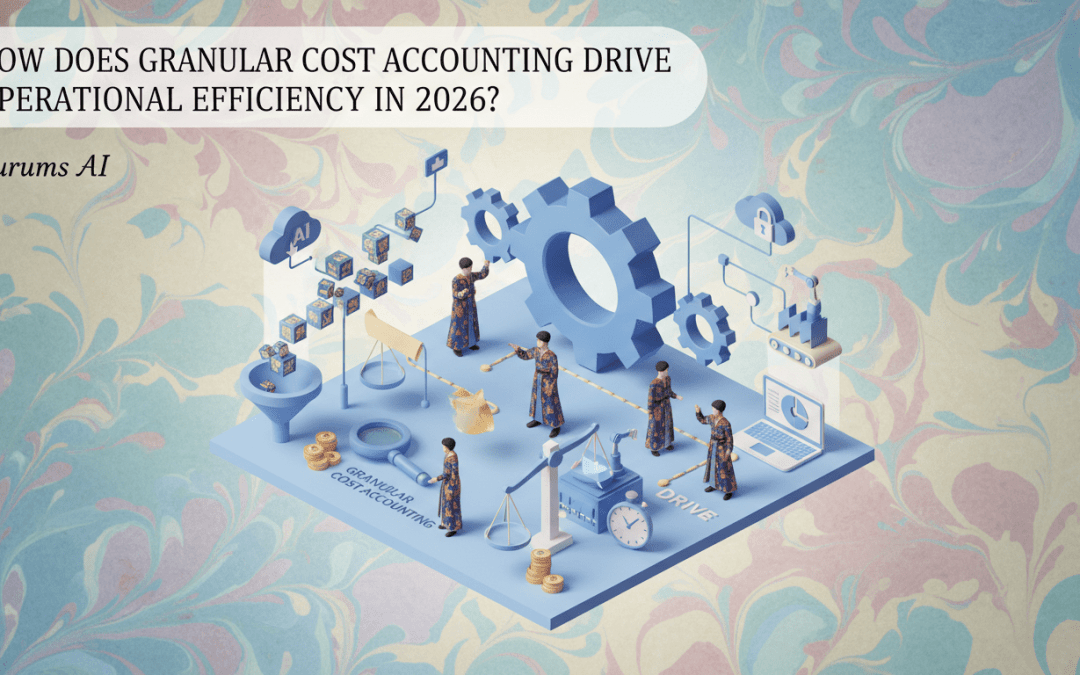
Granular cost accounting has evolved from a back-office administrative task into a real-time strategic weapon. In 2026, the integration of AI-driven data streams and IoT sensors allows businesses to track internal production costs with sub-cent precision. By moving beyond traditional “standard costing” toward dynamic Activity-Based Costing (ABC) and Lean Accounting, organizations are realizing a 15-25% increase in net profit margins. This guide explores the technical methodologies, technological integration, and operational frameworks required to master internal cost visibility in a high-inflation, high-speed global economy.
In the hyper-competitive landscape of 2026, the difference between a market leader and a struggling enterprise often comes down to a single metric: granularity. Visibility into every cent spent on the factory floor is no longer a luxury; it is a prerequisite for survival in a high-inflation global economy. But here is the real catch: most businesses fail to distinguish between spending money and investing in production value.
Standard accounting practices provide a rearview mirror perspective—useful for tax compliance but often fatal for operational agility. To thrive, CEOs and COOs are turning to granular cost accounting to expose “hidden leakages” that traditional models simply cannot see. Whether it is the micro-waste in a 3D printing farm or the energy overhead of an AI-managed warehouse, understanding the exact cost of a single unit of output is the key to unlocking hidden margins.
The Shift from Traditional to Granular Cost Accounting
For decades, “Standard Costing” was the gold standard. It relied on estimates, historical averages, and broad overhead allocations. However, in 2026, the volatility of raw material prices and the complexity of customized production runs have rendered these averages obsolete. Granular cost accounting breaks down the “aggregate” and looks at the “atom.”
Think about this for a moment: if you apply a flat 15% overhead to all products, you are likely overpricing your efficient items and subsidizing your most wasteful ones. This “averaging out” is a silent profit killer. Granularity allows managers to assign costs based on actual consumption of resources—be it machine hours, labor seconds, or kilowatt-hours.
Defining the 2026 Costing Trio: ABC, Lean, and Standard
To understand where your money is going, you must first choose the right lens. In 2026, high-performing firms use a hybrid approach, but the technical distinctions remain vital. Below is a comparison of how these methodologies handle the complexities of modern production.
| Methodology | Primary Focus | Overhead Allocation | Best For… |
|---|---|---|---|
| Standard Costing | Budget vs. Actual Variance | Fixed percentages based on labor/hours. | Stable, mass-production environments. |
| Activity-Based (ABC) | Resource consumption per activity | Directly linked to specific tasks (drivers). | High-mix, low-volume complex manufacturing. |
| Lean Accounting | Value Stream Profitability | Eliminates allocation by grouping costs. | Agile companies focused on waste reduction. |
How Internal Production Tracking Reduces Waste
Internal cost tracking identifies specific stages in the production cycle where resources are underutilized or over-allocated. In 2026, “Waste” isn’t just scrap metal in a bin; it is “Digital Waste” (idle server time), “Temporal Waste” (wait times in automated lines), and “Energy Waste.”
But how do you actually see this waste? By implementing Real-Time Costing (RTC). When an IoT sensor detects a machine running at 70% efficiency, the accounting system should immediately calculate the “Cost of Idleness.” This isn’t just a technical glitch; it’s a financial leakage. By quantifying waste in monetary terms, production managers are more likely to take immediate corrective action.
- Identify Bottlenecks: Use granular data to find where the “Work-in-Progress” (WIP) value stagnates.
- Scrap Analysis: Categorize scrap not just by weight, but by the value added at the point of failure.
- Energy Profiling: Track peak-load energy costs per unit to shift production to lower-tariff hours.
- Labor Syncing: Match skilled labor costs to high-complexity tasks, preventing “over-paying” for simple assembly.
The Role of Artificial Intelligence in 2026 Cost Control
You might be wondering: how can a human team track thousands of data points every second? They can’t. This is where AI-driven Cost Orchestration comes into play. By 2026, predictive algorithms are no longer just forecasting sales; they are forecasting cost variances before they happen.
AI models analyze historical production data alongside external factors like fluctuating shipping container prices or lithium-ion costs. The system then adjusts the “Internal Transfer Price” in real-time. This level of granularity ensures that the sales team isn’t quoting prices based on last month’s costs, but on today’s actual resource consumption.
Labor Efficiency: Beyond the Hourly Rate
In 2026, labor is often the most volatile cost component. Between the “Great Reskilling” and the integration of cobots (collaborative robots), the traditional “Labor Hour” metric is dying. Granular accounting treats labor as a dynamic asset.
Instead of looking at a generic labor cost, companies are now calculating “Value-Added Labor Ratio” (VALR). This metric distinguishes between time spent actually transforming a product and time spent on setup, transit, or maintenance. If your VALR is below 60%, your operational efficiency is bleeding money, regardless of how low your hourly wages are.
The “Hidden” Cost of Employee Turnover
Granular cost accounting also factors in the “soft” costs of production. When a skilled technician leaves, the cost isn’t just the recruitment fee. It is the decrease in yield, the increase in machine downtime, and the “knowledge debt” that impacts the remaining team. In 2026, savvy CFOs are amortizing the cost of training over the lifecycle of the employee to get a true picture of operational ROI.
Technical Deep Dive: Activity-Based Costing (ABC) for the Modern Era
ABC has seen a massive resurgence because of its ability to handle complexity. In a world where customers demand mass customization, a product with 50 variations cannot be costed the same way as a monolithic product line. ABC assigns costs to activities (e.g., machine setup, quality inspection, specialized packaging) and then assigns those activities to products.
Step-by-Step Implementation for 2026:
- Identify Activities: List every process involved in the production flow.
- Assign Resource Costs: Determine how much electricity, labor, and space each activity consumes.
- Select Cost Drivers: What makes the cost go up? (e.g., Number of setups, number of inspections).
- Calculate Activity Rates: Cost of activity / Total units of driver.
- Assign to Products: Multiply the rate by the actual consumption of that product.
Optimizing Margins through Dynamic Pricing Models
Pricing should never be a static decision. With granular cost data, businesses can implement Contribution Margin Pricing. This allows for tactical flexibility—knowing exactly how low you can drop your price for a bulk order without dipping into negative cash flow.
Consider the following scenario where granular accounting reveals the truth about two seemingly similar products:
| Product Metric | Product A (Mass Market) | Product B (Customized) |
|---|---|---|
| Direct Material Cost | $45.00 | $52.00 |
| Standard Overhead (Traditional) | $20.00 | $20.00 |
| Granular Activity Cost (Actual) | $8.50 | $38.75 |
| True Total Cost | $53.50 | $90.75 |
| Market Selling Price | $75.00 | $95.00 |
| Actual Profitability | High Margin | Loss/Break-even |
Without granularity, you might think Product B is your flagship high-revenue item, when in reality, the hidden complexity costs of customization are eating all your profit. This is the “Product Portfolio Trap” that 2026 cost accounting helps you avoid.
Supply Chain Resilience and the “Total Landed Cost”
In 2026, your factory floor doesn’t end at your walls. The “Total Landed Cost” (TLC) must be part of your granular framework. This includes customs, carbon taxes, insurance, and the cost of capital for goods in transit.
With global logistics still recovering from systemic shocks, granular accounting allows firms to compare the real cost of “Near-shoring” vs. “Off-shoring.” A cheaper part from overseas may actually be more expensive when you factor in the 2026 carbon credits required for its transport and the increased inventory holding costs.
- Carbon Pricing Integration: Track the carbon footprint as a financial cost per unit to stay ahead of EU and North American regulations.
- Risk-Adjusted Costing: Assign a “risk premium” to suppliers in volatile regions.
- Real-time Freight Auditing: Use blockchain or IoT to track logistics costs to the specific SKU level.
Overcoming Cultural Resistance to Granular Tracking
One of the biggest hurdles isn’t technology; it’s people. Shop floor workers often view granular tracking as “Big Brother.” To succeed in 2026, you must pivot the narrative from surveillance to empowerment.
When workers see the data, they become problem solvers. If a team can see that their specific line reduced energy waste by 12% through better startup sequencing, and that savings is reflected in their performance bonuses, you create a culture of continuous improvement (Kaizen). Granular cost data should be transparent—shared on dashboards across the factory floor, not just hidden in the CFO’s office.
Future-Proofing: Cost Accounting as a Sustainability Tool
By late 2026, the convergence of “Green Accounting” and “Cost Accounting” will be complete. Investors now demand ESG (Environmental, Social, and Governance) transparency. Granular cost accounting is the engine that drives this. If you can track the exact amount of water and electricity used per widget, you can provide an audited report of your environmental impact.
The Circular Economy Metric
Are you tracking the cost of “Reverse Logistics”? As 2026 regulations tighten around product take-back schemes, your accounting system must be able to handle the costs of recycling and refurbishing units. This “Lifecycle Costing” is the next frontier of operational efficiency.
- Recyclability Index: Assign lower overheads to products designed for easy disassembly.
- Resource Circulation: Track the monetary value of recaptured materials from the production waste stream.
- Incentivized Design: Link R&D budgets to the long-term maintenance and disposal costs of new products.
Strategic Implementation: The 90-Day Roadmap
How do you move from your current state to a granular powerhouse? It requires a phased approach. You cannot track everything at once; you must prioritize the “Cost Centers” with the highest variability.
Phase 1 (Days 1-30): Data Audit. Map your existing data streams. Where is the data “dark”? Install sensors or update software to bridge the gap between the shop floor and the finance office.
Phase 2 (Days 31-60): Pilot Activity-Based Costing. Pick one product line. Apply ABC principles. Compare the results with your old “Standard” costs. The discrepancy will likely shock you.
Phase 3 (Days 61-90): Scale and Automate. Integrate the pilot findings into your ERP. Automate the data flow so that “Cost Reports” become “Live Dashboards.”
Conclusion: The Path to 2026 Operational Excellence
Granular cost accounting is not just about counting beans; it is about knowing which beans are worth planting. In 2026, operational efficiency is driven by the marriage of high-tech data and disciplined financial methodology. By peeling back the layers of your production costs, you expose the inefficiencies that are holding your business back.
The transition to granular tracking requires a shift in mindset—from viewing costs as an inevitable burden to viewing them as a variable that can be optimized in real-time. Organizations that embrace this level of precision will find themselves with healthier margins, more resilient supply chains, and a significant competitive advantage.
Are you ready to stop guessing and start knowing? The tools are available, the data is waiting, and the profit is there for the taking. Begin your journey toward granular cost mastery today, and redefine what efficiency looks like for your organization in 2026 and beyond.
Discover more from Kurums | Business Intelligence
Subscribe to get the latest posts sent to your email.