
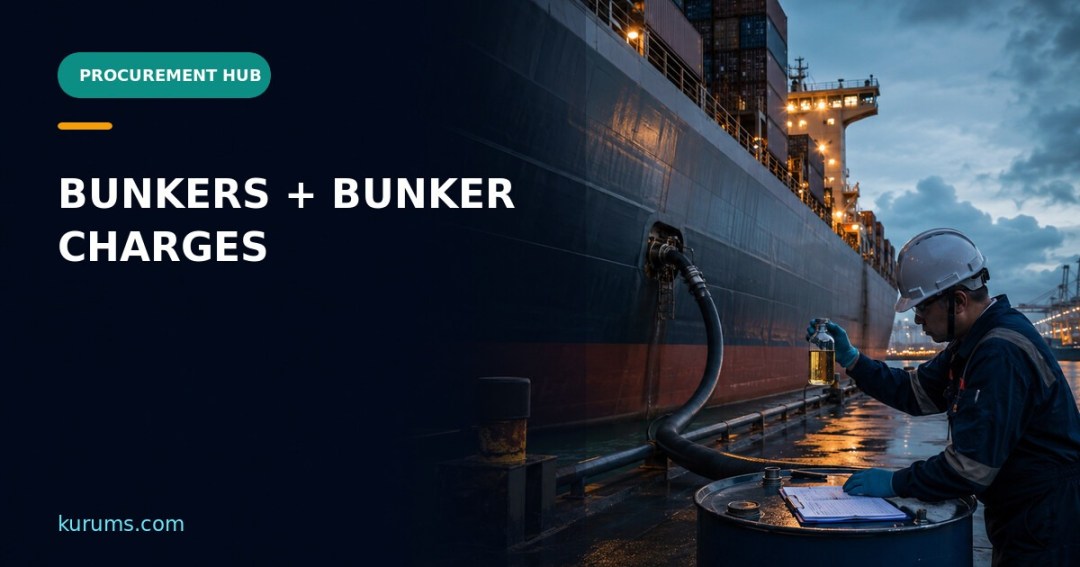
BUNKERS are marine fuel and BUNKER CHARGE is the fuel adjustment or surcharge associated with the voyage. Procurement must align fuel grade, quantity, quality, sulphur limits, route, sampling, bunker delivery note, payment, off-spec response and liability before approving a supplier or charter clause.
- Define fuel grade, ISO reference, sulphur limit, flash point, compatibility, quantity and delivery location.
- Make MARPOL Annex VI, emission-control areas and bunker delivery note evidence part of the purchase requirement.
- Control sampling, sealing, lab testing, custody, discrepancy and off-spec fuel response.
- Separate the physical fuel price, bunker charge, index, quantity, tax, port cost and delay exposure.
Bunkers Are a Technical and Commercial Input
The SSDER glossary defines BUNKERS as ship fuel and BUNKER CHARGE as a fuel adjustment factor. Procurement should treat both as a technical supply and a commercial exposure. Fuel affects engine performance, safety, emissions, schedule, maintenance, consumption and the cost model.
The request should name vessel, engine or equipment constraints, grade, delivery port, expected quantity, route, emission-control areas, quality standard, sampling method, notice, price formula and responsible party. A generic “bunker included” line is not a specification.
Set Compliance and Quality Requirements
IMO MARPOL Annex VI sets sulphur and related fuel-oil requirements, including a 0.50% global limit and stricter 0.10% limits in emission-control areas. IMO Regulation 18 guidance also addresses availability, sampling, supplier declarations and bunker delivery notes.
BIMCO’s bunker quality clause references agreed grades and ISO 8217 and allocates consequences for unsuitable fuel. Procurement should adapt the clause to the actual charter, local law, vessel system, alternative compliance method and current standard rather than copy an old version.
Control Quantity, Sampling and Chain of Custody
Require the supplier’s delivery note, meter or barge measurement, density, temperature, seal, representative samples, lab result, product certificate and delivery time. State who witnesses the opening and closing gauge, who keeps samples and how a discrepancy is notified.
The buyer should define a hold or escalation when the delivery note is incomplete, the sample is missing or the fuel does not match the order. Do not burn disputed fuel without a documented technical and safety decision.
Model Bunker Charges and Recovery
Separate fuel unit price, quantity, bunker charge, index, currency, port cost, barge or delivery fee, testing, tax, delay and replacement exposure. Track consumption, variance to plan, off-spec events, lab time, claims, emissions evidence and delay by supplier and port.
Review the price formula and route assumption whenever the vessel, trade, ECA, fuel strategy or charter period changes. A low surcharge may be offset by poor quality, extra consumption or a compliance failure.
Worked Example: Correct Sulphur, Wrong Compatibility
A supplier provides fuel within the sulphur limit but the delivered blend is incompatible with the vessel’s remaining fuel. The engine team reduces power, the vessel misses a berth and the buyer has only a generic bunker invoice and no sealed sample chain.
The corrected award defines compatibility, grade, sample, BDN, test, notice, segregation, off-spec fuel, replacement, delay and liability. Procurement evaluates the total operational exposure, not only regulatory sulphur compliance.
Metrics and Governance
For marine bunker fuel procurement controls, measure both service and evidence quality. Useful indicators include first-pass acceptance, exception rate, response time, unplanned cost, document completeness, damage or discrepancy rate, and the percentage of shipments that follow the approved process. A dashboard should distinguish a supplier failure from a carrier, terminal, broker or internal master-data failure.
Review the metric trend with procurement, logistics, finance, quality and the responsible specialist. Use a monthly exception sample to test whether the control worked in a real transaction, not just whether a field was filled. Repeated exceptions should change the sourcing strategy, contract, lane design or supplier development plan.
Keep the control proportionate to risk. High-value, regulated, time-critical or safety-sensitive cargo needs stronger evidence and faster escalation than a routine shipment. Record the decision owner, approval date, source documents and follow-up action so the next buyer can understand the operating history.
Supplier and Carrier Questions
- Which BUNKERS or related glossary condition is assumed in your quotation, procedure or service description?
- Which party owns each data field, physical handoff, inspection, document and exception?
- What evidence will be available before release, loading, movement, receipt, invoice approval or claim?
- What changes require advance notice, requalification, a revised price or a new risk decision?
- How will the supplier report incidents, delays, mismatches and corrective actions, and within what response time?
Implementation Sequence
Implement the control in a small, representative lane first. Capture the baseline process, test the required data and evidence, run a real transaction, and review every exception with the people who performed the work. Do not declare the control effective only because a supplier signed a procedure.
After the first three shipments or operating cycles, update the purchase-order clause, work instruction, scorecard and training. Scale the control to other suppliers only when the evidence is repeatable and the owner can explain what happens when the normal path fails.
Common Mistakes to Avoid
- Treating bunkers as a simple fuel-price line.
- Ignoring emission-control areas, current sulphur limits or vessel compatibility.
- Accepting fuel without a complete delivery note, representative sample and chain of custody.
- Using an outdated ISO or BIMCO clause without technical and legal review.
- Measuring price while ignoring consumption, delay, replacement and compliance exposure.
Procurement Implementation Checklist
- Define grade, quantity, route, ECA, sulphur, flash point and compatibility.
- Specify MARPOL, BDN, sampling, seal, lab and supplier declaration requirements.
- Set measurement, discrepancy, off-spec, replacement and delay responsibilities.
- Separate fuel, bunker charge, index, port, testing, tax and recovery lines.
- Retain technical and commercial evidence in one transaction record.
- Review fuel strategy after vessel, route, ECA, charter or standard changes.
Frequently Asked Questions
What are bunkers?
They are marine fuels used for a vessel’s propulsion or operation. The grade, quantity, quality and compliance requirements must be defined.
What is a bunker charge?
It is a fuel adjustment or surcharge associated with the voyage or service. The price formula and included costs should be transparent.
What is a bunker delivery note?
It records required delivery and fuel information and supports MARPOL compliance and evidence. Retain it with the representative sample and commercial record.
What happens with off-spec fuel?
Follow the contract, technical safety procedure, notification, sampling, testing, segregation, replacement and claim path agreed with the supplier and vessel operator.
Who owns bunker quality risk?
Allocate it explicitly among supplier, charterer, owner and operator, including quantity, compatibility, compliance, delay, replacement and damage.
Related Kurums Guides
- ABC Inventory Analysis
- Freight Network Design
- Freight Contracts and Parties
- Freight Rates and Surcharges
- Container Types and Load Securing
- Cargo Insurance and Claims
Standards and Authoritative Sources
- IMO — Fuel oil quality and Regulation 18
- IMO — MARPOL sulphur limits
- BIMCO — Bunker Quality and Liability Clause
- ISO — ISO 8217 petroleum products and marine fuels
Glossary terms covered: BUNKERS, BUNKER CHARGE, fuel oil, bunker delivery note, ISO 8217, MARPOL Annex VI, sampling
Kurums.com · Procurement, sourcing and business operations
Discover more from Kurums | Business Intelligence
Subscribe to get the latest posts sent to your email.