
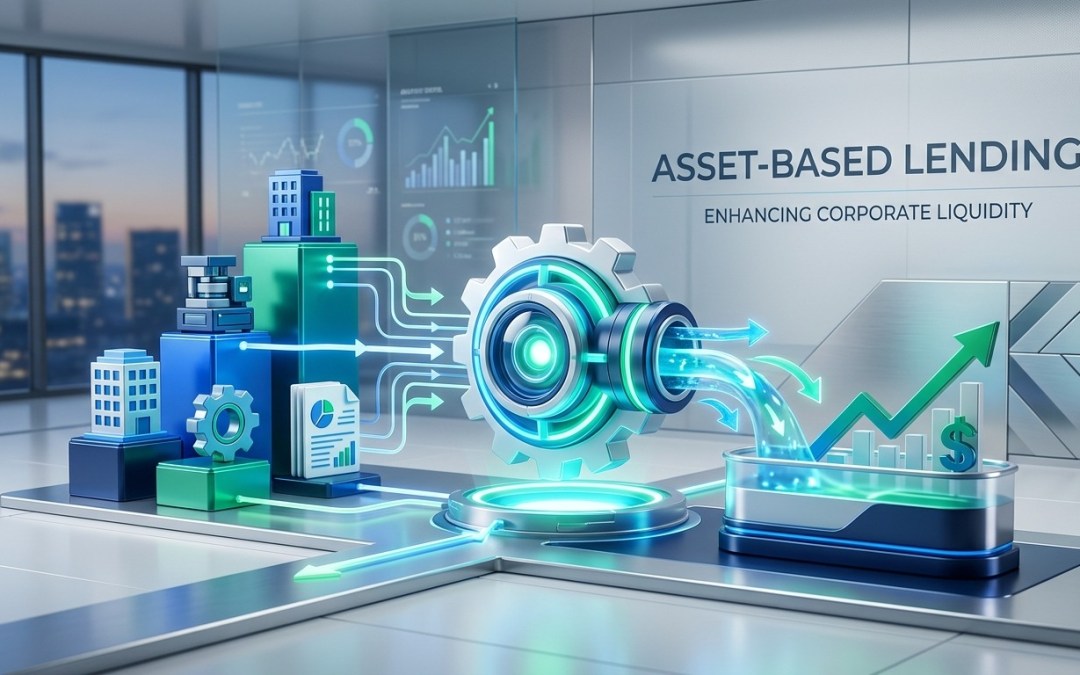
Executive Summary: Maximizing Corporate Liquidity
In an era defined by macroeconomic volatility, tightening credit markets, and rigorous regulatory capital requirements, corporate treasurers and chief financial officers are increasingly turning to Alternative Capital structures. Chief among these is Asset-Based Lending (ABL). This comprehensive technical treatise explores how asset-based lending utilizes a company’s balance sheet—specifically inventory, accounts receivable, and equipment—to provide flexible, scalable working capital for mid-market and high-growth enterprises. By decoupling borrowing capacity from historic cash flow metrics and tethering it directly to the liquidation value of tangible assets, ABL offers a resilient liquidity mechanism. This article provides a deep dive into the historical evolution, mechanical underwriting processes, advance rate algorithmic determinations, failure-case empirical analyses, and future technological trajectories of Asset-Based Lending.
The Genesis and Historical Evolution of Asset-Based Lending
Early Iterations in Commercial Finance
To fully comprehend “What Is Asset-Based Lending and How Can Businesses Use It?”, one must examine its historical context. Asset-Based Lending did not emerge in a vacuum; it is the evolutionary product of centuries of commercial finance. Originally stigmatized in the early to mid-20th century as “lender of last resort” financing, early iterations of ABL were often relegated to distressed companies that could not secure traditional, unsecured commercial loans. In these nascent stages, commercial banks viewed reliance on collateral as an admission of fundamental corporate weakness, favoring entities that demonstrated pristine, predictable cash flows and robust historical earnings.
However, the 1970s and 1980s catalyzed a profound paradigm shift. The advent of the Leveraged Buyout (LBO) boom required massive influxes of debt capital that could not be serviced purely by the target company’s historical cash flow. Financial engineers and private equity sponsors recognized that the massive, unleveraged balance sheets of target corporations—replete with valuable accounts receivable, raw materials, and heavy machinery—represented an untapped reservoir of borrowing capacity. Asset-Based Lending evolved rapidly during this period, transitioning from a marginalized financing option to a highly strategic corporate finance tool utilized to facilitate acquisitions, recapitalizations, and explosive growth.
The Paradigm Shift Post-2008 Financial Crisis
The 2008 Global Financial Crisis (GFC) and the subsequent implementation of the Basel III regulatory framework marked the next major inflection point for ABL. As systemic risk concerns prompted global central banks to enforce stringent capital adequacy ratios on traditional depository institutions, traditional Cash Flow lending became increasingly restricted. Banks were penalized for holding highly leveraged, under-collateralized corporate loans. Asset-Based Lending, conversely, benefited from these regulatory shifts. Because ABL facilities are inherently over-collateralized and continuously monitored, they attract more favorable regulatory capital treatments.
Consequently, the stigma surrounding ABL completely evaporated. Today, Fortune 500 companies, highly successful mid-market enterprises, and high-growth tech-enabled manufacturing firms utilize ABL facilities not out of desperation, but out of strategic optimization. The flexibility of a revolving credit facility tied to a dynamically expanding asset base allows these entities to optimize their Weighted Average Cost of Capital (WACC) while maintaining significant dry powder for opportunistic expansion.
The Technical Anatomy of Asset-Based Lending Mechanisms
Borrowing Base Calculations and Advance Rates
At the core of any Asset-Based Lending facility is the Borrowing Base. Unlike traditional cash flow loans, which dictate maximum debt loads based on multiples of Earnings Before Interest, Taxes, Depreciation, and Amortization (EBITDA)—such as 3.0x or 4.0x EBITDA—an ABL facility determines borrowing capacity through a rigorous, daily or weekly algorithmic assessment of eligible collateral.
The Borrowing Base is calculated using predetermined Advance Rates applied to strictly defined eligible assets. A standard mathematical representation of a Borrowing Base calculation follows this formula:
Borrowing Base = (Eligible Accounts Receivable × AR Advance Rate) + (Eligible Inventory × Inventory Advance Rate) + (Eligible Machinery/Equipment × M&E Advance Rate) – Lender Reserves
Algorithmic Determination of Liquidity and Eligibility
The operative word in the Borrowing Base equation is “Eligible.” Not all assets on a corporate balance sheet hold value to a secured lender. ABL lenders construct rigorous eligibility criteria to protect against downside risk. For instance, Accounts Receivable may only be deemed eligible if they are generated from arm’s-length transactions, are less than 90 days past invoice date, and are devoid of contra-accounts (where the debtor is also a supplier to the borrower). By algorithmically filtering out ineligible assets, the lender guarantees that the borrowing capacity accurately reflects the true, highly liquid liquidation value of the collateral pool.
Corporate Treasury Pro-Tip: To maximize your Borrowing Base, corporate treasurers should aggressively manage the “Cross-Aging” rule. Most ABL agreements state that if more than 25% or 50% of a specific customer’s receivables are past due (e.g., >90 days), the entire balance of that customer’s receivables becomes ineligible. Proactive collections on older invoices can disproportionately unlock millions in liquidity.
Comparative Structural Analysis
To fully appreciate the utility of ABL, financial executives must understand how it juxtaposes with traditional Cash Flow lending. The following table provides a comprehensive technical comparison of the two primary corporate debt methodologies.
| Financial Metric / Characteristic | Asset-Based Lending (ABL) | Traditional Cash Flow Lending |
|---|---|---|
| Primary Underwriting Focus | Liquidation value of balance sheet assets (AR, Inventory). | Historical and projected EBITDA, debt-service coverage. |
| Financial Covenants | Generally “Covenant-Lite.” Often requires only a Fixed Charge Coverage Ratio (FCCR) that triggers *only* if availability drops below a certain threshold (e.g., 10%). | Highly restrictive. Frequent testing of Total Leverage (Debt/EBITDA), Interest Coverage, and CapEx limits. |
| Reporting Requirements | Intensive. Daily or weekly Borrowing Base Certificates (BBCs), regular field exams, and inventory appraisals. | Moderate. Monthly or quarterly financial statements and covenant compliance certificates. |
| Cyclical Resilience | High. During economic downturns, if EBITDA drops but asset values remain, lines of credit stay intact. | Low. A dip in EBITDA can cause immediate covenant breaches, leading to default or penalty pricing. |
| Typical Advance Rates | 85% on Eligible AR; 50-65% on Eligible Inventory (NOLV). | N/A; lending limit tied to cash flow multiples. |
Deep-Dive into Collateral Classes and Valuation Methodologies
Accounts Receivable: The Premier Collateral
Accounts Receivable (AR) represents the most liquid and consequently the most highly leveraged collateral class within an ABL structure. Because AR represents a legal claim on cash resulting from a completed sale, lenders routinely offer aggressive advance rates, typically ranging between 80% and 90% of the eligible pool. However, the underwriting process is intensely analytical. Lenders do not merely look at the gross AR figure; they engage in exhaustive “dilution” analysis.
Dilution, Concentration Limits, and Cross-Aging
Dilution represents the difference between the gross invoice amount and the actual cash collected. This differential is driven by trade discounts, product returns, volume rebates, warranty claims, and bad debt write-offs. If a company historically experiences a 5% dilution rate, an ABL lender will build this directly into the advance rate matrix, often mandating a minimum equity cushion (e.g., Advance Rate = 100% – Dilution – 10% Reserve). Furthermore, lenders impose Concentration Limits. If a mid-market manufacturer sells 40% of its goods to a single big-box retailer (e.g., Walmart), the lender may cap the eligible AR from that single debtor at 20% of the total pool, thereby mitigating catastrophic default risk should that single retailer declare bankruptcy.
Inventory Financing: Net Orderly Liquidation Value (NOLV)
Unlike Accounts Receivable, inventory is an illiquid asset that has not yet been converted into a cash claim. Financing inventory introduces significant execution and market risks to the lender. Consequently, ABL providers will rarely finance inventory at its cost or market value. Instead, inventory is aggressively discounted using a metric known as Net Orderly Liquidation Value (NOLV). NOLV represents the estimated net cash that would be recovered if the inventory had to be liquidated in an orderly manner (typically over 60 to 90 days) by a third-party liquidator, net of all liquidation expenses such as rent, payroll, and auctioneer fees.
Raw Materials vs. Work-in-Progress vs. Finished Goods
The stratification of inventory types further impacts liquidity generation.
- Raw Materials: Often command favorable advance rates (e.g., 50-60% of cost) because commodities like rolled steel, lumber, or raw plastic resin are highly fungible and easily sold to secondary buyers.
- Work-in-Progress (WIP): Rarely financed (advance rate of 0%). WIP is essentially useless to a liquidating lender because it requires additional capital injection to finish the manufacturing process. Half-assembled electronics or unsown garments hold near-zero secondary market value.
- Finished Goods: Advance rates vary wildly (40-85% of NOLV) depending on brand strength, seasonality, and technological obsolescence. A warehouse of universally compatible automotive parts will secure much higher availability than a warehouse of seasonal fast-fashion apparel.
Risk Management Warning: Companies must continuously monitor inventory obsolescence. ABL lenders conduct annual or semi-annual physical appraisals. If your company is hoarding slow-moving or technologically obsolete stock to inflate your balance sheet, the next appraisal will result in a sudden, drastic downward revision of your NOLV, triggering an immediate and potentially fatal reduction in borrowing availability (an “over-advance” situation).
Machinery, Equipment, and Real Estate
While working capital assets (AR and Inventory) form the revolving basis of an ABL facility, many structures also incorporate term loan tranches collateralized by fixed assets. Machinery, equipment, and owner-occupied commercial real estate can provide critical supplemental liquidity. These assets are evaluated using Forced Liquidation Value (FLV) or Orderly Liquidation Value (OLV) appraisals. The advance rate for these assets is typically 75-80% of the appraised OLV. However, unlike revolving AR and inventory lines, loans against fixed assets are generally amortized over a 3 to 7-year schedule, meaning the borrowing capacity diminishes over time as the principal is paid down and the equipment depreciates.
Strategic Imperatives for Mid-Market and High-Growth Enterprises
Navigating Rapid Expansion and Working Capital Deficits
For high-growth enterprises, success can ironically be the catalyst for insolvency. This paradox is driven by the Cash Conversion Cycle (CCC). As a company secures massive new purchase orders, it must deploy cash to purchase raw materials, pay labor to manufacture the goods, and distribute the final product. If the customer demands 60-day or 90-day payment terms, the high-growth enterprise experiences a severe working capital deficit; cash goes out months before cash comes in. Traditional cash flow lenders often cap credit facilities based on past, historically lower earnings, choking the company’s ability to fulfill new orders.
Asset-Based Lending serves as the perfect strategic fulcrum in this scenario. As the company acquires more inventory and generates more invoices, the ABL Borrowing Base automatically and proportionally expands. The liquidity scales linearly in real-time with the company’s growth trajectory, ensuring that rapid revenue expansion is continuously funded without requiring highly dilutive equity raises from venture capital or private equity sponsors.
Mergers, Acquisitions, and Leveraged Buyouts (LBOs)
In the realm of M&A, ABL is a weapon of financial engineering. Private equity firms frequently utilize Asset-Based Lending to execute Leveraged Buyouts. By utilizing the target company’s balance sheet, the acquirer can fund a significant portion of the purchase price. For example, if a target manufacturing company has $50 million in unleveraged inventory and AR, an ABL lender might provide $40 million in Day-One availability. The private equity sponsor can use that $40 million directly to pay the seller, drastically reducing the cash equity required to close the transaction, thereby exponentially amplifying the sponsor’s Internal Rate of Return (IRR).
Turnarounds and Debtor-in-Possession (DIP) Financing
Asset-Based Lending is inherently immune to P&L (Profit and Loss) volatility. Consequently, it is the premier financing vehicle for corporate turnarounds and restructuring. A company posting negative EBITDA for three consecutive quarters will universally breach the covenants of a traditional cash flow loan. An ABL lender, however, primarily cares about the integrity of the collateral. As long as the company is generating valid receivables and maintaining salable inventory, the ABL facility remains intact. Furthermore, in formal bankruptcy scenarios (Chapter 11 in the United States), ABL structures form the backbone of Debtor-in-Possession (DIP) financing, providing the critical operational liquidity needed to reorganize.
Corporate Treasury Pro-Tip: When negotiating an ABL facility during a distressed period, ensure you aggressively negotiate the “Springing Dominion” threshold. This is the availability level at which the lender takes direct control of your cash collections. Maintaining a comfortable buffer above the springing dominion threshold ensures management retains unencumbered control of operational cash flow.
Empirical Evidence: Real-World Scenarios and Failure-Case Analysis
Success Scenario: Manufacturing Sector Capacity Expansion
Consider a mid-market Tier-2 automotive parts manufacturer generating $150 million in annual revenue. The company secured a highly lucrative, multi-year contract to supply electric vehicle (EV) components to a major OEM. Fulfilling the contract required a $20 million immediate investment in specialized inventory and extended 90-day payment terms to the OEM.
The company’s traditional bank balked at the expanded credit line due to a temporary dip in historical EBITDA caused by R&D expenditures. The CFO pivoted to an Asset-Based Lending syndicate. The ABL lenders appraised the EV inventory components (highly standardized, commanding a strong NOLV) and the receivables from the investment-grade OEM. The ABL facility provided an $85 million revolving line of credit. As the manufacturer purchased raw steel and electronics, the inventory portion of the borrowing base provided the initial cash. As those parts were assembled and shipped, the collateral converted into AR, drawing an 85% advance rate that replenished the cash to start the cycle anew. The manufacturer successfully scaled revenue to $250 million within 24 months without a single breach of covenant or the need to issue dilutive preferred equity.
Failure-Case Analysis: The Retail Inventory Trap and The Phantom Phenomenon
Asset-Based Lending is not a panacea; when risk parameters are ignored, the consequences are swift and severe. A poignant failure-case analysis involves a publicly traded, fast-fashion retail chain that aggressively expanded its footprint in 2018. The company utilized a $150 million ABL facility heavily reliant on retail inventory.
The Catalyst for Failure: The retailer experienced consecutive quarters of poor merchandising decisions, resulting in a buildup of undesirable, out-of-season apparel. Management, fearing an earnings miss, delayed taking heavy markdowns to clear the inventory, allowing it to artificially age on the balance sheet at full cost.
The ABL Mechanic Breakdown: The ABL lender dispatched a third-party appraisal firm for the mandatory semi-annual inventory evaluation. The appraisers noted the extreme aging of the fashion inventory and drastically reduced the NOLV from 65% of cost to merely 30% of cost. This sudden drop in NOLV wiped out $40 million in borrowing availability overnight.
The Collapse: The drastic reduction forced the retailer into an “Over-Advance” position, meaning they had drawn more cash than the newly calculated borrowing base allowed. The ABL lender immediately froze the revolver and invoked a “Springing Blocked Account Control Agreement” (DACA), sweeping 100% of the retailer’s daily cash receipts directly to pay down the loan principal. Stripped of operating liquidity and unable to pay overseas vendors or store rent, the retailer was forced into an involuntary Chapter 11 bankruptcy filing within 45 days. This case exemplifies the cardinal rule of ABL: Collateral quality is absolute, and valuation adjustments are merciless.
Corporate Implementation Protocol: Securing the ABL Facility
The Underwriting and Due Diligence Process
Transitioning from a traditional commercial loan to an Asset-Based Lending structure requires rigorous preparation. The underwriting process is intensely forensic. ABL lenders operate on the axiom of “Trust, but Verify.” Corporate executives must prepare their organizations for a deep-dive operational audit.
The cornerstone of this due diligence is the Field Examination. Lenders will dispatch independent auditors to spend weeks at the corporate headquarters. They will test AR aging reports by directly verifying invoices with customers, perform test counts of physical inventory in warehouses, review the general ledger for unrecorded liabilities, and scrutinize cash application procedures. Any discrepancies between the ERP (Enterprise Resource Planning) system’s reporting and the physical reality will result in immediate “availability reserves” being deducted from the borrowing base.
CFO Action Plan: Preparatory Steps for ABL Execution
- ERP System Optimization: Ensure your IT infrastructure (e.g., SAP, Oracle, NetSuite) can generate highly granular, real-time perpetual inventory reports and clean AR aging schedules broken down by customer, geography, and invoice date.
- Clean Up Receivables: Proactively write off dead receivables and resolve outstanding customer disputes before the Field Exam. Dispute-ridden AR will be flagged as ineligible and will taint the lender’s view of your credit controls.
- Inventory Stratification: Physically and digitally segregate raw materials, WIP, and finished goods. If WIP is commingled with finished goods in your warehouse management system, lenders may apply the lower WIP advance rate to the entire lot.
- UCC Lien Clearance: Conduct a preemptive Uniform Commercial Code (UCC) search on your own entities. Pay off any lingering minor equipment leases or supplier liens, as the ABL lender will require a pristine, first-priority, perfected security interest on all core assets.
- Intercreditor Structuring: If you intend to carry subordinated mezzanine debt or unsecured bonds alongside the ABL, have your legal counsel prepare term sheets for an Intercreditor Agreement. The ABL lender will demand absolute priority over cash distributions in a default scenario.
Future Trajectories: Technological Disruptions in Asset-Based Lending
The fundamental principles of Asset-Based Lending have remained consistent for decades; however, the operational execution is currently undergoing a radical technological renaissance. The historical friction points of ABL—specifically the burdensome manual reporting requirements and periodic, lagging appraisals—are being systematically eradicated by modern financial technology.
API Integration and Real-Time Borrowing Bases
Historically, corporate controllers spent days at month-end manually compiling Borrowing Base Certificates (BBCs) via massive Excel spreadsheets. Today, leading ABL institutions deploy Application Programming Interfaces (APIs) that plug directly into the borrower’s ERP and bank systems. This allows the lender to extract sales, shipping, and cash collection data continuously. The result is a Dynamic Borrowing Base that updates liquidity availability in real-time, minute by minute, reflecting every shipped pallet and paid invoice instantly. This frictionless environment massively reduces the administrative burden on the borrower while giving the lender unparalleled, real-time risk mitigation.
Blockchain and Smart Contracts in Collateral Tracking
The tracking of complex, multi-national inventory supply chains represents a profound risk vector for ABL providers. The integration of Blockchain technology, coupled with Internet of Things (IoT) sensors, is revolutionizing collateral tracking. Lenders can now finance inventory while it is still “on the water” in oceanic transit. GPS trackers and environmental sensors attached to shipping containers update distributed ledgers autonomously. Smart contracts are utilized to automatically adjust advance rates based on the geographical location and verified condition of the goods, practically eliminating the risk of fraud or “phantom inventory.”
Artificial Intelligence and Predictive Advance Rates
Artificial Intelligence and Machine Learning (ML) are fundamentally altering how lenders calculate dilution and NOLV. Traditionally, advance rates were backward-looking, based on historical dilution averages over the past twelve months. Modern AI algorithms ingest vast macroeconomic datasets, consumer sentiment indices, and real-time point-of-sale data to predict future dilution and inventory depreciation. If an AI model detects a macro-shift in consumer spending away from luxury durable goods, it can proactively and gradually adjust the NOLV of a luxury retailer’s inventory, preventing the catastrophic “cliff” adjustments seen in historical failure cases.
The Integration of ESG Metrics into Borrowing Bases
An emerging frontier in ABL is the integration of Environmental, Social, and Governance (ESG) criteria into the mechanical architecture of the loan. Forward-thinking syndicates are introducing “Sustainability-Linked Asset-Based Loans” (SLL-ABL). In these structures, the pricing matrix (interest margin and unused line fees) and even the Advance Rates are tethered to the borrower achieving specific Key Performance Indicators (KPIs), such as reducing carbon emissions in the supply chain or maintaining sustainable sourcing certifications for raw materials. This creates a direct, mathematically measurable financial incentive for mid-market companies to execute on their ESG mandates, marrying corporate responsibility with enhanced liquidity provisioning.
Conclusion: A Strategic Fulcrum for Corporate Liquidity
Asset-Based Lending has comprehensively transcended its historical reputation as a distressed capital alternative. In the contemporary financial ecosystem, ABL represents a highly sophisticated, algorithmic, and deeply resilient mechanism for corporate finance. By decoupling liquidity generation from the cyclical constraints of EBITDA and tethering it directly to the intrinsic value of tangible balance sheet assets, ABL provides an un-matched level of scalability for mid-market and high-growth enterprises.
Whether employed to execute an aggressive leveraged buyout, to navigate the cash-burn of rapid capacity expansion, or to weather macroeconomic downturns without the threat of restrictive financial covenants, the asset-based methodology offers structural superiority over traditional cash flow lending in terms of raw liquidity generation. However, this power demands rigorous operational discipline. Corporations that harness ABL must maintain pristine technological infrastructure, flawless inventory management, and vigilant receivables administration. As Artificial Intelligence and API integrations continue to streamline the reporting mechanisms, Asset-Based Lending is poised to become the dominant framework for working capital optimization globally, enabling the next generation of corporate growth.
Discover more from Kurums | Business Intelligence
Subscribe to get the latest posts sent to your email.