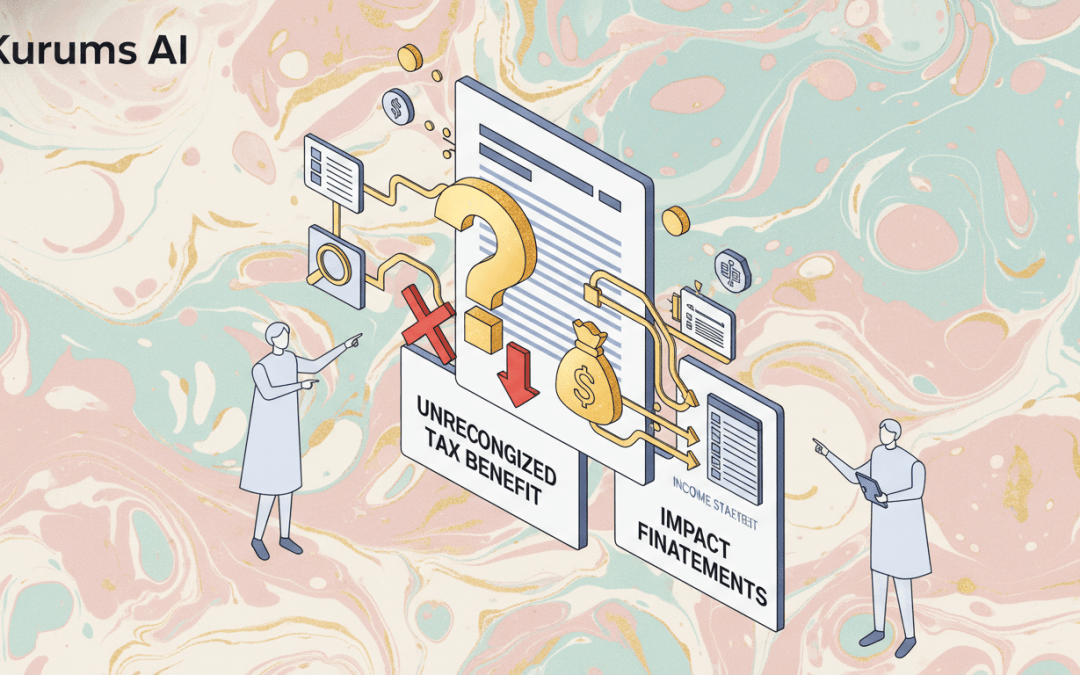
Do corporate tax filings always match the financial reports shared with shareholders? The short answer is no. In the high-stakes world of global finance, tax laws are often subject to multiple, sometimes conflicting, interpretations. This inherent ambiguity leads to what accountants call uncertain tax positions.
When a corporation takes a tax deduction or credit that might be challenged by authorities like the IRS or HMRC, they cannot simply record the full savings immediately in their financial statements. Instead, they must evaluate the probability of keeping that benefit under rigorous accounting standards. This is the realm of the Unrecognized Tax Benefit (UTB)—a critical yet often misunderstood component of corporate accounting that serves as a bridge between aggressive tax planning and conservative financial reporting.
The Fundamental Nature of Unrecognized Tax Benefits
At its core, an unrecognized tax benefit represents a “reserve” for tax positions that a company has taken on its tax returns but has not yet recognized in its financial statements. Why would a company do this? Because accounting standards (ASC 740 in the US) require a higher level of certainty for financial reporting than tax authorities might require for a filing.
Think of it as a financial safety net. If a company claims a $10 million R&D tax credit on its return but realizes there is only a 60% chance the IRS will agree with the full amount, it cannot “book” the entire $10 million as a gain in its net income. The portion that is likely to be disallowed—or the portion that fails the recognition test—becomes an unrecognized tax benefit.
But here is the kicker: UTBs are not just numbers on a page; they are indicators of a company’s tax risk appetite. High UTB balances often signal that a company is engaging in sophisticated tax optimization strategies that may be subject to future litigation or audits.
The ASC 740 Framework: How We Got Here
Before the mid-2000s, companies had significant leeway in how they accounted for uncertain tax positions. This led to “earnings management,” where companies would release tax reserves to meet quarterly earnings targets. To stop this, the Financial Accounting Standards Board (FASB) introduced FIN 48 (now codified as ASC 740-10).
ASC 740 created a standardized, two-step process for evaluating all tax positions. This framework removed the “all or nothing” approach and replaced it with a rigorous, evidence-based model. It forces companies to ask: “If the highest court in the land looked at this, would we win?”
Step 1: The Recognition Threshold (More-Likely-Than-Not)
The first step is a binary “yes or no” test. A company must determine whether it is more-likely-than-not (a probability of >50%) that a tax position will be sustained upon examination, based solely on its technical merits.
Crucially, this assessment assumes that the taxing authority will examine the position and have full knowledge of all relevant information. You cannot “bet” on the chance that you won’t get audited. If the position has a 49% chance of being sustained, the recognized benefit is zero, and the entire amount becomes an unrecognized tax benefit liability.
Step 2: The Measurement Process
If the position passes the 50% threshold, the company moves to measurement. This isn’t about the full amount; it’s about the “largest amount of tax benefit that is greater than 50% likely of being realized upon ultimate settlement.”
This requires a cumulative probability assessment. Let’s look at how this works in practice with a detailed breakdown.
| Possible Estimated Outcome | Individual Probability of Occurrence | Cumulative Probability of Occurrence | Recognizable Benefit? |
|---|---|---|---|
| $100,000 Benefit | 20% | 20% | No |
| $80,000 Benefit | 25% | 45% | No |
| $60,000 Benefit | 15% | 60% | YES (Threshold Met) |
| $40,000 Benefit | 20% | 80% | Yes |
| $20,000 Benefit | 20% | 100% | Yes |
In the table above, the company would recognize $60,000 in its financial statements. The remaining $40,000 ($100,000 minus $60,000) becomes the Unrecognized Tax Benefit recorded as a liability.
The Impact of UTBs on Financial Statements
The existence of UTBs creates a ripple effect across all three major financial statements. For stakeholders, understanding these impacts is vital for assessing a company’s true “after-tax” value.
1. The Balance Sheet: The “Hidden” Liability
UTBs are typically recorded as “Other Long-Term Liabilities” or “Accrued Taxes Payable.” They represent money that the company has kept (by paying less in taxes) but expects it might have to pay back to the government eventually. This affects the debt-to-equity ratio and current ratio calculations.
2. The Income Statement: Volatility in the Effective Tax Rate (ETR)
This is where things get interesting. When a company increases its UTB reserve, it increases its Income Tax Expense, which lowers Net Income. Conversely, if an audit is settled favorably or the statute of limitations expires, the company “releases” the UTB. This release acts as a one-time windfall that drops the effective tax rate and boosts earnings per share (EPS).
3. Cash Flow Statement: Timing Differences
While the UTB is an accounting entry (non-cash), the payment of the tax is a cash event. A high UTB balance suggests a potential future cash outflow that could impact liquidity. Analysts often track the “Cash Taxes Paid” vs. “Tax Expense” to see how much cash is being preserved through aggressive tax positions.
Common Sources of Uncertain Tax Positions
Why do these uncertainties exist? The global tax landscape is a minefield of complexity. Here are the most common areas where UTBs arise:
- Transfer Pricing: How multinational corporations price goods and services sold between their own subsidiaries in different countries (e.g., Apple Ireland selling to Apple USA).
- R&D Tax Credits: Determining exactly which activities qualify as “innovation” under Section 41. Tax authorities often take a narrower view than companies.
- Nexus and Permanent Establishment: Determining if a company has a sufficient physical or economic presence in a state or country to be subject to its taxes.
- Business Combinations: The valuation of deferred tax assets and the survival of Net Operating Losses (NOLs) after an acquisition.
- Interpreting New Legislation: Large-scale changes like the Tax Cuts and Jobs Act (TCJA) or the OECD Pillar Two global minimum tax create years of uncertainty while “guidance” is being written.
Disclosure Requirements: What Companies Must Reveal
Transparency is the enemy of tax secrecy, and ASC 740 requires significant transparency. Companies must provide a reconciliation of the beginning and ending amounts of unrecognized tax benefits. This “roll-forward” table is a goldmine for IRS auditors and financial analysts alike.
Specifically, companies must disclose:
- The total amount of UTBs that, if recognized, would affect the effective tax rate.
- The total amount of interest and penalties recognized in the income statement and balance sheet.
- A description of tax years that remain subject to examination by major tax jurisdictions.
- Any positions for which it is reasonably possible that the total amounts of UTBs will significantly increase or decrease within 12 months.
Global Comparison: US GAAP (ASC 740) vs. IFRS (IFRIC 23)
While the world is moving toward converged standards, differences remain in how uncertain tax positions are handled. If you are analyzing a European or Canadian company, you are likely looking at IFRS standards.
| Feature | US GAAP (ASC 740) | IFRS (IFRIC 23) |
|---|---|---|
| Recognition Threshold | Strict “More-Likely-Than-Not” (>50%) | Probability-weighted or Most Likely Amount |
| Measurement Basis | Cumulative probability (Step 2) | Reflects the uncertainty (Expected Value) |
| Unit of Account | Each individual tax position | Can aggregate similar positions |
| Interest/Penalties | Policy choice (Tax or Operating expense) | Follows the underlying tax treatment |
The Role of Interest and Penalties in UTBs
Wait, it’s not just about the tax! When a tax position is deemed uncertain, the company must also accrue interest and penalties as if the tax were due today. Because tax audits can take 5-7 years to resolve, the accrued interest can sometimes represent 20-30% of the total UTB liability.
The accounting treatment for this is flexible but must be consistent. Some companies include interest in “Income Tax Expense,” while others put it under “Interest Expense.” This choice matters because “Interest Expense” is often excluded from EBITDA calculations, whereas “Income Tax Expense” is not. Moving these numbers around can subtly change how “profitable” a company looks to a casual observer.
Strategic Management of Uncertain Tax Positions
Management isn’t just a passive observer of UTBs. They actively manage these risks through several strategic levers. But how do they maintain balance without drawing too much attention from the IRS?
- Tax Opinion Letters: Engaging Big 4 accounting firms or tax attorneys to write “Should” or “Will” level opinions to support the “More-Likely-Than-Not” threshold.
- Advanced Pricing Agreements (APAs): Negotiating with tax authorities in advance to agree on transfer pricing methods, thereby eliminating uncertainty.
- Clawback Provisions: In M&A deals, the buyer often demands an escrow account to cover any unrecognized tax benefits discovered during due diligence.
- Continuous Monitoring: Tax departments must re-evaluate UTBs every quarter. If a new court case is decided in another state, it might trigger a re-measurement of the company’s own position.
Real-World Example: The “Transfer Pricing” Trap
Consider a tech giant, “CloudSphere Inc.,” which develops software in Silicon Valley but sells it globally through a subsidiary in a low-tax jurisdiction like Bermuda. CloudSphere charges the Bermuda subsidiary a “royalty” for using its IP.
If CloudSphere sets the royalty too low, it keeps more profit in Bermuda (taxed at 0%) and less in the US (taxed at 21%). The IRS might argue the royalty should be higher. CloudSphere calculates that while they claimed a $100M tax saving, there’s only a 55% chance they will keep the whole thing. They might only “recognize” $60M in their financial statements. The other $40M stays on the balance sheet as an Unrecognized Tax Benefit.
If the IRS audits CloudSphere three years later and wins, CloudSphere uses that $40M reserve to pay the bill. If CloudSphere wins, they “release” the $40M back into their earnings, creating a massive “beat” on their quarterly profit report.
Future Trends: AI and the Global Minimum Tax
The landscape of UTBs is shifting. Two major forces are at play: Artificial Intelligence and the OECD Pillar Two initiative.
AI in Tax Accounting
AI is now being used to scan thousands of court rulings and tax treaties to provide more accurate “probability” assessments for Step 1 recognition. This reduces the subjectivity inherent in human judgment, potentially leading to more stable UTB balances.
The 15% Global Minimum Tax (Pillar Two)
With over 130 countries agreeing to a 15% minimum tax, many “tax haven” strategies that previously generated high UTBs are becoming obsolete. However, the complexity of implementing Pillar Two is creating a new wave of uncertainty. Accountants are currently struggling to determine how these new global rules interact with local tax credits, which will likely lead to a spike in UTB disclosures in 2024 and 2025.
Conclusion and Strategic Takeaways
Unrecognized tax benefits are the “fine print” of the corporate world. They reveal the tension between aggressive financial growth and the reality of global tax enforcement. For the professional accountant, they require a mix of legal analysis and statistical probability. For the investor, they are a window into the company’s risk profile and future cash flows.
The bottom line? A company with zero UTBs isn’t necessarily “safer”; they might just be leaving money on the table. Conversely, a company with ballooning UTBs might be heading for a costly collision with tax authorities.
Actionable Checklist for Financial Professionals
- Review the Roll-Forward: Compare the “Additions for current year” vs. “Reductions for settlements.” Are they taking more risks than they are resolving?
- Check Interest Accruals: Is the interest growing faster than the principal? This suggests long-stalled audits that could be nearing a high-cost conclusion.
- Analyze ETR Reconciliations: Identify how much of the “Effective Tax Rate” is being driven by the release of old tax reserves versus actual operational efficiency.
- Assess Geographic Risk: If UTBs are concentrated in specific jurisdictions (like Brazil or India), evaluate the political and judicial stability of those regions.
Ready to master your corporate tax strategy? Understanding UTBs is just the beginning. Ensure your tax department is aligned with ASC 740 standards to avoid costly restatements and maintain investor confidence.
Discover more from Kurums | Business Intelligence
Subscribe to get the latest posts sent to your email.