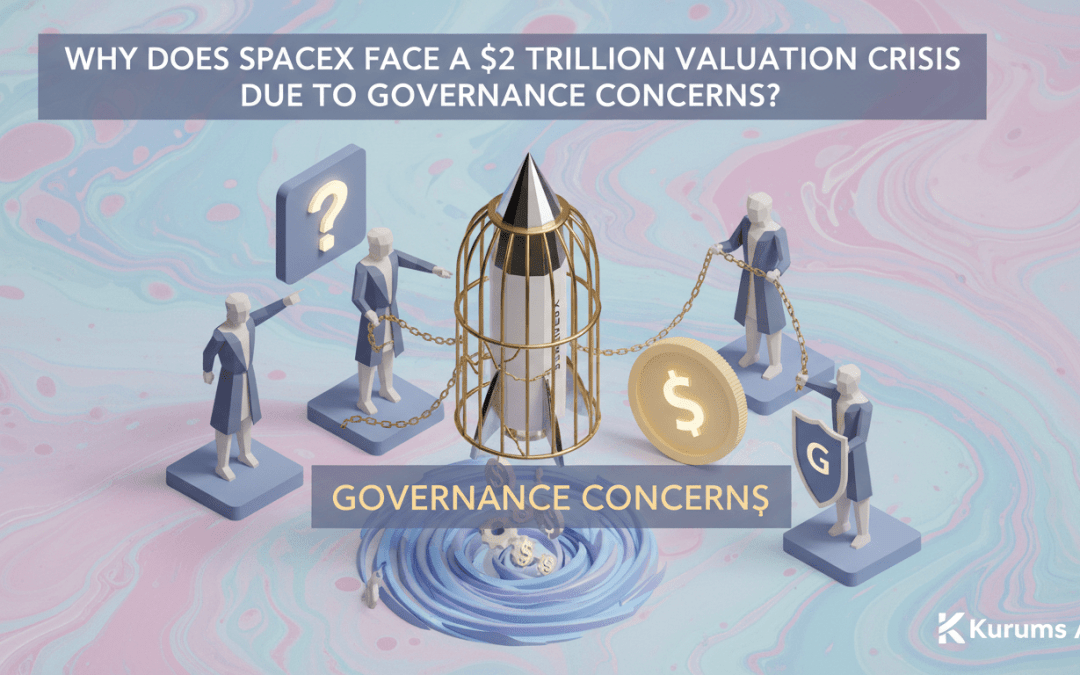
Q: Why is SpaceX’s $2 trillion valuation causing alarm among governance experts?
A: As SpaceX approaches a valuation exceeding the GDP of most nations, the lack of independent board oversight and potential conflicts of interest across Elon Musk’s corporate empire (Tesla, X, xAI) create systemic risks that institutional investors find increasingly difficult to ignore.
Q: What are the primary “red flags” identified by risk analysts?
A: Key concerns include the “controlled board” phenomenon, where directors lack sufficient independence, the blending of resources between Musk’s various companies, and the absence of traditional fiduciary safeguards found in public entities of similar scale.
Q: Can SpaceX maintain this valuation without structural reform?
A: While technological dominance is high, financial sustainability at the $2 trillion level requires a transition from a founder-centric “startup” model to a robust, transparent corporate governance framework to mitigate legal and regulatory liabilities.
SpaceX is currently reaching for the stars, yet its internal structural integrity is under heavy fire from governance specialists. The reality is that reaching a $2 trillion valuation transforms a company from a private venture into a systemic global institution. When a company carries a price tag larger than the market capitalization of most blue-chip giants, the “move fast and break things” ethos of a startup begins to clash violently with the fiduciary requirements of Tier 1 institutional capital.
The current discourse surrounding SpaceX isn’t just about rockets or Mars colonization; it is a fundamental debate about the limits of founder autonomy. As Elon Musk targets a valuation that would place SpaceX in the same echelon as Microsoft or Apple, the scrutiny on his “expanding empire” has never been more intense. Governance experts are raising red flags, suggesting that the very leadership style that fueled SpaceX’s rise could now be its greatest valuation risk.
The “Tesla Ghost”: Why Governance Precedents Matter
To understand the skepticism facing SpaceX, one must look at the legal tremors coming from Delaware. The recent court rulings regarding Elon Musk’s compensation package at Tesla have sent shockwaves through the corporate world. The court essentially found that the Tesla board was “beholden” to Musk, lacking the independence required to protect minority shareholders. Why does this matter for SpaceX? Because the patterns are nearly identical.
But wait, there’s more. SpaceX is a private company, which traditionally allows for more leeway. However, at a $2 trillion valuation, the “private” label becomes a technicality. The sheer volume of secondary market trading and the involvement of massive pension funds mean that SpaceX’s governance affects the broader economy. If the board is perceived as a rubber stamp for Musk’s ambitions—or worse, a tool for his other ventures—the risk of “fiduciary contagion” becomes real.
The Multi-Empire Conflict: SpaceX, xAI, and the Resource Tug-of-War
One of the most pressing concerns for governance experts is the “inter-company resource sharing” within the Musk ecosystem. We are seeing a trend where talent, data, and perhaps even hardware are being shifted between SpaceX, Tesla, xAI, and X (formerly Twitter). From a purely operational standpoint, this synergy is brilliant. From a governance standpoint, it is a nightmare.
Think about it: If SpaceX engineers are spending time optimizing compute clusters for xAI, or if SpaceX’s Starlink data is being used to train Tesla’s FSD (Full Self-Driving) without clear, arms-length commercial agreements, the fiduciary duty to SpaceX shareholders is potentially being breached. Analysts are asking: Who is guarding the gates? Is the board ensuring that SpaceX is getting fair market value for these cross-company collaborations?
The Risk of “Key Man” Dependency at $2 Trillion
In the early days of SpaceX, Musk’s personal involvement was the company’s greatest asset. Today, at a $2 trillion target, it is increasingly viewed as a single point of failure. Governance experts point out that the lack of a clear, empowered “Number 2” or a robust succession plan creates an institutional vacuum. When a single individual controls the vision, the board, and the capital allocation of four different industry-disrupting firms, the risk of “executive burnout” or “attention dilution” becomes a material financial risk.
Comparing Governance Models: Startup vs. Systemic Institution
The transition from a high-growth startup to a $2 trillion entity requires a complete overhaul of oversight mechanisms. The following table illustrates the gap that SpaceX must bridge to satisfy conservative institutional requirements.
| Governance Feature | Current “Startup” Model (SpaceX) | Required “Systemic” Model |
|---|---|---|
| Board Composition | Founder-aligned, long-term associates. | Majority independent directors with diverse industry experience. |
| Executive Compensation | Opaque, tied to massive equity milestones. | Transparent, tied to ESG and long-term stability metrics. |
| Related-Party Transactions | Informal sharing across Musk-owned entities. | Strictly audited, arms-length commercial contracts. |
| Risk Oversight | Aggressive “fail-fast” technical testing. | Robust internal audit and compliance committees. |
| Transparency | Limited to “need-to-know” private investors. | Public-grade financial reporting and disclosures. |
The Fiduciary Duty Battleground: Protecting Private Shareholders
The question of fiduciary duty in a $2 trillion private company is largely uncharted territory. In a public company, the SEC provides a safety net. In the private sphere, shareholders often have to rely on the board’s integrity. However, as SpaceX’s valuation swells, its shareholder base is no longer just venture capitalists; it includes mutual funds and retirement accounts held by millions of people indirectly.
The reality is that these institutional giants are starting to demand “Board Veto Power” over major strategic shifts. They are no longer content with being passive passengers on Musk’s rocket. They want to know that if Musk decides to pivot SpaceX’s resources toward a Mars colony that won’t see a return for 50 years, there is a board capable of saying “no” if it harms the company’s current financial health.
Internal Risk Controls: More Than Just Engineering
While SpaceX’s engineering prowess is undeniable, its internal corporate controls are under the microscope. For a company that handles sensitive ITAR (International Traffic in Arms Regulations) technology and multi-billion dollar NASA contracts, the governance requirements are staggering. The “red flags” being raised suggest that the corporate side of the house hasn’t kept pace with the launch cadence.
- Regulatory Compliance Oversight: Ensuring that aggressive launch schedules don’t bypass environmental or safety protocols mandated by the FAA and EPA.
- Conflict of Interest Mitigation: Formalizing the boundaries between SpaceX’s Starshield (military) and Musk’s other international business interests.
- Whistleblower Protection: Establishing an independent channel for employees to report safety or ethical concerns without fear of “founder-led” retaliation.
- Capital Allocation Integrity: Ensuring that the billions raised for Starship are not being leveraged or collateralized for Musk’s acquisitions in other sectors (e.g., X).
The Geopolitical Governance Risk: Starlink and Sovereignty
SpaceX is no longer just a transportation company; with Starlink, it is a global telecommunications utility. This introduces a layer of geopolitical governance that most boards are ill-equipped to handle. When one man controls the internet access of sovereign nations during times of conflict, the “board oversight” becomes a matter of international security.
Governance experts argue that SpaceX needs a “Global Advisory Board” or a “Security Committee” that is independent of the CEO’s personal political leanings. Without this, the $2 trillion valuation is at the mercy of sudden regulatory crackdowns from foreign governments who fear the “Musk Hegemony.” The lack of a formal, predictable policy for Starlink’s use in conflict zones is a glaring governance gap that creates massive volatility risk.
The SEC’s “Shadow” Oversight
You might think being private keeps the SEC away. Think again. The SEC has a history of investigating “misleading statements” by private company executives if those statements affect the value of secondary market shares. As SpaceX seeks to maintain its $2 trillion status, every tweet or public statement by Musk regarding the company’s valuation or technical progress is a potential liability. A robust board would act as a filter, ensuring that corporate communications remain grounded in verifiable data.
Valuation Sustainability: The Risk Mitigation Matrix
How does a company justify a $2 trillion valuation when its governance is under fire? It must demonstrate a transition toward “Institutional Maturity.” Below is a matrix of the risks currently facing the valuation and the governance-led solutions required.
| Risk Category | Primary Governance Concern | Mitigation Strategy |
|---|---|---|
| Financial | Lack of audited public financials. | Voluntary adoption of PCAOB auditing standards. |
| Legal | Personal liability of the CEO impacting the brand. | Executive “Conduct Clauses” and board-led PR control. |
| Operational | Safety shortcuts due to aggressive deadlines. | Independent Safety Oversight Board with veto power. |
| Strategic | Misalignment between Mars vision and Starlink ROI. | Transparent capital allocation frameworks for investors. |
The Institutional Ultimatum: “Governance or No Capital”
The tide is turning in the private equity world. Large-scale investors like Fidelity, T. Rowe Price, and Google (Alphabet) have significant stakes in SpaceX. For years, they have been willing to let Musk lead without interference because the returns were astronomical. But at $2 trillion, the “downside risk” starts to outweigh the “upside potential.”
Why does this matter? Because SpaceX requires constant, massive capital injections to fund Starship and the Starlink constellation. If Tier 1 investors decide that the governance risk is too high, SpaceX could find itself in a “liquidity trap.” They are essentially demanding a seat at the table—not as observers, but as active participants who can check Musk’s more impulsive decisions.
Cult of Personality vs. Corporate Longevity
One of the most difficult challenges for SpaceX is decoupling the brand from the man. Currently, the $2 trillion valuation is intrinsically linked to Elon Musk’s personal brand. If he were to step away, what would happen to the valuation? Governance experts argue that a healthy company should be “institutionalized”—meaning its value is derived from its systems, processes, and people, not just a single visionary.
The current governance structure at SpaceX does little to institutionalize the company. By keeping the board small and filled with long-term allies, the company reinforces the “Cult of Personality.” To reach the next level, SpaceX needs to appoint directors who have experience running $100B+ aerospace or telecom companies—people who are not afraid to challenge the status quo.
Key Governance Red Flags for Investors
- Lack of Independent Lead Director: Without an independent lead director, the board lacks a formal voice to counter the CEO’s influence.
- Director Tenure: Many SpaceX board members have been there since the beginning, leading to “groupthink” and a lack of fresh perspective on modern systemic risks.
- Overlap with Other Boards: Directors who sit on the boards of multiple Musk companies face inherent conflicts of interest when negotiating deals between those companies.
- Opaque Executive Succession: There is no publicly understood or board-vetted plan for who takes over if Musk is incapacitated or distracted.
Conclusion: The Path Forward for a $2 Trillion SpaceX
SpaceX is at a crossroads. Its technological achievements are nothing short of miraculous, but its corporate governance remains in the “startup” era. To sustain a $2 trillion valuation and satisfy the growing concerns of experts and institutional investors, the company must undergo a governance evolution. This is not about stifling innovation; it is about building a foundation that can support the weight of a multi-planetary empire.
The solution is clear: SpaceX needs a more independent board, transparent internal controls, and a clear separation of resources from the rest of the Musk empire. If the company fails to address these “red flags,” the $2 trillion valuation may prove to be a house of cards, vulnerable to the first major regulatory or legal storm. However, if they embrace the transition to institutional maturity, the sky—or rather, Mars—is the limit.
Frequently Asked Questions (FAQ)
Is SpaceX planning an IPO soon?
While there are rumors, particularly regarding a Starlink spin-off, the current governance concerns are a major hurdle for a full SpaceX IPO. Public markets would require a level of transparency and board independence that the company currently lacks.
How does Musk’s acquisition of “X” affect SpaceX?
It creates “Attention Risk.” Governance experts worry that Musk’s focus is divided and that SpaceX resources (human or financial) could be used to prop up other ventures, creating a fiduciary risk for SpaceX shareholders.
What is a “Controlled Board”?
A controlled board is one where the directors are personally or financially beholden to the CEO, preventing them from acting as truly independent fiduciaries for all shareholders.
Discover more from Kurums | Business Intelligence
Subscribe to get the latest posts sent to your email.