Executive Summary: The SEC’s Paradigm Shift
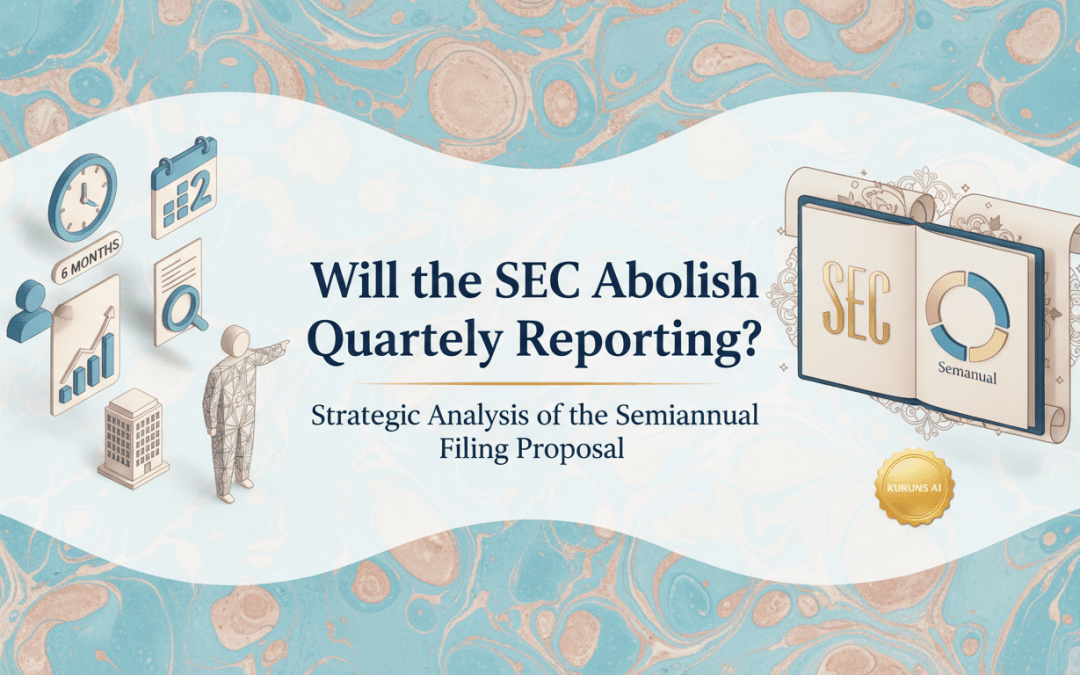
What is the proposal? The Securities and Exchange Commission (SEC) is considering an optional framework that allows public companies to transition from quarterly (Form 10-Q) to semiannual (Form 10-S) reporting.
Why now? To combat “quarterly capitalism,” reduce administrative burdens, and encourage long-term capital investment. The SEC estimates a potential $2.4 billion in cumulative savings for the corporate sector.
Who is affected? Primarily public issuers, institutional investors, and market analysts who rely on 90-day data cycles to value equities.
For over eight decades, the pulse of the American financial markets has been measured in 90-day increments. The quarterly earnings season is more than just a regulatory requirement; it is a cultural phenomenon that dictates executive bonuses, stock price volatility, and corporate strategy. However, the tide is turning.
The SEC’s landmark proposal to allow an optional semiannual reporting framework represents the most significant structural change to disclosure requirements since the mid-20th century. This isn’t just about cutting red tape. It is a fundamental questioning of whether the 10-Q cycle serves the modern economy or hinders it. As we look at the data, the implications are staggering. But here is the real catch: while the proposal offers flexibility, it creates a high-stakes dilemma for management teams regarding investor perception and market transparency.
1. The End of “Quarterly Capitalism”: Why the SEC is Acting Now
The term “quarterly capitalism” has become a pejorative in corporate governance circles. Critics argue that the relentless pressure to meet 90-day earnings-per-share (EPS) targets forces CEOs to prioritize short-term stock price movements over long-term research and development (R&D). The SEC’s proposal aims to break this cycle.
Research has shown that CFOs frequently admit they would forgo a value-adding project if it meant missing quarterly earnings expectations. By offering an optional semiannual path, the SEC is essentially providing a “long-termism” safe harbor. If companies are no longer forced to defend their performance every 13 weeks, they may feel more empowered to invest in multi-year innovation cycles that don’t produce immediate results.
2. Comparing the Frameworks: Form 10-Q vs. The Proposed Form 10-S
Understanding the technical differences between the current quarterly requirements and the proposed semiannual (10-S) filing is crucial for any compliance officer. The proposed framework doesn’t eliminate transparency; it consolidates it. Let’s look at the core differences in this transition.
| Feature | Current (Quarterly 10-Q) | Proposed (Semiannual 10-S) |
|---|---|---|
| Frequency | 3 times per year (plus 10-K) | 1 time per year (plus 10-K) |
| Audit/Review Level | Interim Review (PCAOB) | Enhanced Interim Review |
| Management Discussion (MD&A) | Focus on immediate 3-month variance | Focus on 6-month trends and strategy |
| Compliance Cost | High (Constant audit/legal cycle) | Reduced by 30-45% annually |
The “10-S” would not just be a longer 10-Q. The SEC is suggesting that the 10-S include more robust qualitative analysis. Instead of explaining why a specific marketing spend was high in Q2, companies would be expected to explain how their half-year performance aligns with their five-year strategic roadmap.
3. The $2.4 Billion Dividend: Administrative and Compliance Savings
The most immediate benefit of the proposal is the reduction in direct compliance costs. For a mid-cap public company, the cost of preparing a 10-Q—including legal fees, internal accounting labor, and external auditor reviews—can range from $250,000 to $700,000 per quarter.
Think about it: by eliminating two of these reporting cycles, a company could save over $1 million annually. Scale this across the thousands of public companies in the U.S., and the SEC’s estimate of $2.4 billion in cumulative savings begins to look conservative.
- Reduced Audit Fees: Lower frequency of interim reviews by external accounting firms.
- Internal Resource Optimization: Freeing up the finance and accounting teams to focus on internal controls and strategic planning rather than filing deadlines.
- Legal Cost Mitigation: Fewer “window periods” and filing-related liability exposures.
- Executive Focus: Management spends less time on earnings call preparation and more on operational execution.
4. Information Asymmetry: The Risk to Retail Investors
But there’s a catch. While the SEC wants to help companies, their primary mandate is investor protection. Critics of the semiannual proposal argue that a longer gap between filings creates “information vacuums.”
In a 180-day reporting cycle, a lot can go wrong. If a company experiences a major operational failure in Month 1 of a six-month period, investors might not get a clear, regulated picture of the impact until Month 6. This asymmetry benefits institutional investors who have the resources to conduct private channel checks, leaving retail investors in the dark.
The Role of Form 8-K in a Semiannual World
To mitigate this risk, the SEC proposal suggests that while periodic reporting (10-Q) becomes optional, current reporting (8-K) requirements would remain—and potentially be strengthened. Companies would still be required to report material events within four business days. However, the definition of “material” becomes the battleground. Would a 10% revenue miss mid-half-year count as an 8-K event? Under the current proposal, the lines are still blurry.
5. The Global Perspective: Lessons from the UK and EU
The U.S. is not the first to consider this. In 2014, the United Kingdom’s Financial Conduct Authority (FCA) abolished the requirement for “Interim Management Statements” (essentially quarterly updates). The European Union followed suit with the Transparency Directive.
What did the data show? Surprisingly, the results were mixed. A study by the CFA Institute found that while compliance costs dropped, there was no significant increase in long-term investment by UK firms. Furthermore, some companies that stopped quarterly reporting eventually returned to it because analysts and investors demanded the frequency. This suggests that “market pressure” is often a more powerful force than “regulatory requirement.”
6. Impact on Market Volatility and High-Frequency Trading
High-frequency trading (HFT) algorithms thrive on the volatility of earnings releases. When a 10-Q hits the wires, millions of trades are executed in milliseconds. Moving to a semiannual cycle would theoretically reduce these “volatility spikes” from four times a year to two.
But does less frequent reporting actually mean less volatility? Some market theorists argue the opposite. They suggest that when information is released less frequently, each release carries much more weight. A “bad half-year” could lead to a catastrophic one-day sell-off that is far more damaging than a “bad quarter” would have been. This “concentration of risk” is a major concern for market makers.
7. Strategic Analysis: Which Companies Should Opt-In?
The SEC is making this optional. This creates a fascinating game theory scenario. If Company A moves to semiannual but its direct competitor, Company B, stays quarterly, does Company B gain a competitive advantage in the capital markets? Or does Company A look more “mature” and “long-term oriented”?
| Sector Profile | Suitability for Semiannual | Primary Reasoning |
|---|---|---|
| Biotechnology (R&D Stage) | High | Long clinical trial cycles; quarterly data is often “noise.” |
| Retail / E-commerce | Low | Highly seasonal; monthly/quarterly sales data is critical for valuation. |
| Heavy Manufacturing | Medium | Benefit from focus on multi-year contract cycles. |
| Software (SaaS) | Medium-Low | Investors expect high-velocity growth metrics. |
8. The Technological Solution: Is Real-Time Disclosure the Future?
Here is where the conversation gets truly innovative. Some experts argue that periodic reporting—whether quarterly or semiannual—is an artifact of a paper-based world. We now live in an era of real-time data, blockchain ledgers, and AI-driven analytics.
Instead of a massive document every six months, could we move toward a “continuous disclosure” model? In this scenario, companies provide a “live dashboard” of certain non-sensitive KPIs. If the SEC adopts the semiannual framework, it may be a bridge to a future where traditional “filings” are replaced by continuous, audited data streams. This would solve both the administrative burden and the information asymmetry problem simultaneously.
9. Legal and Regulatory Hurdles: The SOX Factor
Any change to reporting frequency must grapple with the Sarbanes-Oxley Act (SOX), particularly Section 302 and 404 certifications. Currently, CEOs and CFOs must certify the accuracy of financial statements every quarter.
Under a semiannual framework, do these certifications also become semiannual? If so, does this weaken the internal control environment? The SEC proposal suggests that internal control testing must remain rigorous, but the formal certification would align with the new filing frequency. Legal experts warn that this could lead to a “lapse in discipline” during the off-quarters, potentially increasing the risk of accounting restatements down the line.
10. Impact on Analyst Coverage and Earnings Guidance
Equity analysts are the primary consumers of 10-Q filings. Their entire business model—building financial models, issuing buy/sell ratings, and setting price targets—is built on the quarterly pulse. If a company stops reporting quarterly, it is likely that fewer analysts will cover it.
For small and mid-cap companies, a loss of analyst coverage can be devastating for liquidity. Without a “consensus estimate” to beat or miss, the stock may see lower trading volume. Management teams must weigh the $500,000 in savings against the potential loss of market visibility and liquidity.
- Guidance Strategy: Will companies still provide quarterly “guidance” even if they don’t file a 10-Q? (The SEC suggests this would be discouraged to avoid “guidance-only” volatility).
- Earnings Calls: Companies may choose to host “Update Calls” without a formal SEC filing to keep the market informed.
- Modeling Challenges: Analysts will have to shift from 3-month to 6-month or 12-month trailing windows, potentially reducing the “precision” of their estimates.
11. ESG and Long-Term Value Creation
The move toward semiannual reporting dovetails perfectly with the rise of ESG (Environmental, Social, and Governance) investing. ESG factors are inherently long-term. You cannot measure a company’s progress on carbon neutrality or board diversity in 90-day increments.
By moving to a 6-month cycle, companies have more space in their MD&A (Management Discussion and Analysis) to discuss these “non-financial” but material long-term value drivers. This shift could turn the periodic report from a “scorecard of the past” into a “manifesto for the future.”
12. Implementation Roadmap: What CFOs Should Do Today
While the SEC proposal is still in the comment and finalization phase, forward-thinking finance leaders should start preparing now. This is not a change you implement overnight. It requires a total rethink of investor relations, internal controls, and corporate communication.
Step-by-Step Transition Checklist
- Stakeholder Audit: Survey your top 20 institutional investors. Would they support a move to semiannual reporting? What information gaps would they fear most?
- Cost-Benefit Analysis: Quantify the actual savings. Factor in auditor fees, legal hours, and the “opportunity cost” of executive time.
- IR Strategy Revision: Develop a plan for “interim updates.” How will you communicate material progress between the 6-month markers?
- Internal Control Stress Test: Ensure your SOX compliance framework can handle a longer reporting window without losing data integrity.
Conclusion: A New Era of Corporate Disclosure
The SEC’s proposal to allow optional semiannual reporting is a bold attempt to fix the “short-termism” that has plagued American capital markets for decades. By offering an alternative to the 90-day earnings treadmill, the SEC is placing the power back in the hands of management teams and long-term investors.
However, this freedom comes with significant responsibility. Companies that choose this path must work twice as hard to maintain investor trust and prevent information gaps. The $2.4 billion in savings is a compelling carrot, but the “transparency discount” is a dangerous stick. As we move toward 2027 and beyond, the companies that thrive will be those that use this new flexibility not to hide, but to tell a more compelling, long-term story of value creation.
Is your organization ready to lead the shift? The time to analyze your reporting strategy is now. Consult with your legal and financial advisors to determine if the “10-S” framework aligns with your vision for the future.
Discover more from Kurums | Business Intelligence
Subscribe to get the latest posts sent to your email.