
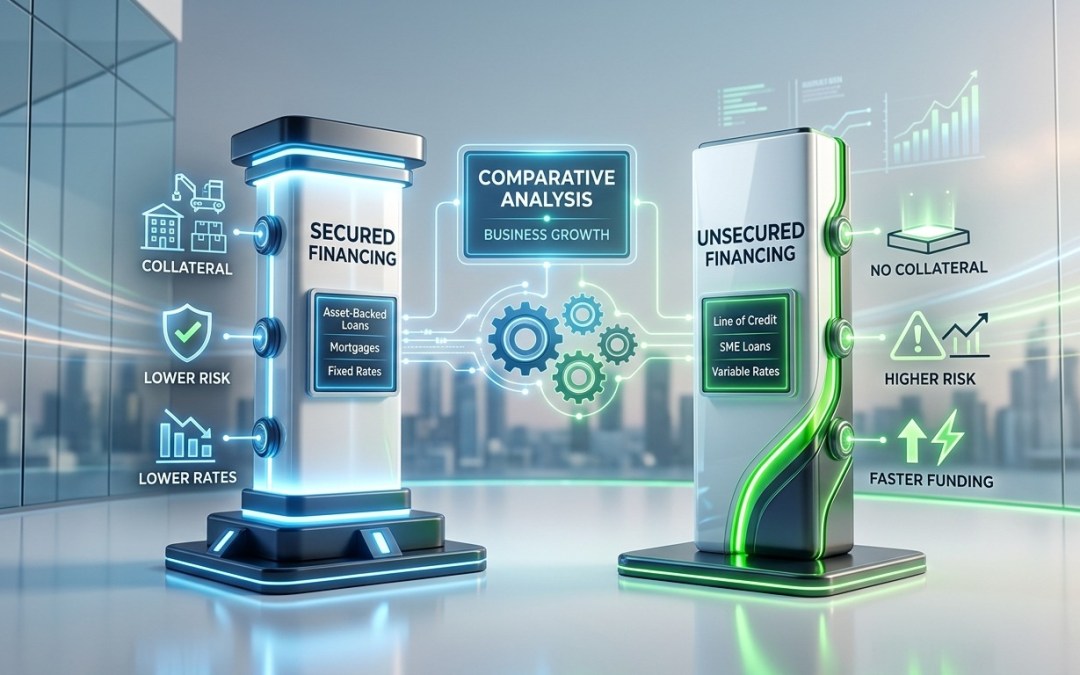
Introduction: The Strategic Dichotomy of Debt Capital
In the contemporary corporate landscape, the optimization of the balance sheet is a prerequisite for sustainable growth and competitive advantage. At the heart of this optimization lies the fundamental choice between secured and unsecured debt instruments. These two mechanisms represent the primary pillars of business lending, each governed by distinct risk-mitigation philosophies and legal structures. Understanding the nuance between a lien-backed facility and a cash-flow-driven line of credit is essential for executive decision-making.
Historically, the distinction was binary: small businesses with limited history utilized secured loans (often collateralized by real estate or equipment), while blue-chip corporations commanded unsecured credit based on their reputation and balance sheet strength. However, the maturation of global financial markets, the rise of private credit, and the advent of algorithmic underwriting have blurred these lines. Today, even high-growth startups and mid-market firms must navigate a complex landscape where “hybrid” structures and specific asset-based lending (ABL) play a critical role.
The Historical Evolution of Business Credit Mechanisms
The journey from rudimentary pawnbroking to sophisticated unsecured revolving credit facilities spans centuries of legal and economic evolution. In the pre-industrial era, lending was almost exclusively secured. The concept of “hypothecation”—where a debtor pledges an asset as collateral while retaining possession—originated in Roman law and remains the bedrock of modern secured financing.
The 19th and 20th centuries saw the emergence of the “reputational economy.” As accounting standards became codified and public companies began sharing audited financial statements, lenders started to assess the probability of default (PD) based on earnings rather than just the loss given default (LGD) based on collateral liquidation value. This shift birthed the unsecured corporate bond market and the commercial paper market.
The Impact of Basel III and IV on Lending Preferences
In the post-2008 financial crisis era, regulatory frameworks like Basel III have significantly influenced how banks view secured vs. unsecured debt. Banks are now required to hold higher capital reserves against unsecured loans due to their higher risk-weighted asset (RWA) profiles. Consequently, secured lending has seen a resurgence as a preferred tool for institutional lenders looking to optimize their own regulatory capital ratios. This has created a paradoxical situation where secured debt is often more readily available and cheaper, even for companies with strong credit profiles.
Secured Financing: The Architecture of Collateralization
Secured business financing is defined by the creation of a security interest in favor of the lender. This interest provides the lender with a legal claim to specific assets in the event of a contractual default. This “safety net” allows for lower interest rates and longer repayment terms, as the lender’s exposure is capped by the valuation of the underlying collateral.
Types of Collateral and the LTV Ratio
The efficacy of a secured loan is intrinsically linked to the liquidity and stability of the collateral. Lenders typically apply a “haircut” to the market value of the asset, resulting in a Loan-to-Value (LTV) ratio. Common collateral types include:
- Real Estate: Often providing the highest LTV (70-80%) due to the historical stability of property values.
- Equipment and Machinery: LTVs usually range from 40-60%, accounting for depreciation and specialized resale markets.
- Accounts Receivable (Factoring/Invoicing): Highly liquid but subject to the creditworthiness of the borrower’s customers.
- Inventory: Typically the least desirable collateral, often seeing LTVs as low as 20-50% due to obsolescence risks.
Legal Frameworks: UCC-1 Filings and Perfection
In the United States, secured transactions are governed by Article 9 of the Uniform Commercial Code (UCC). For a lender to protect its interest against other creditors, it must “perfect” its security interest, usually by filing a UCC-1 Financing Statement. This public record alerts other potential creditors that certain assets are already encumbered. In an insolvency scenario, the order of these filings determines the “waterfall” of payment—who gets paid first from the liquidation proceeds.
Unsecured Financing: The Logic of Cash-Flow Lending
Unsecured business loans, often referred to as “signature loans” or “cash-flow loans,” do not require specific collateral. Instead, the lender relies on the borrower’s historical financial performance, projected future revenue, and overall credit reputation. Because the lender has no direct claim to assets in a default, the risk premium—and thus the interest rate—is significantly higher.
The Role of the Personal Guarantee
While the loan itself may be unsecured by business assets, many lenders (especially for SMEs) require a Personal Guarantee (PG) from the business owners. Technically, this transforms the loan into a “semi-secured” instrument, where the lender can pursue the personal assets (homes, savings) of the guarantors if the business fails. For a truly unsecured corporate loan, the lender must rely solely on the “Negative Pledge” covenant, where the borrower agrees not to pledge assets to other lenders.
Underwriting in the Digital Age
Modern unsecured lending has been revolutionized by fintech and Big Data. Traditional banks might take weeks to analyze tax returns, but contemporary unsecured lenders use API integrations into a company’s ERP and banking software to analyze real-time cash flow. This speed of execution is a primary driver for the popularity of unsecured lines of credit, despite the higher APRs.
Technical Comparison: Data-Driven Insights
To facilitate a decision-making framework, we must look at the quantitative differences. The following table provides a comparative analysis based on current market averages for mid-market corporate debt.
| Feature | Secured Financing | Unsecured Financing |
|---|---|---|
| Typical Interest Rates | SOFR + 2.0% to 5.0% | SOFR + 6.0% to 15.0%+ |
| Loan-to-Value (LTV) | 40% – 80% of asset value | Based on 1x – 3x EBITDA |
| Repayment Term | 5 – 25 years (Long-term) | 1 – 5 years (Short to Mid-term) |
| Covenants | Asset-maintenance covenants | Stringent financial/ratio covenants |
| Speed of Funding | Slow (requires appraisals/legal) | Fast (often 24-72 hours) |
| Risk of Liquidation | High (Direct seizure of assets) | Low (Legal action/Judgments) |
| Impact on Balance Sheet | Restricts asset mobility | Increases leverage without encumbrance |
Cost of Capital Analysis: WACD and Risk Premiums
From a corporate finance perspective, the decision hinges on the Weighted Average Cost of Debt (WACD). Secured debt is almost always cheaper in nominal terms, but it carries “hidden costs.” These include the costs of asset appraisals, legal fees for perfecting liens, and the potential increase in insurance premiums for the pledged collateral.
The Risk-Premium Calculus
Lenders calculate the interest rate on unsecured debt using a “Risk Premium” model. If the risk-free rate (e.g., Treasury yields) is 4%, a secured lender might charge 7% (3% premium). An unsecured lender, facing a higher Loss Given Default (LGD), might charge 12% (8% premium). For a corporation, the question is: Is the 5% difference in interest worth the freedom of keeping assets unencumbered?
If the company anticipates needing to pivot its operations—such as selling a division or upgrading a fleet of vehicles—the flexibility of unsecured debt often outweighs the higher interest expense. Conversely, for capital-intensive industries (manufacturing, logistics), secured debt is the only viable way to fund large-scale infrastructure without eroding margins.
Legal Covenants: The Invisible Shackles
Debt agreements are rarely just about the money; they are about control. Secured loans often come with affirmative and negative covenants that are asset-specific. For example, a lender with a lien on a manufacturing plant may require the borrower to maintain the facility to a specific standard and provide annual engineering reports.
Unsecured loans, because they lack collateral, use “Financial Covenants” to protect the lender. These might include:
- Maximum Leverage Ratio: Total Debt / EBITDA must remain below a certain threshold (e.g., 4.0x).
- Minimum Net Worth: The company must maintain a specific level of equity.
- Dividend Restrictions: Preventing the company from paying out cash to shareholders if certain financial health markers aren’t met.
Sector-Specific Application Scenarios
Scenario A: The SaaS/Technology Firm
A software-as-a-service (SaaS) company typically has high margins but few physical assets. Secured lending is difficult because their primary asset—intellectual property (IP)—is notoriously hard to value for traditional banks. In this case, unsecured financing (specifically Venture Debt or Revenue-Based Financing) is the standard. The lender bets on the recurring revenue stream rather than the liquidation of server racks.
Scenario B: The Logistics and Cold-Storage Provider
A company operating a fleet of refrigerated trucks and 100,000 sq. ft. of warehouse space is an ideal candidate for secured financing. The trucks and the real estate have clear market values and secondary markets. By using these as collateral, the firm can access low-interest, 15-year amortizing loans that match the long-term utility of the assets themselves.
Failure Case Analysis: What Happens in a Default?
To truly understand the difference, one must look at the mechanics of failure. The bankruptcy of a business exposes the structural strengths and weaknesses of each debt type.
Case Study 1: The Secured Creditor’s Advantage
In the liquidation of a regional retail chain, a bank holding a first-priority lien on the inventory and real estate is paid first. Even if the assets are sold at 60 cents on the dollar, the secured lender often recovers 100% of their principal. This “Recovery Rate” is why secured debt is priced so competitively.
Case Study 2: The Unsecured Creditor’s Dilemma
In the same retail bankruptcy, the unsecured creditors (bondholders, vendors, and unsecured line-of-credit providers) are at the bottom of the stack. They often receive “pennies on the dollar” or equity in a restructured, potentially worthless version of the company. In many Chapter 7 liquidations, the recovery rate for unsecured creditors is 0%.
Future Trends: AI-Driven Risk Assessment and Decentralized Finance (DeFi)
The landscape of secured vs. unsecured lending is undergoing a seismic shift driven by technology. We are entering an era of “Dynamic Collateralization.”
1. AI and Predictive Underwriting
Artificial Intelligence is moving unsecured lending closer to the cost of secured lending. By analyzing thousands of data points—from social media sentiment to real-time supply chain telemetry—AI models can predict defaults with higher accuracy than traditional FICO or Dun & Bradstreet scores. This reduces the risk premium lenders need to charge for unsecured debt.
2. Tokenization of Assets
Blockchain technology allows for the “fractionalization” of collateral. In the future, a business might secure a loan by pledging a fraction of its real estate or its patent portfolio via digital tokens. This would allow for “micro-secured” loans, offering the interest rate benefits of secured debt with the flexibility of unsecured credit.
3. The Rise of Private Credit
As traditional banks retreat due to regulatory pressure, private credit funds are stepping in. These funds are often more creative, offering “unitranche” facilities that combine secured and unsecured components into a single loan structure, simplifying the capital stack for the borrower.
Decision Matrix: Which Mechanism Should You Choose?
The choice between secured and unsecured debt should be a function of your “Capital Strategy Cycle.”
- Analyze Asset Lifecycle: If the asset being financed has a life of 10+ years (e.g., a factory), use secured debt to match the term and lower the cost.
- Evaluate Growth Velocity: If you are in a “hyper-growth” phase, prioritize unsecured debt to avoid the administrative burden and restrictive covenants of collateral audits.
- Assess “Liquidity Runway”: Calculate your “Emergency Buffer.” If all assets are pledged (secured), you have no “dry powder” to offer a lender in a crisis. Keep some assets unencumbered.
- Review “Cost of Carry”: Compare the higher interest of an unsecured loan against the “Soft Costs” (appraisals, legal, filing fees) of a secured loan. Over short durations (under 18 months), unsecured is often cheaper in total dollars.
- Examine the Personal Impact: If you are a small to mid-sized business owner, determine if an “unsecured” loan requires a Personal Guarantee. If it does, you are effectively securing it with your personal life—evaluate that risk carefully.
Conclusion: Balancing Risk and Flexibility
Secured and unsecured business loans are not mutually exclusive; rather, they are tools that should be used in tandem to build a resilient capital stack. Secured debt provides the foundation—low-cost, long-term capital that fuels core infrastructure. Unsecured debt provides the agility—the high-speed liquidity needed to seize market opportunities, manage seasonal fluctuations, and innovate without the “anchors” of asset liens.
As a corporate leader, the goal is to minimize the Weighted Average Cost of Capital (WACC) while maximizing operational freedom. By deeply understanding the technical nuances of these two mechanisms, from UCC filings to risk-adjusted premiums, you can navigate the credit markets with precision, ensuring your organization is never over-leveraged nor under-capitalized.
In the final analysis, the “best” loan is not necessarily the one with the lowest interest rate, but the one that aligns most closely with your company’s risk tolerance, asset base, and long-term strategic vision. In an increasingly volatile global economy, the flexibility of unencumbered assets can often be worth more than a few percentage points in interest savings. Conversely, the disciplined use of secured debt can provide the low-cost fuel necessary to outpace competitors in capital-intensive industries.
Discover more from Kurums | Business Intelligence
Subscribe to get the latest posts sent to your email.