Introduction: The API-Driven Transformation of Corporate Finance
For decades, corporate finance departments have been hampered by the limitations of legacy banking infrastructure. Historically, the interaction between a corporate entity and its financial institutions was characterized by latency, opacity, and highly manual processes. Treasury teams relied on end-of-day batch files—such as MT940 or BAI2 formats—transmitted over secure but antiquated networks like SWIFT or SFTP. This reliance on asynchronous, delayed data feeds created structural inefficiencies, leading to liquidity fragmentation, delayed accounting reconciliation, and sub-optimal working capital management.
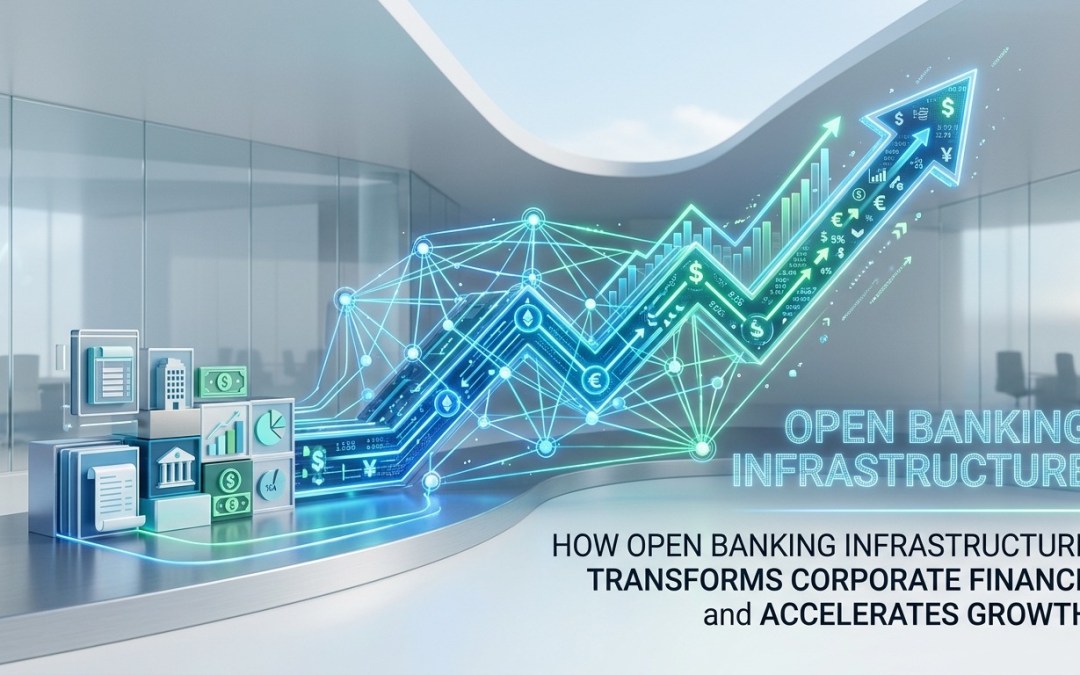
Today, the financial services landscape is undergoing a systemic revolution driven by open banking. At its core, open banking is a regulatory and technological framework that mandates or encourages financial institutions to open up their customer data (with explicit consent) to verified Third-Party Providers (TPPs) via secure, standardized Application Programming Interfaces (APIs). This infrastructure allows enterprise resource planning (ERP) systems, accounting software, and custom treasury management systems (TMS) to connect directly to a bank’s core ledger in real-time. The result is a seamless, bidirectional flow of financial data and payment initiation commands that transforms corporate finance from a reactive, backward-looking function into a proactive, strategic driver of enterprise growth.
Understanding the deep technical mechanics and the profound strategic implications of this shift is critical for modern executive leadership. The open banking business benefits extend far beyond mere convenience; they encompass hyper-automated reconciliation, risk mitigation, drastically reduced transaction costs, and the democratization of financial data. This article will provide an exhaustive technical and strategic analysis of how open banking infrastructure is reshaping the corporate financial ecosystem.
Historical Context: The Genesis and Evolution of Open Banking
To fully appreciate the sophisticated architecture of modern financial APIs, one must understand the fraught historical context from which they emerged. The journey to open banking is a story of technological workarounds evolving into standardized regulatory mandates.
The Legacy Era of Screen Scraping
Before the advent of dedicated banking APIs, early financial technology (fintech) companies and forward-thinking enterprises utilized a highly problematic technique known as “screen scraping” to aggregate financial data. In this model, a corporate user would provide their actual online banking credentials (username and password) to a third-party software provider. The software’s automated bots would then log into the banking portal, mimicking human behavior, and literally “scrape” the HTML code of the web page to extract balance and transaction data.
This approach was inherently flawed and introduced severe operational and security risks. First, sharing core banking credentials violated fundamental security protocols and often breached the bank’s Terms of Service, creating immense legal liability for the enterprise. Second, screen scraping was incredibly brittle. If a bank updated its website’s user interface, altered an HTML tag, or introduced a pop-up message, the automated scraper would fail, leading to sudden, catastrophic data outages for the corporate treasury team. Finally, screen scraping placed immense, unnecessary computational load on the banks’ consumer-facing web servers.
Regulatory Catalysts: PSD2 and Global Frameworks
The unsustainable nature of screen scraping, coupled with a desire to foster market competition, prompted regulatory intervention, most notably in the European Union and the United Kingdom. The revised Payment Services Directive (PSD2), implemented in Europe in 2018, was the foundational legislative catalyst for open banking. PSD2 fundamentally changed the ownership model of financial data, decreeing that the data belongs to the customer, not the bank. It legally obligated banks to build secure, dedicated APIs through which third parties could access this data, provided they had the customer’s explicit consent.
PSD2 formalized two distinct types of third-party regulatory statuses:
1. Account Information Service Providers (AISPs): Entities authorized to access read-only data, such as account balances and transaction histories.
2. Payment Initiation Service Providers (PISPs): Entities authorized to initiate a payment directly from the user’s bank account, bypassing traditional card networks.
While Europe led via strict regulation, other regions adopted different approaches. The United Kingdom’s Competition and Markets Authority (CMA) mandated a highly standardized API specification for its largest banks (the CMA9). In contrast, the United States initially followed a market-driven approach, where industry consortiums like the Financial Data Exchange (FDX) developed standards organically. However, recent regulatory movements in the US, particularly the Consumer Financial Protection Bureau’s (CFPB) rule-making under Section 1033 of the Dodd-Frank Act, are now pushing the American market toward formal, standardized open banking mandates, ensuring global convergence on API-first financial data architectures.
Deep Dive into the Technical Architecture of Financial APIs
The transition from batch files to open banking requires a sophisticated, highly secure technological infrastructure. Modern corporate finance teams must understand the underlying technical components to evaluate vendor integrations and build resilient internal systems.
RESTful Interoperability and FAPI Standards
The vast majority of open banking integrations utilize RESTful (Representational State Transfer) API architectures. REST APIs allow enterprise systems to communicate with bank servers over standard HTTP protocols, utilizing standard methods such as GET (to retrieve account balances) and POST (to initiate a payment). The data payloads are almost universally formatted in JSON (JavaScript Object Notation), replacing the rigid, fixed-width, and difficult-to-parse formats of legacy financial files.
To address the stringent security requirements of financial data, the OpenID Foundation developed the Financial-grade API (FAPI) profile. FAPI provides specific implementation guidelines for OAuth 2.0 and OpenID Connect, ensuring that APIs used for high-risk operations (like moving millions of dollars in corporate funds) are resistant to advanced cyber-attacks, including man-in-the-middle (MitM) and token replay attacks.
Authentication and Authorization Frameworks
The security of open banking relies on complex, multi-layered authentication. Gone are the days of sharing passwords. Instead, open banking utilizes a delegated authorization framework, primarily OAuth 2.0.
When an enterprise ERP system requests access to a corporate bank account, the user is redirected to the bank’s secure interface to authenticate (often using Multi-Factor Authentication, or MFA). Once authenticated, the bank issues a cryptographic token (an Access Token) to the ERP system. The ERP system then presents this token with every subsequent API request. The token has a strictly limited scope (e.g., read-only access to specific accounts) and a limited lifespan.
Furthermore, communication between the TPP (or enterprise) and the bank is secured using Mutual TLS (mTLS). In a standard web browsing session (TLS), only the server proves its identity to the client. In mTLS, both the bank’s server and the enterprise’s API client must cryptographically prove their identities to each other using digital certificates. In Europe, these are highly regulated eIDAS certificates (QWACs for securing the transport layer and QSealCs for signing data payloads), ensuring absolute non-repudiation and data integrity.
Analyzing the Core Open Banking Business Benefits
The adoption of API-driven banking infrastructure unlocks immense strategic value. The open banking business benefits can be categorized into four primary domains: operational automation, liquidity management, payment optimization, and risk assessment.
1. Hyper-Automation of Accounting Reconciliation
Perhaps the most immediate and tangible benefit of open banking for corporate finance is the automation of account reconciliation. In traditional setups, accounting teams spend days at the end of the month downloading CSV files from various banking portals, uploading them into the ERP, and manually matching incoming payments to outstanding invoices. This process is highly susceptible to human error and scales poorly as transaction volumes grow.
Open banking APIs allow ERP systems to fetch transaction data in real-time or at highly frequent automated intervals (e.g., every 15 minutes). Furthermore, the structured JSON data often contains richer metadata than legacy formats. Modern fintech solutions leverage this continuous data feed to power intelligent reconciliation engines. By applying fuzzy matching algorithms (like Levenshtein distance) to payment references, and utilizing machine learning to understand historical payment behaviors, enterprises can achieve straight-through processing (STP) rates of over 95% for their accounts receivable. This drastic reduction in manual effort allows the finance team to transition from clerical data entry to strategic financial analysis, while simultaneously reducing the Days Sales Outstanding (DSO) metric.
2. Real-Time Corporate Liquidity and Treasury Management
For multinational corporations with dozens of subsidiaries and hundreds of bank accounts spread across different jurisdictions, maintaining visibility over corporate cash is a massive logistical challenge. Legacy treasury management often relies on end-of-day MT940 sweeps, meaning the CFO’s dashboard is always 24 hours out of date. This liquidity fragmentation forces companies to maintain higher-than-necessary cash buffers, trapping working capital that could otherwise be deployed for growth or debt reduction.
Open banking APIs provide an aggregated, unified, and real-time view of global liquidity. Treasury management systems (TMS) can poll balances across all connected institutions instantaneously. This granular visibility enables precise cash flow forecasting, optimal deployment of surplus funds into short-term yield-bearing instruments, and the automated triggering of inter-company sweeping to prevent localized overdrafts. In a volatile macroeconomic environment characterized by fluctuating interest rates, the ability to mobilize cash instantly based on real-time data is a profound competitive advantage.
3. Mitigation of Payment Friction and Cost Reduction
Beyond read-only data access, the Payment Initiation (PISP) capabilities of open banking are revolutionizing B2B payments. Traditionally, businesses accepting digital payments rely heavily on corporate credit cards. These transactions are processed through legacy card networks (like Visa and Mastercard), which impose hefty interchange fees—often ranging from 1.5% to over 3% per transaction. For high-value B2B invoices, these fees represent a massive erosion of profit margins.
Open banking enables Account-to-Account (A2A) payments. When a business sends an invoice, it can include an embedded open banking payment link. When the client clicks the link, they authenticate with their own bank and authorize a direct, real-time bank transfer over faster payment rails (such as SEPA Instant in Europe, Faster Payments in the UK, or FedNow/RTP in the US). Because this process bypasses the card networks entirely, the transaction fees are typically a fraction of a cent or a low flat fee, resulting in millions of dollars in annual savings for high-volume enterprises. Furthermore, A2A payments settle instantly, eliminating chargeback risks and improving corporate cash flow.
4. Credit Risk Assessment and Underwriting Optimization
For B2B enterprises that extend credit terms to their customers (e.g., Net-30 or Net-60 terms), assessing counterparty risk is critical. Traditional credit checks rely on stale data from credit bureaus, which may not reflect the current financial health of a prospective partner.
Open banking allows businesses to request explicit consent to view a potential partner’s real-time banking data during the onboarding process. By algorithmically analyzing cash flow consistency, debt obligations, and historical revenue streams via API feeds, corporate credit teams can build dynamic, highly accurate credit risk models. This allows enterprises to safely extend higher credit lines to healthy partners while identifying distressed counterparties long before a traditional credit bureau rating is downgraded.
Data-Rich Comparison: Traditional Corporate Banking vs. Open Banking
To quantify the architectural paradigm shift, the following table illustrates the stark operational differences between legacy corporate banking integrations and modern open banking frameworks.
| Feature / Metric | Traditional Corporate Banking (Legacy) | Open Banking API Infrastructure |
|---|---|---|
| Data Format | MT940, BAI2, CSV (Rigid, fixed-width, hard to parse) | JSON, XML (Highly structured, extensible, standardized) |
| Data Freshness | End-of-day batch processing (T+1 or T+2 delay) | Real-time / On-demand synchronous fetching |
| Security Architecture | Shared credentials, IP whitelisting, SFTP | OAuth 2.0, mTLS, eIDAS certificates, FAPI standards |
| Reconciliation Rate | Low to Medium (requires heavy manual intervention) | High (>95% STP) via machine learning and metadata |
| Payment Initiation Cost | High (Wire fees or Card Network Interchange Fees: 1.5% – 3%) | Low (Account-to-Account / Flat fee / Bypasses card networks) |
| Integration Agility | Months (Custom host-to-host VPN setups per bank) | Days/Weeks (Unified API documentation and standardized endpoints) |
Real-World Application Scenarios for Corporate Finance
Theoretical benefits only translate to enterprise value when applied to specific operational challenges. Below are highly detailed application scenarios demonstrating how open banking is deployed in complex corporate environments.
Scenario A: Multi-Subsidiary Treasury Consolidation and Sweeping
The Context: A large manufacturing enterprise operates subsidiaries across the UK, Germany, and France. Each subsidiary uses local banking institutions (Barclays, Deutsche Bank, BNP Paribas).
The Legacy Problem: To calculate the daily global cash position, the corporate treasury team in London had to manually log into three separate corporate banking portals every morning, download files, normalize the currencies in a massive Excel spreadsheet, and identify idle cash. This process took four hours daily. By the time the cash position was known, the window to invest surplus funds in overnight money markets had often closed.
The Open Banking Solution: The enterprise implements an API-first Treasury Management System (TMS) leveraging an open banking aggregator. The TMS establishes persistent, consent-driven API connections to all three banks.
The Result: The APIs poll the banks continuously. When the Global Treasurer logs in at 8:00 AM, the dashboard instantly displays the consolidated cash position, normalized to GBP via real-time FX APIs. The system detects an unutilized €5 million surplus in the German account and, via a PISP API call, automatically sweeps €4.5 million into a centralized, high-yield holding account, optimizing yield generation without human intervention.
Scenario B: Supply Chain Finance and Dynamic Discounting Interventions
The Context: A retail conglomerate manages a complex supply chain with hundreds of small and medium-sized enterprise (SME) vendors.
The Legacy Problem: The retailer pays vendors on Net-60 terms. Many SME vendors struggle with cash flow and request early payments, but the retailer’s AP department lacks the data to dynamically assess which vendors need liquidity most and what early-payment discount rate is optimal.
The Open Banking Solution: The retailer implements an open banking-powered dynamic discounting platform. Vendors opt-in to share their banking data via API with the platform.
The Result: The platform analyzes the vendors’ real-time cash buffers. If the algorithm detects that a critical supplier is facing a short-term cash crunch, the system automatically triggers a dynamic discounting offer (e.g., “We will pay your $100k invoice today instead of in 45 days, for a 1.5% discount”). The vendor accepts, securing their supply chain operations, while the enterprise earns a risk-free return on its own surplus cash.
Failure-Case Analysis: When Open Banking Deployments Go Wrong
Despite its transformative potential, open banking integration is not without peril. Executive leadership must understand the common failure modes to avoid disastrous implementations. Transitioning to an API-first financial strategy requires rigorous engineering discipline.
Failure Mode 1: Insufficient Data Normalization Leading to Erroneous ERP Bookings
A common trap for internal engineering teams is assuming that standard open banking APIs output perfectly uniform data across all institutions. While the technical transport (JSON) is standardized, the semantic meaning of transaction descriptions is not.
The Failure: A mid-sized software company built a direct integration to five different banks to automate their general ledger (GL) entries. They failed to implement an intelligent normalization middleware. Bank A described a Stripe payment gateway payout as “Stripe * Payout”, while Bank B described it as “ACH/STRIPE/TRANS”. The company’s basic regex matching failed to catch Bank B’s format. Consequently, millions of dollars of revenue were misclassified as “Uncategorized Incoming Transfers.” This silent failure cascaded into the ERP, resulting in a disastrously inaccurate quarterly financial close that required weeks of manual untangling by external auditors.
The Mitigation: Enterprises must utilize sophisticated data enrichment layers. Instead of building raw direct integrations, companies should partner with Tier-1 open banking aggregators that provide AI-driven data cleansing, mapping heterogeneous bank descriptions into a unified, standardized taxonomy before it ever touches the ERP.
Failure Mode 2: Inadequate Token Lifecycle Management Leading to Silent Batch Failures
As discussed, open banking relies on OAuth 2.0 tokens. A severe failure point in corporate architectures is poor state management of these cryptographic keys.
The Failure: A corporate treasury system was scheduled to pull historical transaction data over the weekend to prepare for Monday morning forecasting. The system relied on a 90-day access token. The token expired at 2:00 AM on Sunday. The internal application lacked an automated refresh token protocol. Consequently, the API threw consecutive 401 Unauthorized errors. Furthermore, the bank’s security systems interpreted the repeated failed requests as a brute-force attack and permanently revoked the enterprise’s API access credentials. On Monday morning, the treasury team had zero visibility and was locked out of their automated workflows for three days while new certificates were provisioned.
The Mitigation: Engineering teams must build robust error-handling logic. Applications must anticipate HTTP 401 and 403 errors, automatically pause batch processing, execute token refresh workflows, and implement exponential backoff retry algorithms to avoid triggering bank-side rate limits.
Future Trends: The Evolution to Open Finance and Open Data
Open banking is merely the foundational layer of a much broader transformation. The trajectory of financial technology is expanding the scope of data sharing beyond basic checking and savings accounts. The keyword “open banking business benefits” will soon evolve into “open finance business benefits.”
Embedded Corporate Finance and Banking as a Service (BaaS)
We are moving toward an era of Embedded Finance, facilitated by Banking as a Service (BaaS) platforms. Soon, corporate ERP systems will not just read data from banks; they will essentially function as banks. Enterprises will be able to issue virtual corporate cards, spin up thousands of unique virtual IBANs for individualized customer payment reconciliation, and originate corporate loans directly from within their own proprietary software interfaces, all powered by underlying banking APIs. This deep vertical integration will erase the boundaries between accounting software and financial institutions.
AI-Driven Predictive Treasury Management
The convergence of open banking data and advanced Artificial Intelligence (AI) will create predictive treasury systems. Currently, cash flow forecasting is largely deterministic—based on known accounts payable and receivable. Future systems will ingest massive streams of real-time open banking data, combine it with macroeconomic indicators, supply chain logistics data, and historical behavioral models, to probabilistically forecast liquidity bottlenecks weeks in advance. These AI engines will not only flag future shortfalls but will autonomously execute API calls to draw down on revolving credit facilities or liquidate short-term assets precisely in time to prevent overdrafts.
Strategic Implementation Checklist for Executive Leadership
To successfully harness open banking infrastructure, CFOs and CTOs must approach the transition methodically. The following checklist outlines the critical steps for enterprise implementation:
- Conduct a Legacy Systems Audit: Identify all existing host-to-host connections, SFTP batch processes, and any instances of screen scraping currently utilized by the finance department.
- Define the Business Use Case: Pinpoint the specific bottleneck. Is the primary goal reducing manual reconciliation hours, optimizing treasury yield, or cutting B2B payment transaction fees? Focus on one primary objective for the pilot phase.
- Evaluate Vendor vs. Direct Integration: Determine whether to build direct API integrations to your partner banks (requires immense engineering and compliance resources) or to utilize an enterprise-grade Open Banking Aggregator / Middleware provider.
- Assess Information Security Compliance: Ensure that any third-party aggregator maintains ISO 27001 and SOC 2 Type II certifications, and verify that their data sovereignty policies align with local regulations (e.g., GDPR in Europe, CCPA in California).
- Implement Robust Data Enrichment: Ensure your architecture includes a layer to parse, clean, and categorize raw JSON API data before it is ingested into your ERP or General Ledger.
- Establish a Cross-Functional Task Force: Open banking integration is not merely an IT project; it requires deep collaboration between Treasury, Accounting, Information Security, and Engineering.
Conclusion: Seizing the Data-Driven Financial Future
The open banking revolution represents a fundamental re-architecting of the global financial system. The shift from siloed, batch-processed legacy networks to interoperable, real-time API ecosystems is unlocking unprecedented operational velocity for modern enterprises. As thoroughly analyzed, the open banking business benefits—ranging from the hyper-automation of tedious accounting reconciliations to the profound optimization of corporate treasury liquidity—are no longer theoretical; they are hard, quantifiable advantages that separate market leaders from laggards.
However, realizing this value requires a sophisticated understanding of the underlying technical architectures, a rigorous approach to security and token management, and a strategic vision that looks beyond basic data aggregation toward fully embedded, AI-driven financial workflows. Corporate leadership that acts decisively to integrate open banking infrastructure today will not only insulate their operations from macroeconomic volatility but will build a resilient, scalable foundation for exponential future growth.
Discover more from Kurums | Business Intelligence
Subscribe to get the latest posts sent to your email.