Summary: Frequently Asked Questions about Life Cycle Costing (LCC)
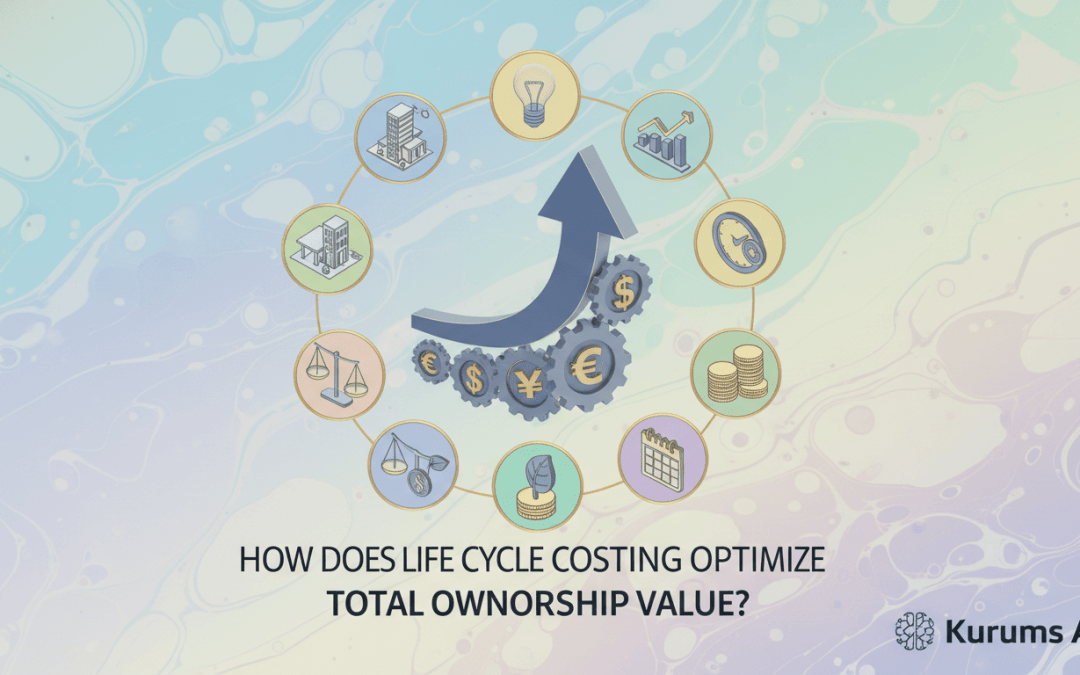
What is Life Cycle Costing (LCC)? It is a financial assessment tool that calculates the total cost of ownership of an asset over its entire life span, including acquisition, operation, maintenance, and disposal.
Why is LCC superior to traditional procurement? Traditional methods focus on the “sticker price,” while LCC reveals hidden costs that often account for 70-80% of the total expenditure, enabling better long-term ROI.
Which industries benefit most from LCC? Manufacturing, construction, aerospace, and IT (specifically data center management) gain the most due to the high operational and maintenance requirements of their assets.
How does LCC impact sustainability? By evaluating the cost of energy consumption and decommissioning, LCC naturally aligns financial goals with environmental sustainability and ESG targets.
In the high-stakes world of corporate finance and capital expenditure (CAPEX), procurement decisions are often made under the shadow of short-term budget constraints. Most executives look at the initial purchase price as the primary metric for success. However, this narrow focus is a financial trap. It’s called the “Iceberg Effect,” where the visible purchase price is just the tip, and the massive operational, maintenance, and disposal costs are lurking beneath the surface, ready to sink your project’s profitability.
Life Cycle Costing (LCC) is the navigational radar that helps C-level executives and procurement managers see through these murky waters. By shifting the perspective from “How much does it cost to buy?” to “How much does it cost to own and operate?”, organizations can unlock massive value. Research indicates that focusing solely on the acquisition price can lead to a 30% decrease in overall project profitability over a ten-year horizon. This article provides a comprehensive deep dive into how LCC optimizes total ownership value and why it is the most critical strategic tool in modern asset management.
1. The Philosophy of Total Ownership: Beyond the Sticker Price
The core philosophy of Life Cycle Costing is that every asset is a long-term commitment, not a one-time transaction. Whether it is a fleet of electric delivery trucks, a new manufacturing line, or a massive data center, the “sticker price” is often the least significant component of the total financial impact. LCC requires a multidisciplinary approach, blending accounting, engineering, and predictive analytics to forecast future cash flows related to an asset.
But why is this shift happening now? In an era of high energy prices and tightening environmental regulations, the operating costs (OPEX) have skyrocketed. An asset that is 10% cheaper to buy but 20% more expensive to power will eventually become a liability rather than an asset. LCC provides the framework to quantify these variables before the contract is signed.
2. The Four Pillars of Life Cycle Costing
To implement LCC effectively, one must understand the four distinct phases that constitute the “life” of an asset. Neglecting any of these pillars will result in an incomplete financial model and potentially disastrous investment decisions.
- Acquisition Costs: This includes the purchase price, taxes, shipping, installation, and initial training. While highly visible, it is often the smallest piece of the puzzle.
- Operating Costs: The daily “fuel” of the asset. This includes energy consumption (electricity, fuel), labor required for operation, and raw materials consumed during the process.
- Maintenance and Repair Costs: This encompasses routine servicing, spare parts, emergency repairs, and the cost of downtime. Predictive maintenance technologies are now helping to forecast these costs more accurately.
- End-of-Life (Decommissioning) Costs: The costs associated with dismantling, recycling, or disposing of the asset, minus any potential salvage or resale value.
The synergy between these four pillars determines the Total Cost of Ownership (TCO). By analyzing these components together, a company might choose a more expensive machine that has lower energy consumption and longer service intervals, resulting in a significantly lower TCO.
3. Phase 1: Deep Dive into Acquisition and Planning
The acquisition phase is where the most critical decisions are made. It is the only phase where the organization has maximum leverage to influence the future costs of the asset. Once an asset is purchased and installed, roughly 70-90% of its future life cycle costs are already “locked in.”
Here is the kicker: Effective LCC starts during the research and development (R&D) or design phase. For instance, in the construction industry, investing in higher-quality insulation during the design phase might increase acquisition costs by 5%, but it could slash energy-related operating costs by 40% over the next 30 years. The goal of the acquisition phase in LCC is not to find the cheapest option, but to specify the requirements that will minimize long-term expenditure.
The Role of Technical Specifications in Cost Control
Detailed technical specifications act as a shield against future costs. By demanding high efficiency, modular components (which are easier to repair), and standardized parts, procurement teams can drastically reduce the “tail” of the asset’s cost curve. This stage requires close collaboration between the finance department and the technical engineering teams.
4. Phase 2: Operating Costs and the Energy Efficiency Factor
Operating costs are often the “silent killers” of profitability. In many heavy industries, the cost of the electricity required to run a motor over its lifetime can be 20 to 50 times its original purchase price. This is why LCC is inherently linked to energy management.
Consider the following comparison between two industrial air compressors: One is a “Standard Model” with a low purchase price, and the other is a “High-Efficiency Variable Speed Drive (VSD) Model.”
| Cost Component (10-Year Period) | Standard Model (Cheap Buy) | High-Efficiency Model (LCC Focused) |
|---|---|---|
| Initial Purchase Price | $45,000 | $65,000 |
| Annual Energy Consumption | $30,000 | $18,000 |
| 10-Year Energy Total | $300,000 | $180,000 |
| Maintenance & Consumables | $25,000 | $15,000 |
| Total Life Cycle Cost (LCC) | $370,000 | $260,000 |
As clearly demonstrated, the high-efficiency model, despite being $20,000 more expensive upfront, saves the organization $110,000 over its useful life. This is the power of LCC: it turns a “cost center” (procurement) into a “profit center.”
5. Phase 3: Maintenance Strategies and Reliability Engineering
Maintenance is where most financial leaks occur. Traditional accounting treats maintenance as a necessary evil, but LCC treats it as a strategic variable. There are three primary maintenance strategies that LCC must evaluate:
- Reactive Maintenance: Fixing things when they break. This has low upfront costs but leads to unpredictable downtime and high emergency repair fees.
- Preventive Maintenance: Scheduled servicing based on time or usage. This reduces the risk of failure but can lead to “over-servicing” and wasted resources.
- Predictive Maintenance (PdM): Using sensors and AI to monitor asset health in real-time. This is the gold standard for LCC because it optimizes the timing of repairs, preventing both failures and unnecessary work.
When calculating LCC, the cost of unplanned downtime must be factored in. For a high-volume manufacturer, one hour of downtime can cost tens of thousands of dollars. An asset that is “cheaper” but has a lower Mean Time Between Failures (MTBF) will quickly become a financial disaster.
6. Phase 4: The Forgotten Frontier — Disposal and Decommissioning
How an asset leaves your balance sheet is just as important as how it entered. Many organizations fail to account for the costs of removing old machinery, hazardous waste disposal, or data destruction for IT assets. Conversely, some assets have a high salvage value that can offset the initial investment.
In the context of modern ESG (Environmental, Social, and Governance) goals, disposal is becoming a massive regulatory risk. Companies are now being held responsible for the “circularity” of their assets. LCC helps quantify the potential fines or recycling costs, ensuring that “Future You” isn’t left with a multi-million dollar cleanup bill.
7. The Financial Mechanics: NPV, IRR, and Payback Period
LCC is not just a concept; it is a mathematical discipline. To compare two different assets with different life spans and cost structures, financial managers use several key formulas:
Net Present Value (NPV) in LCC
Money today is worth more than money tomorrow. Because LCC looks at costs occurring 5, 10, or 20 years into the future, we must use a “discount rate” to bring those future costs back to their value in today’s currency. This allows for a true apples-to-apples comparison between a high-CAPEX/low-OPEX asset and a low-CAPEX/high-OPEX asset.
Internal Rate of Return (IRR)
When an organization invests in a more expensive, high-efficiency asset, they are essentially “investing” the price difference to get future savings. The IRR of that investment should exceed the company’s cost of capital (WACC).
8. Implementing LCC: A Step-by-Step Strategic Framework
Transitioning from price-based procurement to LCC-based asset management requires a shift in organizational culture. It is not enough for the procurement team to want it; the finance and operations teams must also be aligned.
- Identify the Project Scope: Define the “cradle-to-grave” timeline for the asset.
- Gather Data: Collect historical data on similar assets regarding energy consumption, repair frequency, and labor requirements.
- Select a Discount Rate: Determine the organization’s cost of capital to use in NPV calculations.
- Perform Sensitivity Analysis: Test how your LCC model holds up if energy prices double or if the asset’s lifespan is shortened by 20%.
- Standardize Reporting: Use a common LCC template across all departments to ensure consistency in decision-making.
9. LCC in Different Sectors: Case Studies of Success
The application of LCC varies significantly depending on the nature of the industry. However, the underlying goal remains the same: maximizing ownership value.
Manufacturing and Heavy Industry
In manufacturing, LCC is used to justify the purchase of robotics and automation. While the initial investment is high, the reduction in labor costs, waste (scrap), and energy consumption over a 15-year period usually yields a massive ROI. LCC here focuses on “Total Productive Maintenance” (TPM).
Real Estate and Green Building
The construction industry uses LCC to evaluate HVAC systems and building envelopes. A “Passive House” design might cost 15% more to build but reduces heating and cooling costs by 80%. Over 50 years, the LCC of a green building is a fraction of a traditional one.
Information Technology (SaaS vs. On-Premise)
LCC is the primary tool used to decide between cloud-based SaaS and on-premise servers. On-premise has high CAPEX but lower monthly fees, while SaaS has zero CAPEX but perpetual OPEX. LCC reveals the “break-even” point where one becomes more expensive than the other.
10. Overcoming the Barriers to LCC Adoption
If LCC is so effective, why isn’t every company using it? The reality is that several organizational hurdles often stand in the way. Understanding these barriers is the first step to overcoming them.
| Barrier | The Problem | The LCC Solution |
|---|---|---|
| Budget Silos | CAPEX and OPEX budgets are managed by different departments with no incentive to cooperate. | Unified “Total Cost” budgeting where savings in OPEX can justify increases in CAPEX. |
| Data Scarcity | Lack of reliable data on future maintenance or energy costs. | Using industry benchmarks and pilot programs to gather baseline data. |
| Short-termism | Executive bonuses tied to quarterly profits rather than 10-year value. | Linking performance metrics to TCO reduction and long-term asset health. |
| Complexity | LCC calculations require time and specialized knowledge. | Investing in LCC software tools and training for procurement teams. |
11. The Future of LCC: AI and Digital Twins
We are entering a new era of LCC where static spreadsheets are being replaced by dynamic, real-time models. “Digital Twins”—virtual replicas of physical assets—allow companies to run simulations on how an asset will perform over its entire life cycle. By feeding real-world data from IoT sensors into these twins, organizations can predict exactly when an asset will fail and what the most cost-effective maintenance path is.
Artificial Intelligence (AI) can also analyze thousands of vendor quotes and historical maintenance logs to spot patterns that human procurement officers might miss. For example, AI might find that a certain brand of industrial motor consistently fails 15% faster in humid environments, allowing for a more accurate LCC calculation based on geographical location.
12. Risk Mitigation through Life Cycle Costing
LCC is, at its heart, a risk management tool. It protects the organization from the “Tail Risk” of an asset. What happens if environmental taxes on carbon emissions triple in the next five years? A low-CAPEX, high-emission machine becomes a massive financial risk. By including “Carbon Costing” into the LCC model, companies can future-proof their operations against regulatory changes.
13. Strategic Sourcing: Partnering for Life Cycle Value
Finally, LCC changes the relationship between buyers and sellers. Instead of a purely transactional relationship, LCC encourages “Partnership Sourcing.” Many forward-thinking vendors now offer “Performance-Based Contracts” or “Equipment-as-a-Service.” In these models, you don’t buy the machine; you pay for its output (e.g., compressed air, hours of uptime). The vendor, who now bears the maintenance and operating costs, is incentivized to provide the most efficient and reliable equipment possible.
14. Conclusion: Turning Data into Decisive Action
Life Cycle Costing is the difference between a company that survives and a company that thrives. In an increasingly competitive global market, the organizations that master the art of TCO optimization will have leaner operations, higher margins, and more resilient balance sheets. The days of making decisions based on the “sticker price” are over. It is time to dive beneath the surface of the iceberg and uncover the true value of your assets.
Are you ready to stop leaking capital? Start by auditing your top three most expensive assets. Apply an LCC framework to their historical performance and compare it to current market alternatives. The results will likely be the most important financial revelation of your fiscal year. Transform your procurement from a clerical function into a strategic engine of growth today.
Discover more from Kurums | Business Intelligence
Subscribe to get the latest posts sent to your email.