
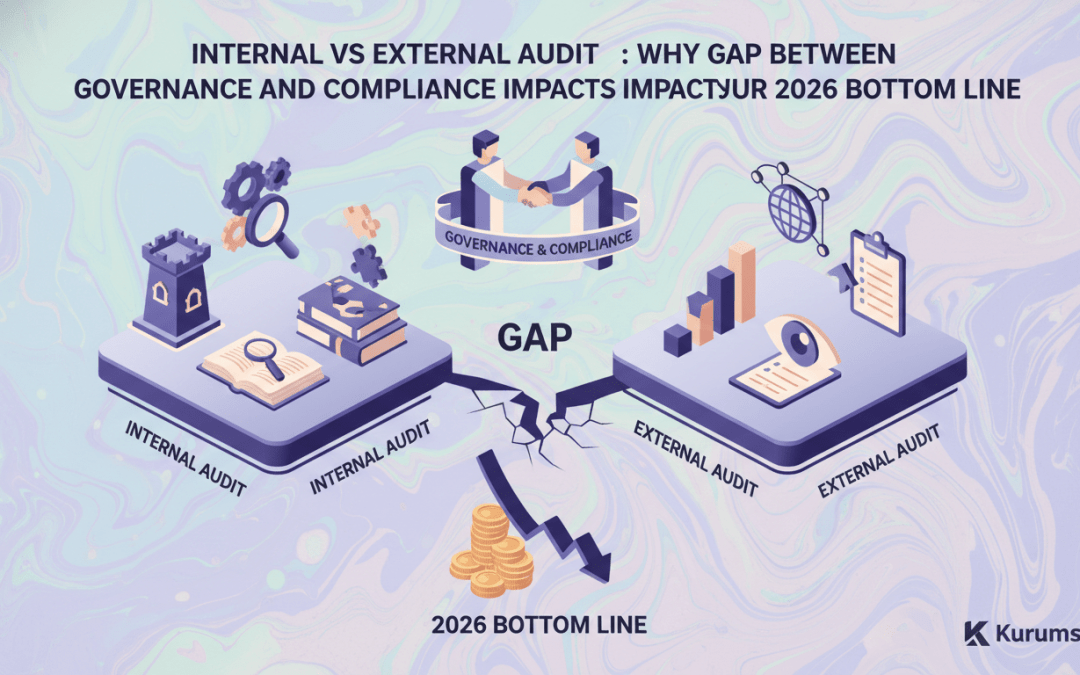
Internal audit is a voluntary, continuous process focused on improving operational efficiency, risk management, and internal controls (Governance). External audit is a mandatory, periodic examination by an independent third party to verify that financial statements represent a true and fair view of the company’s position (Compliance). In the 2026 landscape, the gap between these two determines whether a company merely survives regulatory scrutiny or thrives through operational excellence.
As we navigate the complexities of the 2026 global economy, the distinction between internal and external auditing has moved far beyond simple accounting definitions. Today, it is a matter of strategic survival. Organizations that treat these two functions as “identical boxes to check” often find themselves bleeding capital through operational inefficiencies or facing catastrophic reputational damage during statutory reviews.
But here’s the real kicker: The convergence of AI-driven reporting, ESG (Environmental, Social, and Governance) mandates, and heightened transparency requirements has turned the “audit gap” into a financial metric in its own right. If your internal governance isn’t talking to your external compliance, your bottom line is at risk.
Internal vs External Audit: Why the Gap Between Governance and Compliance Impacts Your 2026 Bottom Line
To understand the future of corporate integrity, we must first dissect the two pillars that support it. Internal and external audits serve different masters, utilize different methodologies, and yield different results. However, their ultimate goal is the same: ensuring the organization’s longevity and trustworthiness.
1. The 2026 Auditing Paradigm: Why Traditional Definitions Are No Longer Enough
In the past, an audit was seen as a retrospective “look back” at what happened last year. By 2026, the paradigm has shifted toward predictive auditing. Internal auditors are no longer just checking receipts; they are analyzing data streams to predict where the next supply chain disruption or cybersecurity breach might occur.
Think about it. An external auditor confirms that you didn’t lose money illegally last year. An internal auditor identifies the process that will prevent you from losing money next year. This distinction is the difference between forensic accounting and strategic foresight.
2. Internal Audit: The Engine of Operational Excellence
Internal audit is an independent, objective assurance and consulting activity designed to add value and improve an organization’s operations. It helps an organization accomplish its objectives by bringing a systematic, disciplined approach to evaluate and improve the effectiveness of risk management, control, and governance processes.
But that’s just the textbook definition. In practice, internal audit acts as the organization’s “nervous system.” It senses pain points in departments ranging from HR to IT and reports them directly to the Board of Directors or the Audit Committee.
Focus Areas of Internal Audit in the Modern Era
- Operational Efficiency: Identifying bottlenecks in production and resource allocation.
- Risk Management: Assessing the impact of geopolitical shifts and market volatility.
- Regulatory Readiness: Ensuring the company is prepared for new laws before they become mandatory.
- Fraud Prevention: Establishing internal controls that make embezzlement or data theft nearly impossible.
- Culture and Ethics: Auditing the “tone at the top” to ensure corporate values are being lived.
3. External Audit: The Pillar of Market Confidence
If internal audit is the internal nervous system, the external audit is the “public stamp of approval.” External auditors are independent firms (like the Big Four) hired to examine the financial records and provide an opinion on whether the financial statements are free from material misstatement.
Why does this matter so much for your 2026 bottom line? Because without a “clean” audit opinion, a company’s cost of capital skyrockets. Investors lose faith, stock prices tumble, and credit lines dry up. In the 2026 market, where transparency is the highest currency, the external audit is the ultimate validator of a company’s financial health.
4. Side-by-Side Comparison: Internal vs. External Audit
To truly grasp the differences, we need to look at the technical nuances. Below is a comprehensive breakdown of how these two functions diverge across key metrics.
| Feature | Internal Audit | External Audit |
|---|---|---|
| Primary Objective | Improve operations and mitigate risk. | Provide an opinion on financial statements. |
| Audience | Board of Directors and Management. | Shareholders, Investors, and Regulators. |
| Scope | Broad (Financial, Operational, Strategic). | Specific (Financial records and internal controls over financial reporting). |
| Frequency | Continuous throughout the year. | Annual or Periodic. |
| Employment | Employees of the organization (or outsourced). | Independent third-party firm. |
| Requirement | Discretionary (though highly recommended). | Mandatory for public companies (Statutory). |
5. The Synergy: How Governance Meets Compliance
You might be wondering: “If they are so different, do they ever work together?” The answer is a resounding yes. In fact, ISA 610 (International Standard on Auditing) specifically addresses how external auditors can use the work of internal auditors.
Here is where the magic happens. When the internal audit team has high standards, rigorous documentation, and independence, the external auditors can rely on their testing of controls. This creates a “single source of truth” that accelerates the audit cycle.
But wait, there’s more. By aligning these two functions, a company avoids the “double-testing” trap where employees are interviewed twice for the same process, wasting hundreds of billable hours. In 2026, efficiency isn’t just a goal; it’s a competitive necessity.
6. The Bottom Line: How Audit Quality Influences Corporate Valuation
Investors in 2026 are more sophisticated than ever. They don’t just look at EBITDA; they look at the Audit Quality Indicators (AQIs). A company with a robust internal audit function is perceived as lower risk. Lower risk equals a lower discount rate applied to future cash flows, which directly increases the company’s valuation.
Let’s break down the financial impact of a “Governance Gap”:
| Scenario | Immediate Cost | Long-term Impact on Bottom Line |
|---|---|---|
| Weak Internal Controls | High external audit fees due to increased testing. | Increased likelihood of fraud and operational waste. |
| External Audit Failure | Regulatory fines and legal fees. | Loss of market capitalization and investor trust. |
| Optimized Synergy | Lower combined audit spend. | Higher stock price multiples and lower cost of debt. |
7. Technological Disruption: AI, Blockchain, and the 2026 Audit
Is the human auditor becoming obsolete? Not exactly, but their role is being fundamentally rewritten. In 2026, Continuous Auditing is the gold standard. Instead of sampling 50 invoices out of 10,000, AI algorithms now scan 100% of transactions in real-time.
For internal auditors, this means they can focus on high-level strategic risks rather than data entry. For external auditors, blockchain technology provides an immutable “audit trail,” making the verification of assets much faster and more secure. If your organization is still using manual spreadsheets for audit preparation, you are already behind the curve.
8. Navigating ESG: The New Frontier of Auditing
By 2026, ESG reporting has become as mandatory as financial reporting in many jurisdictions. Here, the gap between internal and external audit is most visible. Internal audit must ensure the accuracy of carbon footprint data and diversity metrics, while external audit must attest to these figures for the annual report.
If your internal audit team isn’t comfortable with non-financial data, your external ESG assurance will likely fail. This isn’t just about “looking good”—greenwashing penalties in 2026 are severe enough to bankrupt mid-sized firms.
9. The Three Lines of Defense Model: A 2026 Refresh
To manage the gap effectively, organizations must utilize the “Three Lines of Defense” model, which has been updated for the modern risk landscape:
- First Line (Management): Owns the risks and implements controls in daily operations.
- Second Line (Risk & Compliance): Monitors the first line and sets the standards for control.
- Third Line (Internal Audit): Provides independent assurance to the Board that the first and second lines are functioning.
- External (The Fourth Line): External auditors and regulators providing final validation.
The synergy between these lines ensures that nothing falls through the cracks. When the third line (Internal) and the fourth line (External) are misaligned, the “governance gap” widens, leading to the financial leakage we discussed earlier.
10. Common Pitfalls: Why Misaligning Audit Functions Destroys Value
It’s a common story: A company invests heavily in external audit to please the market but ignores its internal audit function. The result? The external auditors find a “Material Weakness” in internal controls. The stock price drops 15% overnight. Why? Because the market interprets a lack of internal audit as a sign of poor management.
11. Preparing for the 2026 Audit Season: A Checklist for CFOs
As we approach the next fiscal cycle, how can you ensure your audit strategy is air-tight? Use the following checklist to bridge the gap between governance and compliance.
- Verify Independence: Ensure the Head of Internal Audit reports directly to the Audit Committee, not the CFO.
- Map the Risks: Align the Internal Audit plan with the top 10 risks identified in the External Audit’s risk assessment.
- Invest in Data Analytics: Move away from sampling and toward full-population testing using AI tools.
- Review ESG Controls: Treat environmental and social data with the same level of rigor as financial data.
- Establish a Clear Communication Protocol: Schedule quarterly meetings between internal and external auditors to share insights.
12. Future-Proofing Your Audit Strategy for 2027 and Beyond
The gap between internal and external audit will continue to narrow as real-time reporting becomes the norm. By 2027, we expect to see “Continuous Assurance” models where the distinction between a periodic audit and daily monitoring almost disappears.
The companies that will dominate the late 2020s are those that view audit not as a cost center, but as a value driver. High-quality internal audits lead to leaner processes, which leads to higher margins. High-quality external audits lead to lower risk premiums, which leads to cheaper capital. It is a virtuous cycle that starts with understanding the fundamental differences between the two.
Conclusion: Integrating Resilience into Your Corporate DNA
In conclusion, the debate of “Internal vs. External Audit” is not an “either/or” proposition. It is a “both/and” necessity. While internal audit builds the fortress from the inside, external audit verifies its strength to the world outside.
The gap between governance and compliance is where risk lives. By bridging this gap through technological integration, strategic alignment, and a culture of transparency, you don’t just protect your 2026 bottom line—sen you elevate it to new heights.
Are you ready to transform your audit function from a compliance burden into a competitive advantage? The time to act is now. Start by conducting a “Gap Analysis” of your current audit functions and ensure that for 2026, your governance is as strong as your compliance.
Ready to Optimize Your 2026 Audit Strategy?
Don’t let the governance gap erode your profit margins. Contact our team of experts today for a comprehensive review of your internal controls and compliance framework. Let’s build a more resilient future together.
Contact us: [email protected]
Discover more from Kurums | Business Intelligence
Subscribe to get the latest posts sent to your email.