
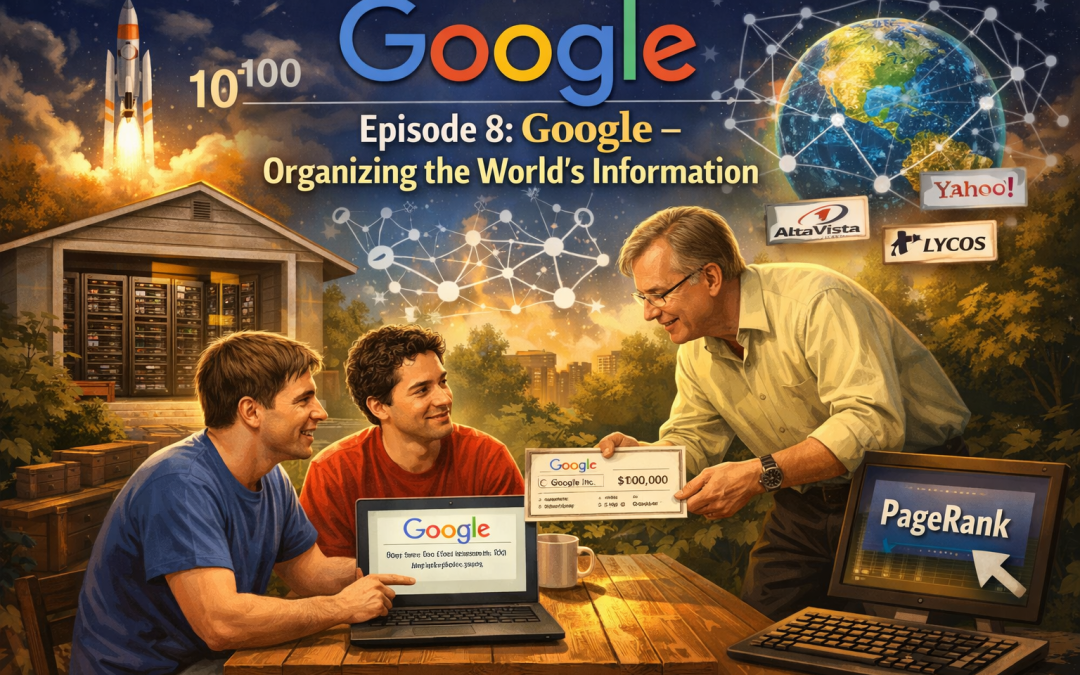
In September 1998, two Stanford graduate students met with Andy Bechtolsheim, co-founder of Sun Microsystems, in the front yard of a faculty member's Palo Alto home. Larry Page and Sergey Brin demonstrated their search engine, which they had been developing as a research project. Bechtolsheim immediately grasped the technology's potential and interrupted the demonstration after a few minutes. "Instead of us discussing all the details, why don't I just write you a check?" He wrote a check for $100,000 made out to "Google Inc."—a company that didn't yet legally exist. Page and Brin deposited the check weeks later after incorporating, using the funds to rent garage space and buy servers. This encounter captured Google's founding dynamic: technically sophisticated product attracting capital from people who understood technology before they fully understood the business model.
Google's name came from a misspelling of "googol," the mathematical term for 10^100, representing the founders' ambition to organize the vast amount of information on the web. This ambition seemed simultaneously grandiose and understated in 1998. Search engines already existed—AltaVista, Yahoo, Excite, Lycos, and others competed for users. The search market appeared crowded and possibly mature. Yet Page and Brin believed that existing search engines fundamentally misunderstood the problem. They weren't organizing information; they were matching keywords. Google would be different, better, and eventually so dominant that "google" would become a verb meaning "to search the internet."
The PageRank Insight: Links as Academic Citations
Larry Page's foundational insight came from thinking about how academics evaluate research papers. A paper's importance isn't determined primarily by its content or keywords but by how many other papers cite it and, crucially, how important those citing papers are themselves. A paper cited by ten highly influential papers is more significant than one cited by hundreds of obscure papers. This recursive quality—importance deriving from being recognized as important by other important sources—seemed applicable to web pages. Links between pages were like citations. Pages linked to by many important pages were probably themselves important.
Page began developing an algorithm to calculate web page importance based on link structure while pursuing his PhD at Stanford in 1996. He called it PageRank, a pun on his own name and the concept of ranking pages. The algorithm crawled the web, built a graph of pages and links, and computed a score for each page based on the quantity and quality of incoming links. Pages with high PageRank scores would rank higher in search results, even if they contained fewer keyword matches than other pages. This approach aligned search results with human intuition about quality and relevance in ways that pure keyword matching didn't.
Sergey Brin, Page's fellow graduate student, contributed mathematical expertise and helped refine the algorithm. Brin's background in data mining and pattern recognition complemented Page's intuition about link structure. Together they built a search engine called BackRub (referring to backlinks) that ran on Stanford's network and consumed enormous computing resources. The university tolerated this because it was research, but the scale of computation required soon exceeded what Stanford could support. Page and Brin needed either to abandon the project or commercialize it.
They initially tried to sell or license PageRank to existing search engines. Yahoo, Excite, and AltaVista all declined, not recognizing the algorithm's superiority or not wanting to depend on external technology for their core capability. These rejections forced Page and Brin to start their own company, an outcome they initially resisted because both wanted to complete their PhDs. However, once they began showing Google to potential investors and users, the enthusiastic response convinced them that commercializing the technology was worth delaying or abandoning academic careers.
The PageRank algorithm had limitations and vulnerabilities that would become apparent later. It could be manipulated through "link farms" that created artificial links to boost page rankings. It struggled with new pages that hadn't accumulated many links. It sometimes favored older, established pages over newer, better content. However, these problems were solvable through algorithmic refinement and additional signals. The core insight—using link structure to infer quality—was sound and gave Google a technical foundation that competitors found difficult to match.
The Minimalist Interface: Less is More
Google's homepage became iconic for what it didn't contain. While Yahoo, Excite, and other portals crammed their homepages with news, weather, stock quotes, directories, and advertising, Google's page featured only a logo, a search box, and two buttons. This minimalism was initially a pragmatic choice—Page and Brin lacked design resources and wanted to launch quickly—but it became a defining feature that users loved and competitors couldn't easily copy because their business models depended on homepage clutter.
The clean interface communicated focus and speed. Users understood immediately that Google did one thing: search. There was no distraction, no cognitive load deciding where to click or what to ignore. The page loaded almost instantly because it contained minimal graphics and code. This speed advantage mattered enormously in an era when most users had dial-up internet connections and page load time determined whether they stayed or left. Google became associated with fast, relevant search while competitors' portal strategies made them slow and cluttered.
The minimalism also reflected Page and Brin's engineering culture and aesthetic preferences. They valued efficiency, simplicity, and user focus over monetization and engagement metrics. The homepage didn't try to keep users on Google; it tried to get them to their desired information as quickly as possible. This approach seemed counterintuitive for a web company—most internet businesses measured success by time users spent on the site—but it built trust and loyalty that proved more valuable than engagement metrics.
The "I'm Feeling Lucky" button demonstrated Google's confidence in search quality and playful approach to design. Clicking it took users directly to the top search result, bypassing the results page entirely. This feature cost Google revenue because it eliminated opportunities for advertising impressions, yet the company kept it for years because it delighted users and reinforced Google's focus on utility over monetization. The button was rarely used but became beloved as a symbol of Google's culture.
However, the minimalist interface also created challenges for monetization. Where would Google display advertisements without cluttering the homepage? How could the company generate revenue from users who spent minimal time on Google properties? These questions didn't have obvious answers in 1998-1999, which contributed to investor skepticism about Google's business model. The company would need to invent advertising formats that maintained the clean interface while generating sufficient revenue—a design challenge that proved more difficult than building the search algorithm.
The Scaling Challenge: Engineering the Infrastructure
Google's early technical history was dominated by the challenge of crawling, indexing, and searching the entire web with limited capital and computing resources. The web in the late 1990s contained hundreds of millions of pages growing to billions. Downloading every page, processing the content, building indexes, computing PageRank, and serving search results required computational scale that exceeded what commercial servers could economically provide. Google needed to build infrastructure that could scale to web-size problems without consuming venture-capital financing as quickly as it arrived.
Page and Brin's solution was building their own server infrastructure from commodity components. Rather than purchasing expensive commercial servers from Sun or HP, Google bought cheap PC components, assembled them into basic servers, and built reliability through redundancy rather than component quality. Individual servers failed constantly, but Google's software detected failures and routed around them. This approach allowed building massive computing capacity for a fraction of what commercial servers would cost, though it required sophisticated engineering to manage thousands of unreliable machines reliably.
The infrastructure approach became a core competency that gave Google competitive advantages for decades. While competitors relied on commercial data center equipment, Google built custom servers, networking equipment, and eventually custom processors optimized for specific workloads. This vertical integration allowed optimizing the entire stack from algorithms to hardware, extracting performance and efficiency that competitors using commercial components couldn't match. Infrastructure engineering became as important to Google's success as search algorithms.
The crawling process raised ethical and technical questions. Google's crawlers consumed bandwidth and server resources from websites they indexed, sometimes creating problems for smaller sites that couldn't handle the traffic. The company needed to crawl respectfully—honoring robots.txt files that indicated crawling preferences, limiting crawl rates to avoid overwhelming servers—while still indexing the web comprehensively and keeping the index fresh. Balancing these competing goals required both technical solutions and community relationships with webmasters.
The index freshness problem became increasingly important as the web grew more dynamic. Early web pages were mostly static documents that changed infrequently, making it acceptable for Google's index to be days or weeks old. As blogs, news sites, and social media emerged, users expected search results to include recent content. Google needed to crawl continuously and update the index in near-real-time, requiring additional infrastructure investment and algorithmic sophistication. The company's ability to solve this scaling challenge faster than competitors maintained Google's quality advantage as the web evolved.
The Business Model Mystery: Making Money from Free Search
Through 1999 and into 2000, Google had a product that users loved, traffic that grew exponentially, and no clear business model that could generate profits comparable to the company's valuation and ambitions. The founders and early investors believed that organizing the world's information was valuable and that value would translate into revenue somehow, but the specific mechanism remained unclear. This uncertainty was acceptable during the dot-com boom when investors prioritized growth over profitability, but it created existential questions about Google's sustainability.
The initial monetization attempts were conventional and uninspiring. Google licensed its search technology to portals including Yahoo, generating modest revenue from technology licensing. The company displayed banner advertisements on search results pages, though these ads were infrequent and unobtrusive to avoid cluttering the interface. Neither approach generated revenue sufficient to support Google's growth or justify its valuation. The company was burning through venture capital funding while searching for a sustainable business model.
The breakthrough came from studying GoTo.com (later Overture), which had pioneered paid search advertising where advertisers bid to have their listings appear next to search results for specific keywords. GoTo's approach had problems—paid results were mixed with organic results in ways that users found confusing or misleading—but the core insight was sound. People searching for specific keywords were expressing intent and interest, making them valuable audiences for relevant advertising. If Google could display ads next to search results in ways that were clearly labeled and useful rather than deceptive, paid search could generate substantial revenue.
Google launched AdWords in October 2000, initially as a simple system where advertisers paid fixed amounts for keyword positions. This version generated revenue but had limited growth potential because Google controlled pricing rather than letting market demand set prices. In 2002, Google adopted an auction model where advertisers bid for keywords, but with a crucial innovation: ad position depended on both bid amount and ad quality, measured by click-through rate. This quality component meant that relevant, useful ads could achieve good positions even with lower bids, aligning Google's incentives with user experience.
The AdWords auction model proved spectacularly successful. It generated revenue that scaled with search traffic while maintaining user experience that made Google's search valuable. Advertisers achieved measurable returns because they paid only for clicks, not impressions, making the spending trackable and justifiable. Small businesses could advertise economically because the self-service platform had low minimum spending and provided precise targeting. Within a few years, AdWords was generating billions in annual revenue at extraordinarily high margins, transforming Google from a promising startup into one of the most profitable companies in history.
The IPO and "Don't Be Evil": Idealism Meets Reality
Google's August 2004 IPO was both conventional in outcome—raising $1.67 billion and valuing the company at $23 billion—and unconventional in process and messaging. The founders insisted on a Dutch auction mechanism rather than traditional bookbuilding, aiming to reduce investment bank influence and allow broader participation. They published a "Founder's Letter" articulating Google's values and long-term focus, warning potential investors that Google would make decisions based on principles rather than short-term stock price. They implemented a dual-class share structure that gave founders voting control, protecting against shareholder pressure that might compromise Google's mission.
The "Don't Be Evil" motto, adopted internally years earlier, became public during the IPO and represented Google's claim to ethical leadership in technology business. The phrase was deliberately ambiguous—evil wasn't defined—but it communicated that Google would consider more than profit maximization in decision-making. The company would protect user privacy, maintain search quality over advertising revenue, and generally try to deserve trust. Critics immediately noted the hubris in claiming special moral status and questioned whether any large corporation could avoid evil while pursuing profit. Google's response was essentially that trying to be good was better than not trying.
The IPO enriched founders, early employees, and investors enormously. Page and Brin each held stock worth over $3 billion immediately post-IPO. Early employees who received stock options became millionaires. This wealth creation demonstrated again, as Netscape's IPO had nine years earlier, that technology startups could generate life-changing returns quickly. However, Google's IPO was different in crucial ways: the company was profitable, growing rapidly, and had a proven business model. Google wasn't a speculative bet on future monetization but a successful business going public to provide liquidity and raise growth capital.
The dual-class share structure proved controversial and prescient. It protected Google from short-term shareholder pressure and allowed the founders to make long-term bets including acquisitions, infrastructure investments, and experimental projects that might not generate immediate returns. This structure became standard for technology IPOs in subsequent years, with Facebook, Snap, and others implementing similar arrangements. However, it also insulated management from accountability and allowed founders to control companies long after their founding vision might have become outdated or problematic.
The IPO marked Google's transition from scrappy startup to establishment technology company. The company had responsibilities to public shareholders, regulatory scrutiny from securities regulators, and visibility that attracted criticism from competitors, civil society organizations, and governments. The early informal culture necessarily evolved toward more structured management, HR policies, and governance. This maturation was inevitable and necessary, but it created tension with Google's self-image as a different kind of company that could maintain startup innovation culture at enterprise scale.
The Acquisitions: YouTube, Android, and Platform Expansion
Google's acquisition strategy demonstrated the company's willingness to pay enormous sums for strategic assets that extended its platform and protected against potential threats. The two most significant acquisitions were YouTube ($1.65 billion in 2006) and Android (estimated $50 million in 2005), purchases that seemed expensive initially but proved extraordinarily valuable. These acquisitions reflected Google's recognition that search alone, however profitable, was vulnerable to platform shifts and that maintaining dominance required controlling multiple internet access points.
The YouTube acquisition was controversial internally and externally. YouTube was hemorrhaging money, serving billions of video streams monthly with massive bandwidth costs and uncertain monetization. The site was flooded with copyrighted content uploaded without authorization, creating legal liability. Many observers considered the acquisition price insane for a company with no clear path to profitability and substantial legal risks. However, Google recognized that video was becoming central to internet experience and that YouTube had achieved network effects that would be difficult to replicate. User-generated content and community made YouTube more than a technology platform.
Google's stewardship of YouTube proved patient and eventually successful. The company absorbed years of losses while building advertising systems, content management tools, and partnerships with media companies. YouTube became profitable in the 2010s and grew into one of the most valuable internet properties, with billions of users and tens of billions in annual revenue. The acquisition demonstrated Google's ability to sustain losses on strategic assets while building business models that might take years to mature. Few companies had the financial resources and patience to take this approach.
The Android acquisition was smaller financially but equally strategic. Andy Rubin had founded Android Inc. to develop an operating system for mobile devices. Google acquired the company and its team, recognizing that mobile internet access was growing rapidly and that controlling a mobile operating system could prevent competitors from controlling Google's access to users. This defensive motivation proved prescient—Apple's iOS and potential dominance in mobile threatened to replicate Microsoft's desktop dominance in a new platform. Google needed an alternative.
Google made Android open source and offered it free to device manufacturers, creating an alliance against Apple's closed iOS ecosystem. The strategy worked spectacularly: Android became the world's most widely used operating system, running on billions of devices globally. Google didn't profit from Android directly through licensing but maintained control over search and other services on Android devices, protecting its core business. The acquisition's return on investment was incalculable—Android prevented platform foreclosure that could have destroyed Google's mobile business.
The Expansion Empire: From Search to Everything
Through the 2000s and 2010s, Google expanded from pure search engine into a sprawling technology conglomerate offering services including email (Gmail), maps (Google Maps), office productivity (Google Docs), video (YouTube), mobile operating system (Android), web browser (Chrome), cloud computing (Google Cloud Platform), and countless other products. This expansion reflected ambition to organize all information, defensive concerns about dependency on any single product, and abundant cash flow from advertising that needed investment outlets.
Gmail, launched in 2004, revolutionized web-based email by offering 1 gigabyte of storage when competitors provided 2-4 megabytes. This 250x storage increase seemed impossible but was economically viable because Google's infrastructure investments had driven storage costs far below what competitors paid. Gmail also introduced conversation threading, powerful search, and innovative interface design. The service grew to over a billion users and became essential infrastructure for personal and business communication. Gmail's dominance in email gave Google additional data about user interests and behavior that improved ad targeting.
Google Maps, launched in 2005, combined mapping data, satellite imagery, and eventually Street View photography to create the definitive online mapping service. The product was initially purely informational but evolved to include turn-by-turn navigation, real-time traffic, and business listings. Maps became essential infrastructure for location-based services and mobile applications, creating another platform that Google controlled. The mapping investment required hundreds of millions in data acquisition and processing but created competitive moats that competitors struggled to cross.
Chrome browser, launched in 2008, represented Google's response to dependence on browsers it didn't control. If Internet Explorer or Firefox deteriorated or implemented features contrary to Google's interests, Google's business would suffer despite having no control over browser development. Chrome guaranteed that Google would have a modern, fast browser supporting web standards that enabled sophisticated web applications. Chrome's success—it became the dominant browser within a few years—gave Google influence over web standards and ensured that the web remained open rather than fragmenting into proprietary platforms.
The expansion strategy created both value and problems. Google's services were often technically superior and free, benefiting users while destroying competitors' businesses. Gmail undermined commercial email providers. Maps destroyed standalone GPS device businesses. Chrome weakened Mozilla's financial sustainability. Google's expansion raised questions about whether any company should control so much internet infrastructure and whether free services created dependencies that would eventually be exploited. These concerns presaged regulatory scrutiny that intensified in the 2010s.
The Algorithm Wars: SEO, Spam, and Search Quality
As Google became the dominant search engine, manipulating search rankings became a lucrative business. Search engine optimization (SEO) practitioners studied Google's algorithms and exploited weaknesses to boost client rankings regardless of content quality. Black-hat SEO techniques included keyword stuffing, hidden text, link farms, and content scraping—all designed to trick algorithms into ranking pages higher than their genuine relevance justified. This adversarial relationship between Google and SEO practitioners became a constant battle as Google improved algorithms to resist manipulation and SEO adapted to new algorithms.
Google's response combined algorithmic improvements and manual penalties. Major algorithm updates including Florida (2003), Panda (2011), and Penguin (2012) targeted specific manipulation tactics and substantially changed search rankings. Sites that relied on SEO manipulation saw traffic collapse overnight as these updates rolled out. Google's webspam team manually reviewed and penalized sites that violated guidelines. The company published webmaster guidelines explaining what was acceptable, though the guidelines remained somewhat vague to prevent complete algorithm reverse-engineering.
The algorithm updates created controversy because legitimate sites sometimes suffered alongside spam sites. Small businesses that depended on Google traffic found themselves suddenly invisible in search results after updates, sometimes without understanding what they did wrong or how to recover. Google's opacity about algorithm specifics—necessary to prevent manipulation—made it difficult for site owners to distinguish between legitimate optimization and manipulation. The company faced criticism for arbitrary power over businesses that depended on Google traffic for survival.
The tension between search quality and business interests created difficult decisions. Certain queries generated more advertising revenue than others, creating incentives to show ads for commercial queries even when organic results would serve users better. Google needed to balance maximizing advertising revenue with maintaining search quality that kept users loyal. The company generally prioritized quality, reasoning that long-term user loyalty was more valuable than short-term revenue, but the temptation to compromise quality for revenue was constant.
The spam battle never ended but rather evolved into ongoing competition between Google's machine learning systems and increasingly sophisticated manipulation attempts. As Google's algorithms became more sophisticated, incorporating machine learning and understanding semantic meaning rather than just keywords, SEO practitioners adapted by creating more sophisticated content and link patterns. The adversarial relationship drove innovation on both sides and kept Google investing heavily in search quality even as the core search business matured.
The Privacy Paradox: Organizing Information About You
Google's business model depended fundamentally on collecting and analyzing user data to target advertising. The company tracked search queries, email content, location, browsing history, and countless other signals to build profiles of user interests and intent. This data collection enabled the advertising targeting that made AdWords profitable, but it also created privacy concerns that intensified as Google's reach expanded and data collection became more comprehensive. Google faced the essential paradox of surveillance capitalism: value came from knowing users intimately, but users increasingly objected to intimate surveillance.
Google's initial approach to privacy emphasized anonymization and security rather than data minimization. The company argued that collecting data served users by improving product quality—better search results, more relevant ads, smarter assistants. Google secured data carefully to prevent breaches and employee access abuses. The company generally didn't sell raw data to third parties but rather sold advertising that used data for targeting while keeping the data itself private. This approach seemed reasonable to Google but felt inadequate to privacy advocates who argued that collection itself was problematic regardless of security.
The Street View controversy illustrated privacy tensions. Google's cars photographing streets for Maps inadvertently captured wifi network data and sometimes photographed people in sensitive situations. Privacy advocates and some governments saw this as surveillance overreach and potential security risk. Google argued that photographing public streets was legal and served legitimate mapping purposes. The company eventually face substantial fines and regulatory restrictions, learning that legal permission didn't equal social acceptance and that Google's scale made activities that might be tolerated from smaller actors feel threatening.
Gmail's content scanning to target ads created particular controversy. Google's systems scanned email content to understand user interests and serve relevant ads. The company emphasized that scanning was automated with no human access to email content, but critics argued that reading email content for any purpose violated privacy expectations. Google eventually discontinued ad targeting based on email content in 2017, partly due to privacy criticism and partly because the company had other data sources that made email scanning unnecessary. The decision illustrated how privacy concerns could force business model adjustments even for highly profitable practices.
The European Union's General Data Protection Regulation (GDPR) and California's Consumer Privacy Act represented regulatory responses to privacy concerns that affected Google substantially. These laws required transparency about data collection, user consent for certain processing, and rights to access and delete personal data. Compliance required significant engineering work and process changes. The regulations also created precedent that data collection wasn't unlimited and that user rights to privacy could constrain technology business models. Google adapted to comply while lobbying to limit regulatory scope.
The China Question: Values Versus Markets
Google's approach to China represented the most visible test of the company's "Don't Be Evil" values. China offered an enormous potential market—hundreds of millions of internet users growing to over a billion—but the Chinese government required censorship of search results for politically sensitive topics. Google faced a choice: accept censorship to access the Chinese market or refuse and forfeit potential revenue and users. The decision became a defining moment for Google's claimed commitment to free information access.
Google initially chose to enter China with a censored search engine (Google.cn) launched in 2006. The company's justification was that providing limited information access was better than providing no access. Chinese users would get Google's search quality even if certain topics were censored. Google would disclose when results were censored, maintaining transparency about limitations. This compromise allowed Google to compete in China against domestic search engine Baidu while acknowledging that the company couldn't operate in China exactly as it did elsewhere.
The compromise satisfied no one. Chinese authorities restricted Google's operations and advantages, ensuring that Baidu maintained dominance. Human rights organizations criticized Google for enabling censorship and legitimizing government control of information. Google's claimed ethical leadership seemed hollow when the company prioritized market access over principles. Internally, many Google employees felt uncomfortable supporting censorship, creating cultural tension. The Chinese operation never achieved the market share or profitability that might have justified the ethical compromise.
The situation escalated in 2010 when Google revealed that Chinese-origin cyberattacks had targeted Gmail accounts of human rights activists and attempted to steal intellectual property. Google's response was extraordinary: the company announced it would stop censoring search results in China and might withdraw entirely rather than comply with Chinese censorship requirements. In March 2010, Google redirected Google.cn to its Hong Kong search engine, which wasn't censored. Chinese authorities blocked access, effectively ending Google's presence in mainland China.
The China withdrawal was portrayed as principled stand and celebrated by many observers, but it also reflected practical reality that Google wasn't succeeding in China anyway. Baidu had over 70% market share, and Chinese government restrictions ensured Google couldn't compete effectively. The principled exit allowed Google to claim ethical high ground while acknowledging business failure. The decision demonstrated that Google's values had limits—the company would accept censorship if it led to commercial success but would exit when censorship combined with business failure made the ethical compromise unjustifiable.
The Reorganization: Alphabet and Corporate Structure
In August 2015, Google announced a major corporate reorganization creating Alphabet Inc. as a parent company with Google as a subsidiary alongside other experimental businesses. The restructuring separated Google's core profitable businesses (search, ads, YouTube, Android) from speculative ventures (self-driving cars, life sciences, venture capital, experimental technologies). Larry Page and Sergey Brin became Alphabet's CEO and President respectively, while Sundar Pichai became Google's CEO. The reorganization aimed to provide transparency about profitability, enable different cultures for mature versus experimental businesses, and prepare for eventual founder transition.
The "Other Bets" category—Alphabet businesses outside core Google—consumed billions in annual losses pursuing ambitious long-term projects. Waymo developed self-driving car technology. Verily pursued life sciences and healthcare. Loon attempted to provide internet access via high-altitude balloons. Wing developed delivery drones. X served as a "moonshot factory" exploring radical technology ideas. These projects represented Page and Brin's vision that the company should tackle ambitious problems beyond internet services, using Google's profits to fund technology development that might not succeed but could be transformative if it did.
Most Other Bets remained unprofitable or were discontinued after failing to find viable business models. Google Fiber, which attempted to provide municipal broadband, proved economically unsustainable and was dramatically scaled back. Many X projects were terminated after determining technical feasibility or market viability was insufficient. The few successes, particularly Waymo, validated the approach of sustained investment in speculative technology but didn't generate profits that justified the aggregate Other Bets losses. The portfolio approach to innovation consumed shareholder capital while providing intellectual satisfaction and occasional breakthroughs.
The reorganization also reflected the founders' desire to maintain influence while reducing operational responsibilities. Page and Brin were brilliant technologists but lacked interest in operational details or public company management. Moving to Alphabet's board level allowed them to focus on strategy and new initiatives while delegating Google's operations to Pichai. This structure worked reasonably well for several years but created confusion about ultimate accountability and decision authority. When Page and Brin fully departed active roles in 2019, Alphabet effectively became Google again, raising questions about whether the reorganization had achieved lasting structural benefit.
The Antitrust Reckoning: Too Successful for Its Own Good
By the late 2010s, Google faced increasing antitrust scrutiny in Europe, the United States, and globally. The European Commission fined Google over $9 billion across three cases involving Android bundling, shopping comparison services, and advertising practices. U.S. federal and state governments filed antitrust lawsuits challenging Google's search and advertising dominance. These actions reflected growing concern that Google had achieved monopoly power in multiple markets and used that power to foreclose competition and harm consumers despite providing superficially free services.
The search antitrust case focused on Google's agreements with device manufacturers and browser developers to be the default search engine. Google paid Apple an estimated $15-20 billion annually to be the default search in Safari, and paid substantial sums to Mozilla and Android manufacturers for similar default positions. Antitrust authorities argued that these payments foreclosed competition by preventing rival search engines from accessing users. Google responded that users could easily change defaults and that Google's payments reflected the value its search quality provided to partners and users.
The advertising antitrust cases alleged that Google used control over multiple parts of the advertising technology stack to favor its own services and charge supracompetitive fees. Google owned the leading tools for both advertisers buying ads and publishers selling ad space, plus the exchange where ads were traded. This vertical integration across the advertising value chain created conflicts of interest and enabled Google to disadvantage competitors. Google argued that the integrated stack provided efficiency and better outcomes for advertisers and publishers than fragmented alternatives.
The antitrust cases revealed tension between traditional competition law and digital platform economics. Google's services were free to users, making it difficult to argue that consumers were harmed by higher prices. Network effects and data advantages created natural tendencies toward dominance that might not reflect anticompetitive conduct. The relevant market definitions were disputed—was Google competing in "general search," "online advertising," or broader "attention economy"? These questions lacked clear answers, making antitrust analysis complex and outcomes uncertain.
The ultimate regulatory outcome remained unresolved as of the mid-2020s, but the scrutiny itself represented a shift. For two decades, Google had operated with minimal regulatory constraint, building dominant positions across multiple markets. The company's early "Don't Be Evil" positioning and general user satisfaction had provided social license that delayed regulatory intervention. As Google's power became undeniable and concerns about platform dominance intensified, that license eroded. Google would remain enormously profitable and powerful but faced constraints and potential structural remedies that could fundamentally reshape the business.
Conclusion: The Search for What Comes Next
Google's journey from graduate research project to one of the world's most valuable companies demonstrated that enormous businesses could be built on organizing information that others created, provided the organization was sufficiently superior. PageRank's insight about using link structure to infer quality gave Google a technical foundation that sustained two decades of dominance despite continuous competition. The advertising model that emerged almost accidentally proved to be one of the most profitable business models in history, generating over $200 billion in annual revenue by the 2020s.
The company's expansion beyond search into mobile, video, cloud computing, and countless other markets reflected both ambition and anxiety. Google succeeded in search so thoroughly that the business seemed mature, with limited growth potential as internet penetration saturated. The company needed new growth engines and needed to protect against platform shifts that could marginalize search. Some expansions succeeded spectacularly (Android, YouTube), others failed entirely (Google+, countless discontinued products), and many remained expensive experiments with uncertain futures.
The original mission—organizing the world's information and making it universally accessible—remained incomplete and perhaps impossible. Information continued proliferating faster than Google could organize it. Misinformation and intentional manipulation challenged the assumption that organizing information served truth. Privacy concerns and regulatory constraints limited how Google could collect and use information. The mission inspired the company's founding and justified its expansion, but achieving it fully required solving not just technical problems but social and political challenges that no algorithm could address.
Larry Page and Sergey Brin's departure from active management in 2019 marked generational transition from founders to professional management. Sundar Pichai, who led Google and then Alphabet, brought operational discipline and stakeholder management that the founders lacked. However, Pichai also represented a shift from visionary technology leadership toward optimizing existing businesses and managing regulatory relationships. Whether Google under Pichai's leadership would maintain innovation culture or gradually become a mature cash cow optimizing search and advertising was an open question that would determine the company's long-term trajectory.
Google's most enduring contribution may be demonstrating that internet platforms operating at global scale with minimal marginal costs could generate unprecedented profits while providing ostensibly free services. This model inspired countless imitators and shaped modern internet economics. Whether the model serves society well—concentrating wealth and power while surveilling users and manipulating behavior—remained deeply contested. Google organized the world's information, but the price of that organization was letting Google know everything about everyone. That bargain defined the internet age, for better and worse.
Discover more from Kurums | Business Intelligence
Subscribe to get the latest posts sent to your email.