
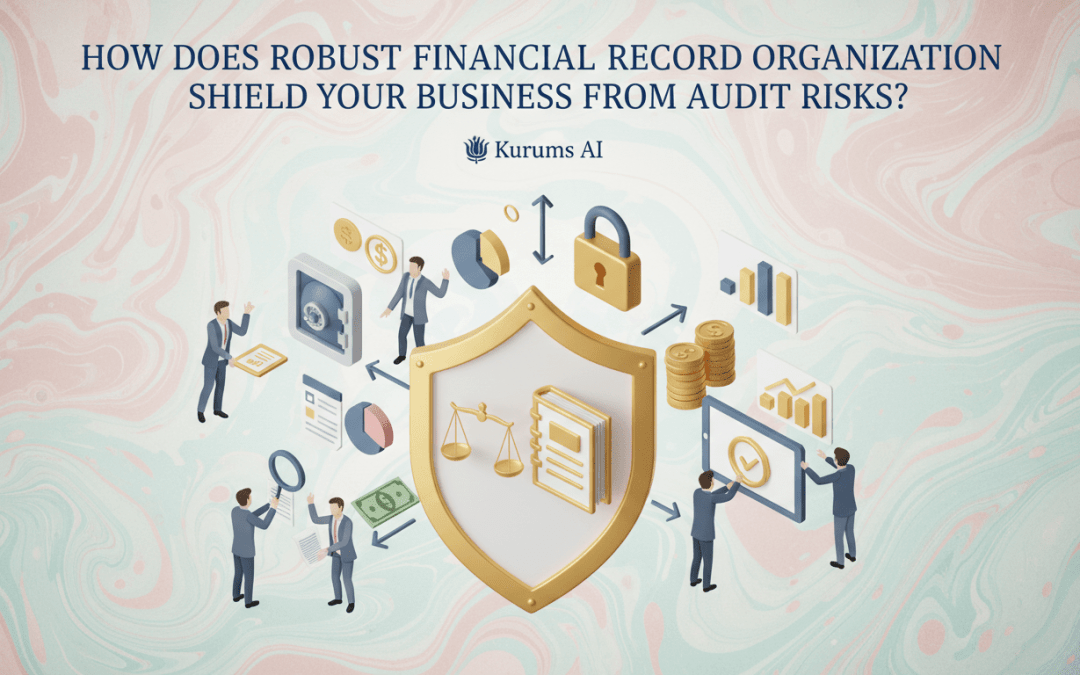
Key Takeaway: An audit is not a threat to a well-organized business; it is merely a validation of its operational excellence.
Financial chaos is the silent killer of corporate scalability. When a CFO cannot retrieve a specific ledger entry or a tax inspector questions a missing depreciation schedule, the cost is not just time—it is a direct hit to the firm’s credibility and bottom line. In an era where regulatory scrutiny is at an all-time high, the ability to produce verifiable, accurate, and timestamped financial data is no longer a luxury; it is a survival requirement. This deep dive explores how a “bulletproof” record-keeping architecture transforms financial data from a liability into a strategic shield.
1. The Strategic Link Between Record Organization and Corporate Governance
Structured documentation serves as the single source of truth for all corporate transactions, ensuring that every capital expenditure is traceable and compliant with international standards like IFRS or GAAP. But why does this matter for governance? Governance is about accountability. Without a rigorous trail of records, accountability vanishes, leaving the board of directors and executive leadership vulnerable to litigation and regulatory fines.
Think about it this way: An organization’s financial records are its “DNA.” If the DNA is fragmented or corrupted, the entire organism fails. By implementing a systematic approach to document management, companies establish a framework where transparency is the default state. This transparency reduces the “information asymmetry” that often leads to internal fraud or external skepticism from investors and auditors alike.
2. The Anatomy of a Bulletproof Filing System: Functional Categorization
Most businesses fail at organization because they categorize by “date” or “vendor” alone. While these are useful, a truly robust system uses Functional Categorization. This means organizing records based on their business purpose and their impact on the financial statements. This approach allows for rapid retrieval during specific types of audits, such as VAT inspections or payroll audits.
But it doesn’t stop there. A functional system must be hierarchical. At the top level, you have broad categories like “Accounts Payable,” “Accounts Receivable,” “Taxation,” and “Equity Documentation.” Below these, you drill down into specific fiscal years, quarters, and then individual transaction types. This “Drill-Down” architecture is what separates a professional treasury department from a chaotic one.
- Source Documents: Invoices, receipts, and deposit slips must be linked to specific bank statement lines.
- Journal Entries: Every manual adjustment must have a signed authorization document attached.
- Contracts and Agreements: Lease agreements, loan documents, and long-term service contracts should be stored in a “Permanent File.”
- Personnel Records: Payroll tax filings and employee benefit records require specialized privacy-focused folders.
3. Digital Archiving vs. Physical Storage: A Comparative Analysis
The transition from paper-heavy offices to digital-first environments is a cornerstone of modern audit defense. However, simply scanning a document and saving it as “Scan_001.pdf” is not digital archiving; it is digital clutter. True digital archiving involves OCR (Optical Character Recognition), metadata tagging, and immutable storage formats.
Here is the bottom line: Digital records are easier to search, cheaper to store, and significantly more secure than physical folders—provided they are managed correctly. In the table below, we compare the two methods across critical audit-risk metrics.
| Metric | Physical Storage | Digital Archiving (Cloud/ERP) |
|---|---|---|
| Retrieval Speed | Hours to Days | Seconds (Keyword Search) |
| Audit Trail | Limited (Manual Logs) | Comprehensive (User Logs/Timestamps) |
| Storage Cost | High (Office space/Offsite units) | Low (SaaS subscription/Cloud storage) |
| Disaster Recovery | Near Zero (Fire/Flood risk) | High (Multi-region redundancy) |
| Security | Locks & Keys (Easily bypassed) | Encryption & MFA (Military grade) |
4. Implementing Immutable Digital Archiving and “Write Once, Read Many” (WORM) Standards
What happens if a disgruntled employee deletes a year’s worth of financial data? Or what if a ransomware attack encrypts your server? This is where Immutable Archiving becomes your business’s ultimate shield. Using WORM-compliant storage ensures that once a financial record is committed to the archive, it cannot be edited, deleted, or overwritten for a set period.
Compliance with regulations like SEC Rule 17a-4 or the Sarbanes-Oxley Act (SOX) often requires this level of data integrity. Auditors love WORM storage because it proves that the records they are reviewing have not been tampered with post-facto to hide discrepancies or financial mismanagement. It provides an “unbroken chain of custody” for your data.
5. Redundant Backup Protocols: The 3-2-1 Rule for Financial Data
Data loss is a primary cause of audit failure. If you cannot produce the records requested, the auditor may issue a “disclaimer of opinion” or assume the worst-case scenario for tax liabilities. To prevent this, every firm must follow the 3-2-1 Backup Strategy.
Let’s break it down: You should have at least three copies of your data, stored on two different types of media, with at least one copy kept offsite (or in a separate cloud region). For financial records, this might look like your primary ERP database, a local server backup, and an encrypted cloud archive. This redundancy ensures that even in the event of a catastrophic regional failure, your financial history remains intact and accessible.
6. How Organization Accelerates Audit Readiness and Reduces Costs
Audit fees are often tied to the “billable hours” spent by the accounting firm. If an auditor spends 40 hours just trying to find missing invoices, your bill will skyrocket. Conversely, an organized digital repository allows you to grant “read-only” access to the auditor, letting them pull the data they need without constant hand-holding from your internal staff.
Furthermore, organization reduces Audit Risk Premiums. When insurance companies or lenders see a meticulously organized financial history, they perceive the business as “lower risk,” which can lead to better interest rates and lower insurance premiums. In essence, your filing system is a financial asset that yields tangible ROI.
7. Internal Controls and the Prevention of Financial Malfeasance
A structured record system is the most effective deterrent against internal fraud. When employees know that every expense report, vendor payment, and journal entry is recorded in a transparent, searchable, and cross-referenced system, the “opportunity” leg of the fraud triangle is significantly weakened.
Modern record-keeping software allows for Segregation of Duties (SoD). For example, the person who records an invoice cannot be the same person who authorizes the payment, and the digital record will show an immutable log of who did what and when. During an audit, showing these internal controls via your documentation process is the fastest way to build trust with the regulatory body.
- Approval Workflows: Digital timestamps on every approval stage.
- Vendor Verification: Documentation showing the vetting process for new suppliers.
- Bank Reconciliation: Monthly records proving that the ledger matches the bank reality.
- Access Logs: Proof of who accessed sensitive financial folders in the last 12 months.
8. The Legal Retention Period: Knowing What to Keep and When to Purge
One common mistake is keeping everything forever. This creates “data bloat” and can actually increase legal risk, as old, irrelevant documents may be used against the firm in discovery phases of litigation. You must establish a Record Retention Policy (RRP) that aligns with the statutes of limitations in your jurisdiction.
Generally, tax records are kept for 7 years, while corporate charters and board minutes are kept permanently. In the table below, we outline a standard retention schedule for corporate financial records.
| Document Type | Retention Period | Reasoning |
|---|---|---|
| Income Tax Returns & Workpapers | 7 Years | Statute of limitations for IRS/Tax audits. |
| Bank Statements & Canceled Checks | 7 Years | Substantiation of business expenses. |
| Employment Tax Records | 4 Years (after tax due) | Specific labor law requirements. |
| Financial Statements (Year-End) | Permanently | Historical performance and valuation. |
| Contracts and Leases (Expired) | 7 Years | Protection against breach of contract claims. |
9. Leveraging AI and Machine Learning for Automated Document Sorting
We are entering the era of Autonomous Finance. Modern ERP systems now use machine learning to “read” an invoice, extract the data, categorize it under the correct General Ledger (GL) code, and file it in the appropriate digital folder—all without human intervention. This doesn’t just save time; it eliminates the human error that leads to audit flags.
But it doesn’t stop there. AI can also perform “anomaly detection.” It can scan your records and flag an invoice that looks suspicious or a ledger entry that deviates from historical norms. By catching these issues internally before an auditor finds them, you can correct the records and maintain your firm’s integrity profile.
10. Cybersecurity: Shielding Financial Records from Digital Theft
A record organization system is only as strong as its security. Financial records contain sensitive PII (Personally Identifiable Information) and trade secrets. If an auditor’s access portal is breached, the company could face massive GDPR or CCPA fines in addition to the audit risks.
Implementing Zero Trust Architecture for financial data is the gold standard. This means that every access request must be verified, regardless of whether it comes from inside or outside the company network. Combined with end-to-end encryption, this ensures that even if data is intercepted, it remains unreadable to unauthorized parties.
11. Developing an Internal Audit Culture: The Human Element
No software can fix a broken culture. If your staff views record-keeping as a “chore” rather than a critical business function, the system will eventually fail. Building an internal audit culture involves training employees on the why behind the documentation. When they understand that a missing receipt could lead to a $10,000 fine, they are more likely to comply with filing protocols.
Furthermore, provide the right tools. If the process for uploading a receipt is cumbersome, people will skip it. Use mobile-first solutions that allow employees to snap a photo of a document and have it automatically synced to the corporate archive. Convenience is the greatest ally of compliance.
- Quarterly Training: Update the team on new regulatory requirements.
- Clear SOPs: Standard Operating Procedures should be documented and easily accessible.
- Incentivize Accuracy: Recognize departments that maintain 100% documentation compliance.
- Feedback Loops: Allow staff to suggest ways to make the filing process more efficient.
12. Conclusion: Transforming Financial Records into a Competitive Advantage
Robust financial record organization is not just a defensive play; it is an offensive strategy. A business that can instantly prove its financial health is more attractive to investors, more resilient to economic shocks, and more capable of rapid scaling. By moving beyond simple filing and embracing sophisticated archiving, redundant backups, and AI-driven automation, you shield your firm from the devastating risks of audit failures and data loss.
Is your business ready for its next audit? Don’t wait for the notification letter from the tax authorities. Start building your bulletproof financial archive today. The cost of implementation is a fraction of the cost of a failed audit. Invest in organization, and you invest in the future of your firm.
Frequently Asked Questions
How long should we keep digital backups of bank statements?
While laws vary by country, the standard best practice is 7 years. However, keeping digital copies is so inexpensive that many firms choose to keep them for 10 years to be extra cautious during potential long-term litigation.
Can an auditor reject a digital scan in favor of the original paper?
In most modern jurisdictions (including the US under IRS Revenue Procedure 97-22), digital images are legally equivalent to paper originals, provided the digital system is reliable and the images are clear and easily retrievable.
Discover more from Kurums | Business Intelligence
Subscribe to get the latest posts sent to your email.