
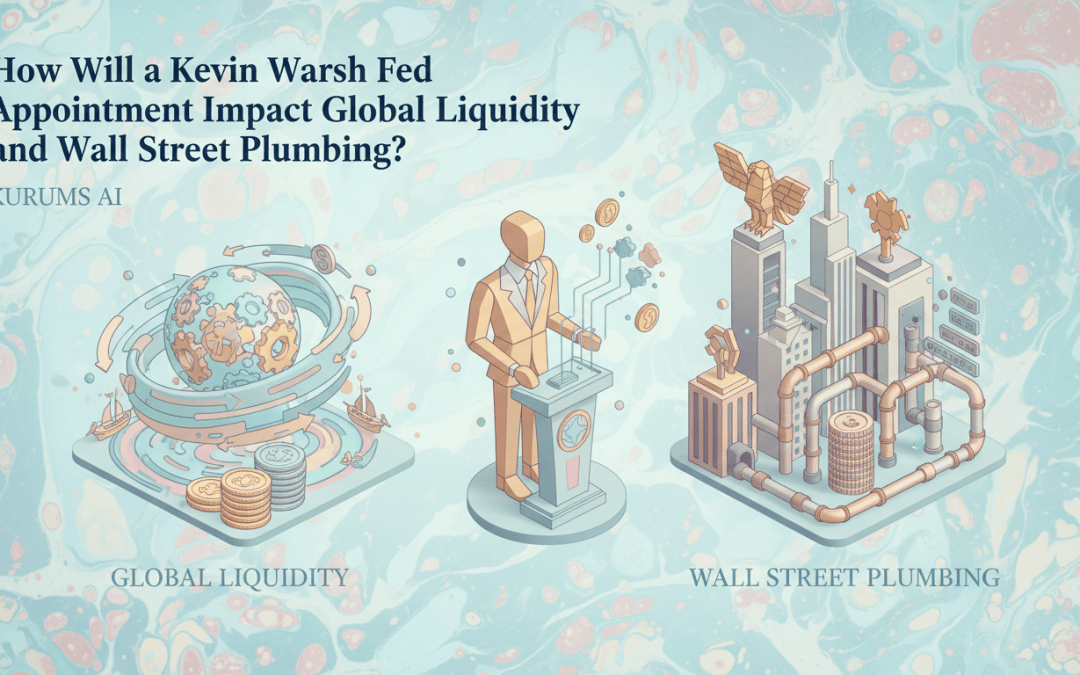
Question: How would a Kevin Warsh Federal Reserve appointment fundamentally alter global liquidity?
Answer: A Kevin Warsh-led Fed represents a pivot from “Central Planning” to “Market Discipline.” By focusing on the structural ‘plumbing’ of Wall Street—specifically repo markets, the balance sheet, and price discovery—Warsh aims to reduce the Fed’s footprint. This shift will likely increase short-term rate volatility, force a faster normalization of the balance sheet, and require corporate treasurers to adopt more sophisticated liquidity management strategies to navigate a world without a guaranteed ‘Fed Put’ in the plumbing.
The global financial ecosystem is standing on the precipice of what may be the most significant ideological shift in monetary policy since the Volcker era. For over a decade, the Federal Reserve has operated as the “Liquidity Provider of Last Resort,” a role that has expanded into nearly every corner of the financial markets, from mortgage-backed securities to corporate credit facilities. However, the potential appointment of Kevin Warsh to a high-ranking Fed position—potentially the Chairmanship—signals a radical departure from this interventionist status quo.
Warsh is not merely a proponent of higher or lower interest rates; he is a structuralist. His primary critique of the modern Fed lies in its “over-engineering” of the financial system. He argues that by suppressing volatility and micromanaging market mechanics, the Fed has blinded the very price signals necessary for a healthy capitalist economy. This article explores the deep-seated mechanical shifts that a “Warsh Fed” would bring to the plumbing of Wall Street and what it means for global institutional liquidity.
1. The Philosophy of “Market Signaling” vs. “Forward Guidance”
For years, the Federal Reserve has relied on “Forward Guidance”—the practice of telling markets exactly what it plans to do months or years in advance. This was intended to provide stability, but critics like Warsh argue it has turned markets into “echo chambers.”
Under a Warsh regime, we should expect a move away from scripted communication and toward Market Signaling. In this framework, the Fed looks to the markets—the yield curve, credit spreads, and inflation expectations—to inform its policy, rather than trying to dictate those variables to the market. But wait, there’s a catch. This shift requires the “plumbing” to work perfectly without constant intervention.
2. Rewiring Wall Street’s Plumbing: The Repo Market Focus
The “plumbing” refers to the massive, multi-trillion dollar markets for Repurchase Agreements (Repo) and the Secured Overnight Financing Rate (SOFR). This is where the world’s liquidity is cleared. Currently, the Fed manages this through the Reverse Repo Facility (RRP) and the Standing Repo Facility (SRF), effectively acting as a massive shock absorber.
Kevin Warsh has historically been skeptical of the Fed’s outsized role in these private markets. His approach would likely involve:
- Downsizing the RRP: Forcing money market funds to find private-sector collateral rather than parking trillions at the Fed.
- Stricter SRF Access: Ensuring the Standing Repo Facility is a backstop, not a primary source of liquidity.
- Encouraging Interbank Lending: Reducing the regulatory hurdles that prevent big banks from lending their excess reserves to smaller players.
This “tough love” for the repo market means that the days of guaranteed, low-volatility overnight funding may be coming to an end. Institutions will need to price in a “liquidity premium” that has been absent for a decade.
3. Comparing the Regimes: Powell vs. Warsh
To understand the depth of this change, we must compare the current “Management” style with the proposed “Market-Driven” style. The following table illustrates the key operational differences.
| Policy Area | The Powell/Current Approach | The Potential Warsh Approach |
|---|---|---|
| Balance Sheet (QT) | Gradual and predictable “watching paint dry” approach. | Aggressive reduction to return to “pre-crisis” norms quickly. |
| Market Intervention | Frequent use of facilities to “smooth” market functioning. | Minimalist. Let markets “break” slightly to find equilibrium. |
| Forward Guidance | Heavy reliance on dot plots and explicit future promises. | Ambiguity. Data-dependent and market-reactive. |
| Inflation Target | Flexible 2% average inflation targeting (AIT). | Strict adherence to price stability, less tolerance for overshoots. |
4. Quantitative Tightening (QT) and the “Stealth Liquidity” Drain
Now, let’s go deeper into the balance sheet. Kevin Warsh has often pointed out that the size of the Fed’s balance sheet is a distortion of the capital allocation process. While the current Fed has been cautious about Quantitative Tightening (QT) to avoid a “taper tantrum,” Warsh might view the balance sheet as a primary tool for correction.
The mechanics are complex. When the Fed shrinks its balance sheet, it removes reserves from the banking system. If this happens too fast, the “plumbing” clogs. We saw this in September 2019 when repo rates spiked to 10% overnight. Warsh’s gamble is that a more transparent, albeit faster, reduction will allow the private sector to step in and fill the void. But there is no guarantee that the private sector is ready for that level of responsibility.
5. Impact on Corporate Finance: The End of Cheap Hedging
What does this mean for the average Fortune 500 CFO? In the Powell era, the “Fed Put” effectively dampened volatility, making it very cheap to hedge interest rate risk. If Warsh reduces intervention, the volatility of volatility (VIX of VIX) is likely to rise.
Corporate treasurers will need to rethink their capital structures. Think about it this way: if you can no longer rely on the Fed to “smooth out” interest rate spikes, your cost of carry for holding cash or hedging debt increases significantly. This could lead to a shift from variable-rate debt to long-term fixed-rate debt, even at higher nominal yields, just to gain certainty in an uncertain regime.
Key Tactical Adjustments for Corporate Treasuries:
- Increased Liquidity Buffers: Holding more “hard” cash rather than relying on credit lines that might dry up during a liquidity squeeze.
- Diversified Funding Sources: Moving beyond commercial paper into direct lending or private credit to avoid public market volatility.
- Scenario Stress Testing: Modeling for “tail risk” events in short-term funding markets that were previously thought to be impossible due to Fed support.
6. The Global Dollar Shortage: A Warsh Fed and Emerging Markets
The Federal Reserve is the de facto central bank of the world. Through the “Eurodollar” system, the entire world runs on US Dollars. When the Fed changes how it manages its plumbing, the ripples are felt from London to Tokyo to Sao Paulo.
Kevin Warsh’s focus on a “disciplined” Fed could inadvertently trigger a global dollar shortage. By reducing the supply of reserves and shrinking the balance sheet, the Fed makes dollars “scarcer.” For emerging markets that have borrowed heavily in USD, this is a nightmare scenario. The cost of servicing that debt rises, not just because of interest rates, but because the mechanical access to dollars becomes more expensive.
7. Institutional Liquidity Management: The Shift to Private Collateral
In a post-Warsh world, the quality of collateral becomes the new currency. Currently, almost any government-backed security is treated as “pristine” because the Fed is always there to buy it or lend against it. Warsh wants to change that. He wants the market to differentiate between “good” collateral and “mediocre” collateral.
The results? A wider spread between different types of Treasury securities and a potential revival of the private-label repo market. Institutional investors will need to hire more “plumbers”—specialists who understand the nuances of the FIMA repo facility, the TGA (Treasury General Account) fluctuations, and the intricacies of the basis trade.
| Asset Class | Likely Reaction to “Warsh Plumbing” | Strategy Shift |
|---|---|---|
| US Treasuries | Higher term premiums and increased yield volatility. | Shift to shorter duration or inflation-protected bonds (TIPS). |
| Equities (Growth) | Multiple compression as the “discount rate” becomes more volatile. | Focus on high-free-cash-flow companies with low debt. |
| Foreign Exchange | Stronger USD due to reduced reserve supply. | Long USD/Short EM carry trades may face liquidation risk. |
| Private Credit | Increased demand as bank lending becomes more constrained. | Selective allocation to senior secured tranches. |
8. The “Warsh Rule” vs. The “Taylor Rule”
While the Taylor Rule provides a mathematical formula for interest rates, the “Warsh Rule” (as described by analysts) is more about Financial Stability through Market Prices. Warsh believes that if the Fed ignores the signals from the stock and bond markets—specifically when they are signaling a bubble—it is failing its mandate.
This means a Warsh Fed might actually raise rates or tighten liquidity even if inflation is at 2%, simply because they see “excessive exuberance” in asset prices. This is a massive change for Wall Street, which has grown accustomed to the Fed only tightening when inflation is a direct threat. In the Warsh world, asset bubbles are a threat to the plumbing itself, and they must be lanced before they grow too large.
9. How the “Basis Trade” Faces its Reckoning
The “basis trade”—where hedge funds use massive leverage to exploit tiny price differences between Treasury futures and cash bonds—is a multi-billion dollar business that relies on stable repo rates. If Warsh allows repo rates to fluctuate more freely, the “cost of carry” for these trades becomes unpredictable.
If the basis trade unwinds due to a “plumbing” failure, it could force a massive sell-off in Treasuries, ironically causing the very instability the Fed tries to avoid. This is the paradox of the Warsh approach: to create a healthier market in the long run, he may have to endure a very painful “cleansing” process in the short term.
10. Positioning for the “Regime Change”
As the narrative around Kevin Warsh gains steam, the market will begin to “front-run” his policies. We are already seeing a slight increase in the term premium and a more cautious approach to long-dated bonds. To prepare for this regime change, institutional players must adopt a three-pronged strategy:
- Liquidity Optionality: Don’t just have liquidity; have the option to access it in multiple markets (Repo, FX Swaps, Private Lines).
- Volatility as an Asset: In a world where the Fed doesn’t suppress volatility, long-volatility strategies become a necessary hedge rather than a drag on performance.
- Real-Time Plumbing Monitoring: Move beyond macroeconomics and into “micro-structure” analysis. Watch the TGA, watch the RRP, and watch the primary dealer inventories.
11. Conclusion: The New Era of Monetary Realism
A Kevin Warsh appointment at the Federal Reserve would be more than just a change in leadership; it would be a change in the very definition of central banking in the 21st century. By prioritizing the mechanics of the financial system—the “plumbing”—over the vanity of economic models, Warsh aims to build a more resilient, albeit more volatile, economy.
For Wall Street, the message is clear: the safety net is being pulled back. The “Fed Put” is being replaced by “Market Discipline.” While this transition will likely be fraught with spikes in volatility and challenges to liquidity, it offers a path toward a more sustainable and transparent financial future. Investors and corporate leaders who understand the mechanics of this shift today will be the ones who thrive in the “Warsh Era” of tomorrow.
Discover more from Kurums | Business Intelligence
Subscribe to get the latest posts sent to your email.