
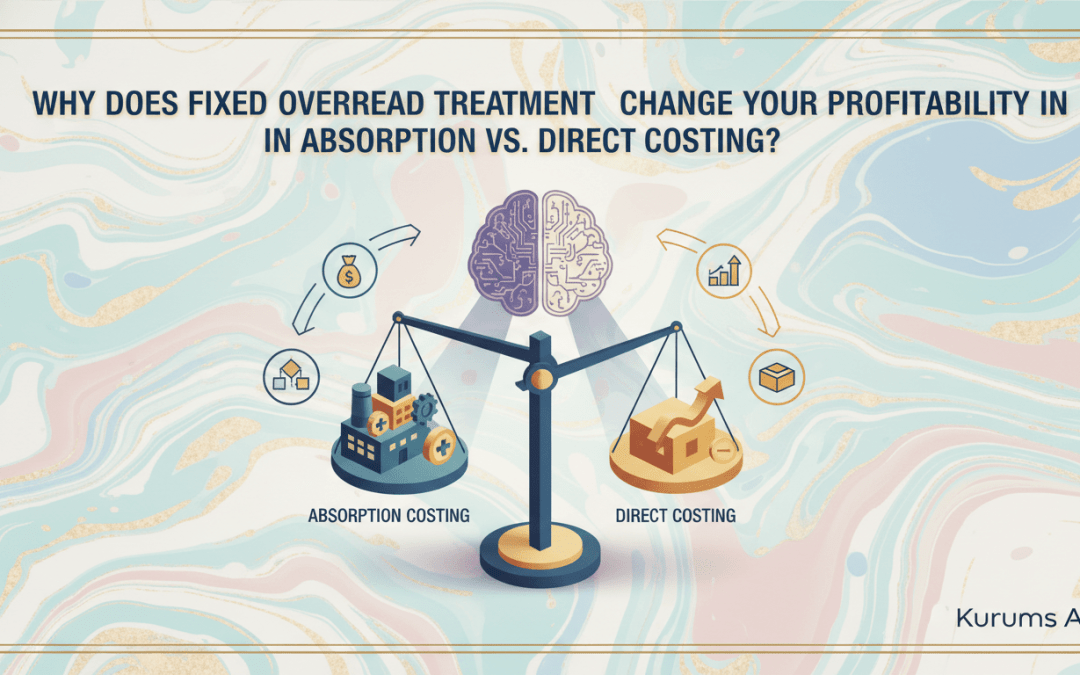
- Absorption Costing: Required for GAAP/IFRS; includes fixed overhead in inventory value.
- Direct Costing: Best for internal management; treats fixed overhead as a period cost.
- The Profit Gap: If production > sales, Absorption reports higher profit. If sales > production, Direct reports higher profit.
In the high-stakes world of corporate finance, a CEO might look at a monthly report and see a healthy profit, only to realize later that the “profit” was actually an accounting byproduct of overproduction. This phenomenon is driven by the subtle but powerful treatment of fixed manufacturing overhead. Whether you are a CFO, a management accountant, or a strategic investor, understanding the divergence between Absorption Costing and Direct (Variable) Costing is non-negotiable for accurate financial analysis.
Financial transparency is the cornerstone of corporate governance. When a CFO reviews monthly performance, the choice between these two models can lead to wildly different interpretations of profitability. This isn’t just a matter of accounting preference; it is a strategic decision that affects tax liabilities, investor relations, and internal performance metrics. Last Update: May 28, 2026.
But here is the real catch… the “profit” shown on an absorption-based income statement might not represent cash flow or actual operational efficiency. It might simply reflect the fact that your warehouse is full.
1. The Architecture of Cost: Defining the Two Pillars
To understand the profitability shift, we must first define the architectural differences between the two methods. At the heart of the debate is how we define a “product cost” versus a “period cost.”
Absorption Costing (also known as Full Costing) views all manufacturing costs—both variable and fixed—as necessary to create a product. Therefore, direct materials, direct labor, variable overhead, and fixed overhead are all “absorbed” by the unit of product. These costs sit on the balance sheet as inventory until the moment of sale, at which point they transition to the income statement as Cost of Goods Sold (COGS).
Direct Costing (also known as Variable Costing) takes a different philosophical stance. It argues that fixed manufacturing overhead (like factory rent, insurance, and executive salaries) will be incurred regardless of whether one unit or ten thousand units are produced. Consequently, these costs are treated as period expenses and are deducted from revenue in the period they occur, regardless of production or sales volume.
2. The Fixed Overhead Trap: How Inventory “Hides” Expenses
Why does absorption costing often make a company look more profitable during periods of high production? The answer is simple: Inventory serves as a sponge for fixed costs.
When a factory produces more than it sells, the fixed overhead associated with those unsold units is not expensed on the current income statement. Instead, it is “capitalized” into the ending inventory value on the balance sheet. By deferring these costs to a future period, the company artificially lowers its current COGS and boosts its reported Net Income.
Think about it this way: If your factory rent is $100,000 and you produce 10,000 units, each unit “carries” $10 of rent. If you only sell 5,000 units, only $50,000 of rent hits your income statement today. The other $50,000 is “parked” in the warehouse. Under direct costing, the full $100,000 would be expensed immediately, showing a lower profit but a more accurate reflection of that month’s cash drain.
3. Comparison Matrix: Absorption vs. Direct Costing
To visualize the structural differences, consider the following table which breaks down cost components under both methodologies:
| Cost Component | Absorption Costing (Product vs. Period) | Direct Costing (Product vs. Period) |
|---|---|---|
| Direct Materials | Product Cost | Product Cost |
| Direct Labor | Product Cost | Product Cost |
| Variable Manufacturing Overhead | Product Cost | Product Cost |
| Fixed Manufacturing Overhead | Product Cost | Period Cost |
| Variable Selling & Admin | Period Cost | Period Cost |
| Fixed Selling & Admin | Period Cost | Period Cost |
4. The Mathematical Impact on Net Income
The relationship between production, sales, and net income can be summarized by three fundamental scenarios. This is where many managers get caught off guard.
- Scenario A: Production = Sales. In this rare equilibrium, both methods report the exact same Net Income because no fixed overhead is added to or released from inventory.
- Scenario B: Production > Sales (Inventory Increases). Absorption Net Income will be higher than Direct Net Income. This is because some fixed overhead is deferred to the future.
- Scenario C: Production < Sales (Inventory Decreases). Absorption Net Income will be lower than Direct Net Income. This is because fixed overhead from previous periods is “released” from inventory and expensed as COGS.
But wait, there’s more. The magnitude of the difference is exactly equal to the change in inventory units multiplied by the fixed overhead rate per unit. This formula is the “Holy Grail” for accountants reconciling the two statements.
5. Case Study: The Phantom Profit of “Alpha Manufacturing”
Let’s look at a concrete example to see these mechanics in action. Alpha Manufacturing produces high-end industrial valves.
Operational Data:
– Selling Price: $500 per unit
– Variable Manufacturing Cost: $200 per unit
– Total Fixed Manufacturing Overhead: $1,000,000 per year
– Units Produced: 10,000
– Units Sold: 8,000
Under Direct Costing, the profit calculation is straightforward:
Contribution Margin: 8,000 units * ($500 – $200) = $2,400,000
Minus Fixed Overhead: $1,000,000
Net Operating Income: $1,400,000
Under Absorption Costing, the fixed overhead rate is $1,000,000 / 10,000 units = $100 per unit.
COGS per unit: $200 (variable) + $100 (fixed) = $300.
Gross Profit: 8,000 units * ($500 – $300) = $1,600,000
Net Operating Income: $1,600,000
The $200,000 difference is exactly the 2,000 units sitting in the warehouse, each carrying $100 of “hidden” fixed overhead. Alpha looks $200,000 more profitable on paper, but they have $200,000 less cash than if they hadn’t overproduced. This is what we call “Phantom Profit.”
6. Why Does GAAP Mandate Absorption Costing?
You might ask: “If Direct Costing is more transparent for decision-making, why does the law force us to use Absorption?”
The regulatory logic is rooted in the Matching Principle. Standard setters (FASB and IASB) argue that all costs incurred to bring a product to its present location and condition should be matched against the revenue that product generates. Since you cannot produce a valve without a factory, the factory rent is seen as part of the product’s essence.
From an investor’s perspective, absorption costing ensures that a company cannot simply “write off” all its factory costs in a year of low sales to avoid future taxes. It forces the cost to follow the asset. However, for internal management, this “matching” often masks the true cost of producing one additional unit (the marginal cost).
7. Strategic Implications for C-Suite Executives
The choice between these methods ripples through the entire organization. It isn’t just about the numbers; it’s about the behavior those numbers drive.
A. Performance Evaluation and Bonuses
If a Division Manager’s bonus is tied to Absorption-based Net Income, they are highly incentivized to produce as much as possible at the end of the year. By ramping up production, they “absorb” more fixed costs into inventory, lowering the COGS on the units they actually sold and inflating their bonus-eligible profit.
B. Pricing Strategy
Direct costing is superior for short-term pricing decisions (e.g., “Should we accept a special one-time order at a lower price?”). If the price covers variable costs and contributes even a penny to fixed overhead, it’s technically profitable in the short run. Absorption costing, however, helps ensure long-term sustainability by reminding the company that, eventually, all costs must be covered by sales.
C. CVP (Cost-Volume-Profit) Analysis
Direct costing is the natural partner of CVP analysis. It allows for the calculation of the Break-Even Point and Margin of Safety with ease. Because fixed costs are isolated, the math remains “clean.” Under absorption costing, the break-even point shifts depending on production levels, making it a moving target that is difficult to manage.
8. Segment Reporting and Product Line Profitability
When analyzing different product lines or geographic segments, the treatment of fixed overhead becomes even more critical. Managers often use Contribution Margin (Revenue – Variable Costs) to decide which products to keep or kill.
- Direct Costing Focus: Highlights the Contribution Margin. Shows how much each segment contributes to covering the company’s total fixed costs.
- Absorption Costing Focus: Highlights Gross Margin. It can be misleading if common fixed costs (like corporate HQ rent) are arbitrarily allocated to segments.
- The “Death Spiral” Risk: If a company drops a product line because it looks unprofitable under absorption costing (after being allocated high fixed costs), those fixed costs don’t disappear—they simply get reallocated to the remaining products, making them look less profitable, too.
9. Technical Breakdown: Reconciling the Profit Difference
In any professional audit or internal audit review, a reconciliation table is required to explain the variance between the “Internal Management Report” (Direct) and the “External Financial Statement” (Absorption).
| Step | Action / Calculation | Reasoning |
|---|---|---|
| 1 | Start with Direct Costing Net Income | Baseline profit where all fixed costs are expensed. |
| 2 | Add: Fixed Overhead in Ending Inventory | These are costs incurred but deferred (not yet expensed). |
| 3 | Subtract: Fixed Overhead in Beginning Inventory | These are old costs now being expensed as units are sold. |
| 4 | Result: Absorption Costing Net Income | The profit figure that will be reported to shareholders. |
10. The Tax Man’s Perspective: Why Governments Prefer Absorption
Revenue services (like the IRS or national tax authorities) generally mandate absorption costing for a very simple reason: Tax revenue timing.
Because absorption costing tends to delay the expensing of fixed overhead (as long as inventory is growing), it results in higher reported net income in the short term. Higher net income means higher taxable income. If companies were allowed to use direct costing for taxes, they could significantly reduce their current tax bill simply by expensing all manufacturing overhead immediately, even if they were building massive stockpiles of inventory.
11. Moving Toward Lean Accounting and Throughput Accounting
In modern manufacturing environments using Just-In-Time (JIT) methods, the difference between absorption and direct costing becomes negligible. Why? Because in a JIT system, production is nearly equal to sales. Inventory levels are kept so low that there is no “sponge” to hide fixed overhead.
However, for companies still operating under traditional batch-and-queue systems, the debate remains fierce. Some progressive firms are moving toward Throughput Accounting, which treats all costs except direct materials as period expenses. This is even more aggressive than direct costing and aims to eliminate any incentive for overproduction.
12. Summary of Key Differences for Financial Analysis
To finalize our deep dive, let’s summarize the essential “takeaways” that should guide your next financial review:
- Focus on Inventory: If inventory levels are rising, absorption profit is likely “inflated.” If they are falling, it is “deflated.”
- Decision Relevance: Use Direct Costing for internal decisions like pricing, segment elimination, and volume planning.
- Compliance: Use Absorption Costing for external reporting, audits, and tax filings.
- Audit Trail: Always keep a clear record of your Fixed Manufacturing Overhead rate per unit to facilitate quick reconciliation.
Conclusion: The Strategic Pivot
The treatment of fixed overhead is not merely a technical accounting rule; it is a lens through which you view your company’s health. Absorption costing provides the “official” story, adhering to the matching principle and satisfyng regulators. Direct costing provides the “operational” story, showing the raw impact of your fixed cost structure on your ability to generate a margin from every unit sold.
As a leader, your job is to look at both. Do not be fooled by the high profits of a massive production run if your sales aren’t following suit. Conversely, don’t be discouraged by a dip in profit during an inventory-clearance month—your cash flow may be stronger than it looks.
Ready to optimize your reporting? Start by reconciling your last quarter’s results using the inventory-change formula. You might be surprised at what you find hidden in your warehouse.
Discover more from Kurums | Business Intelligence
Subscribe to get the latest posts sent to your email.