
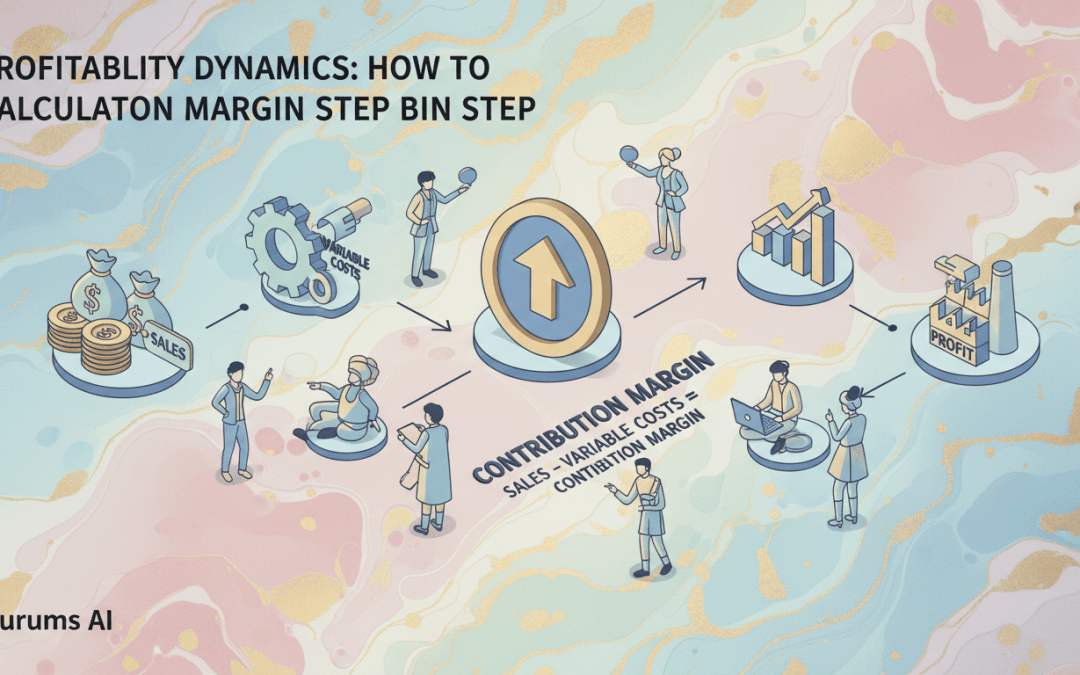
Think about this: Why do companies with soaring revenues often find themselves facing a liquidity crisis? The answer usually lies in a fundamental misunderstanding of unit economics. Revenue alone is a vanity metric; contribution margin is the pulse of your business health. In the volatile economic landscape of 2026, where supply chain fluctuations and AI-driven efficiency change cost structures overnight, mastering this metric is no longer optional—it is a survival requirement.
But here is the real catch: Most managers confuse gross margin with contribution margin. While gross margin focuses on production costs (COGS) including fixed manufacturing overhead, contribution margin isolates variable costs to reveal the true profitability of every single unit sold. This distinction is what separates profitable growth from “selling your way into bankruptcy.”
1. The Conceptual Framework: What Exactly is Contribution Margin?
At its core, contribution margin (CM) is the selling price per unit minus the variable cost per unit. It represents the portion of sales revenue that is not consumed by variable costs and is therefore available to cover fixed costs. Once fixed costs are fully covered, any remaining contribution margin flows directly to the bottom line as profit.
Why does this matter so much? Because in a high-growth environment, your fixed costs (like rent or administrative salaries) stay relatively stable, but your variable costs (like raw materials or shipping) scale directly with your volume. If your contribution margin is too low, or heaven forbid, negative, selling more product will actually accelerate your losses rather than fixing them.
2. Contribution Margin vs. Gross Margin: Clearing the Confusion
Many financial professionals use these terms interchangeably, but doing so in a board meeting can lead to disastrous strategic errors. The primary difference lies in how they treat fixed manufacturing overhead. Gross margin adheres to GAAP (Generally Accepted Accounting Principles) and includes fixed costs related to production in the COGS. Contribution margin, however, is a management accounting tool that strictly separates costs by behavior (variable vs. fixed).
| Feature | Gross Margin | Contribution Margin |
|---|---|---|
| Primary Focus | Production Efficiency & External Reporting | Profitability Per Unit & Internal Decision Making |
| Costs Included | Variable and Fixed Production Costs (COGS) | All Variable Costs (COGS + Selling & Admin) |
| External Use | Mandatory for Financial Statements | Rarely used in public filings |
| Key Utility | Inventory Valuation | Break-even Analysis and Pricing Strategy |
3. Deep Dive into Variable Costs: The 2026 Perspective
To calculate contribution margin accurately, you must be a detective of cost behavior. In 2026, the line between fixed and variable costs has blurred due to cloud computing and the gig economy. However, traditional variable costs still form the bedrock of the calculation.
Variable costs are those that fluctuate in direct proportion to the volume of output. If you produce zero units, these costs should theoretically be zero. In a modern corporate setting, these include:
- Direct Raw Materials: The physical components used to build your product.
- Direct Labor (Hourly): Wages paid to workers for the time spent specifically on production.
- Sales Commissions: Performance-based pay that only triggers upon a successful sale.
- Transaction Fees: Payment gateway charges (e.g., Stripe, PayPal) that apply per transaction.
- Shipping and Fulfillment: The cost of getting the product from the warehouse to the customer’s door.
- Variable Utility Costs: Energy consumed by machines that only run during production cycles.
The Shift to “Digital Variable Costs”
For SaaS and digital product companies, variable costs used to be negligible. However, in 2026, API call costs, AI tokens (LLM usage), and cloud egress fees have become significant variable expenses. If your software uses an AI model for each query, your contribution margin must account for the compute cost of every single interaction.
4. Step-by-Step Guide: How to Calculate Contribution Margin
Calculating the contribution margin is a straightforward process, but the quality of your output depends entirely on the precision of your input data. Let’s break it down into four actionable steps.
Step 1: Determine Total Revenue
Identify the total sales generated during a specific period. Ensure you are using Net Sales (Gross Sales minus returns, allowances, and discounts).
Step 2: Identify and Sum All Variable Costs
Comb through your income statement and pull out every expense that changes with volume. Remember to include variable selling and administrative expenses, not just manufacturing costs.
Step 3: Apply the Contribution Margin Formula
The standard formula is: Contribution Margin = Total Sales – Total Variable Costs.
To find the per-unit value: Unit Contribution Margin = Sales Price Per Unit – Variable Cost Per Unit.
Step 4: Calculate the Contribution Margin Ratio
The ratio is perhaps even more useful for forecasting: Contribution Margin Ratio = (Total Contribution Margin / Total Sales) x 100.
Let’s look at a practical example. Imagine a high-end electronics manufacturer, “Apex Circuits,” selling a premium drone:
- Unit Selling Price: $1,200
- Materials: $400
- Direct Labor: $150
- Shipping: $50
- Sales Commission (5%): $60
Total Variable Cost: $660.
Unit Contribution Margin: $1,200 – $660 = $540.
CM Ratio: ($540 / $1,200) = 45%.
5. The Strategic Significance of the CM Ratio
Why is the percentage (ratio) so critical? Because it tells you how much of every dollar earned is available to pay for the “back office” and eventually become profit. A 45% ratio means that for every $1 million in additional sales, $450,000 will be available to cover fixed costs and profit.
But wait, there’s more. The CM Ratio is the ultimate tool for comparing different business models. A consulting firm might have an 80% CM ratio because their variable costs are low, but they might have massive fixed costs (expensive office space, high executive salaries). Conversely, a retail store might have a 15% CM ratio but very low fixed costs. The ratio allows you to understand the Operating Leverage of your company.
6. Break-Even Analysis: The “Magic Number” for Survival
One of the most powerful applications of the contribution margin is calculating the Break-Even Point (BEP). This is the exact volume of sales where total revenue equals total costs—where the company makes exactly zero profit but suffers zero loss.
The formula is: Break-Even Point (Units) = Total Fixed Costs / Unit Contribution Margin.
If Apex Circuits (from our previous example) has $1,080,000 in annual fixed costs (rent, R&D, salaries), their break-even point would be:
$1,080,000 / $540 = 2,000 units.
But here is the kicker: If they increase their sales commission by just 2%, their unit contribution margin drops, and they suddenly need to sell significantly more units just to break even. This is why C-level executives must obsess over CM; it defines the safety margin of the entire enterprise.
7. Product Mix Optimization: The “Hidden” Profit Killer
Most companies do not sell just one product. They sell a portfolio. Often, managers focus on the “Best Seller”—the product with the highest revenue. But what if the best seller has a contribution margin of 5%, while a lower-volume product has a margin of 60%?
This is where Weighted Average Contribution Margin comes into play. By analyzing the CM of every product, a company can strategically shift its marketing spend to promote higher-margin products, thereby increasing total profit without necessarily increasing total revenue. This is known as “improving the mix.”
| Product Line | Revenue Share | CM Ratio | Action Strategy |
|---|---|---|---|
| Product A (Premium) | 20% | 65% | Aggressive Growth / Maximize Ad Spend |
| Product B (Mid-Range) | 50% | 30% | Efficiency Optimization / Cost Reduction |
| Product C (Economy) | 30% | 8% | Review for Discontinuation or Price Hike |
8. Pricing Strategy: Moving Beyond “Cost-Plus”
How do you set your prices? If you simply take your costs and add a percentage, you are leaving money on the table. Contribution margin analysis allows for Value-Based Pricing and Dynamic Pricing.
By understanding your CM, you can calculate exactly how much of a discount you can offer during a flash sale without losing money. You can also determine the “Floor Price”—the absolute minimum price you can accept for a bulk order. In a competitive 2026 market, the ability to pivot pricing based on real-time variable cost data is a massive competitive advantage.
9. CVP Analysis: The Ultimate Decision-Making Framework
Cost-Volume-Profit (CVP) analysis is the advanced evolution of the contribution margin. It looks at how changes in costs (both variable and fixed) and volume affect operating profit. This is the playground of CFOs.
CVP analysis helps answer critical “What If” questions:
- What happens to our profit if we automate a manual process (shifting variable labor costs to fixed depreciation costs)?
- Can we afford a 10% reduction in selling price if it leads to a 25% increase in volume?
- How much will our profit increase if we reduce our variable material waste by 2%?
- Which marketing channel provides the best ROI when considering the CM of the specific products sold through that channel?
10. Common Pitfalls: Why CM Can Sometimes Mislead
While the contribution margin is a hero of financial metrics, it is not infallible. There are specific scenarios where relying solely on CM can lead to poor decisions.
The most common pitfall is ignoring Fixed Cost Capacity. You might have a product with a fantastic contribution margin, but if producing more of it requires building a new $50 million factory, the CM won’t tell you that. You must always view CM within the context of your total capacity and capital expenditure (CAPEX) plans.
11. The Future: Profitability in the Age of AI (2026 and Beyond)
As we navigate 2026, the way we calculate and use contribution margin is being transformed by real-time data. Automated accounting systems now allow for “Per-Second Profitability Tracking.” Companies are no longer waiting for the end of the month to see their margins; they are seeing them fluctuate in real-time based on live energy prices, AI compute costs, and logistics tolls.
Furthermore, predictive analytics can now forecast variable cost spikes (like a sudden rise in lithium prices for battery makers), allowing companies to adjust their pricing algorithms instantly to maintain a target contribution margin. This “Algorithmic Profitability” is the future of corporate finance.
Conclusion: Your Roadmap to Optimized Profitability
Contribution margin is far more than a line item on a spreadsheet; it is a strategic lens through which you should view your entire business. By isolating variable costs, you gain the clarity needed to price correctly, optimize your product mix, and scale safely. As we move further into 2026, the speed and accuracy of these calculations will differentiate the market leaders from the laggards.
Are you ready to take control of your unit economics? Start by auditing your current cost structures. Separate the fixed from the variable with surgical precision. Calculate your unit contribution margins and compare them against your customer acquisition costs (CAC). When your CM is significantly higher than your CAC, you have found the “Holy Grail” of business growth.
Next Steps for C-Level Executives:
- Conduct a SKU-level profitability audit by next quarter.
- Integrate real-time variable cost tracking into your ERP system.
- Train your sales team to focus on High-Contribution products, not just high-revenue ones.
- Perform a “Sensitivity Stress Test” on your break-even point for the upcoming fiscal year.
The math of profitability is unforgiving, but for those who master it, the rewards are limitless. Don’t let your revenue hide your losses—calculate your contribution margin today and build a resilient, profitable future.
Discover more from Kurums | Business Intelligence
Subscribe to get the latest posts sent to your email.