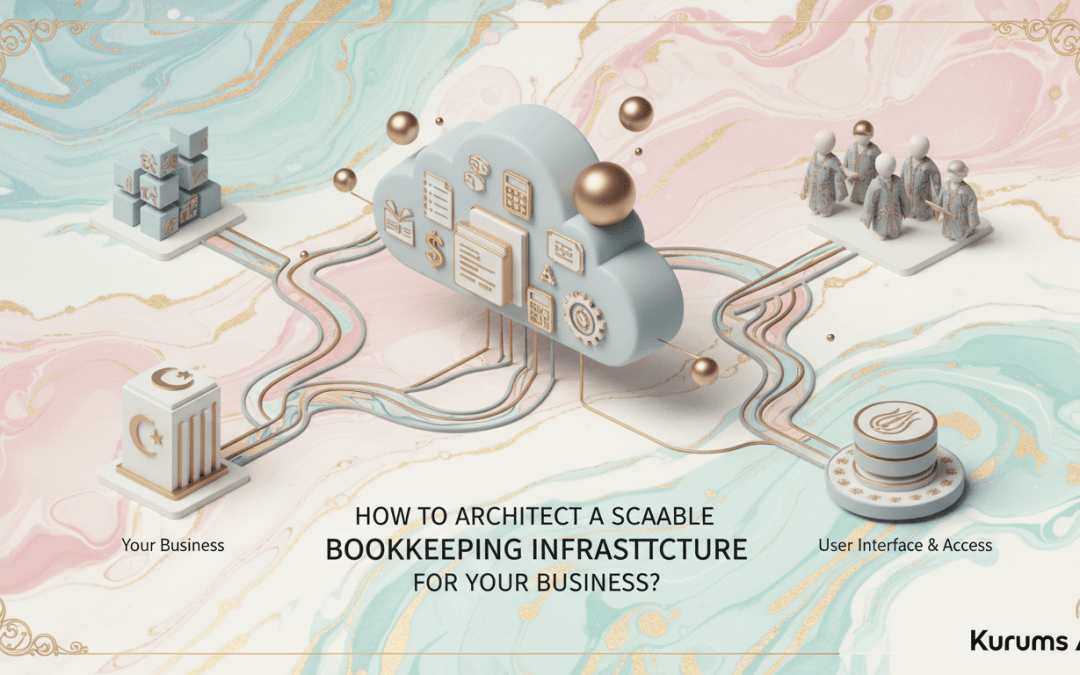
What is a scalable bookkeeping infrastructure? It is a combination of cloud-based software, automated data pipelines, and standardized internal controls designed to handle increasing transaction volumes without a proportional increase in administrative costs.
How does automation impact accuracy? Implementing AI-driven OCR and banking APIs reduces manual data entry errors by approximately 60% and accelerates the month-end close process by up to 40%.
What are the core pillars? High-performance accounting software, seamless banking integrations, a robust Chart of Accounts (CoA), and a strict record retention protocol.
Last Updated: May 27, 2026.
Small business failure is rarely a product of poor marketing; more often, it is the result of financial blindness. When your books are a mess, your strategic decisions are based on fiction rather than data. To transition from a reactive ‘tax-time’ mentality to proactive financial management, you must build a system that captures every cent with surgical precision. In today’s hyper-competitive landscape, “good enough” bookkeeping is a liability. You need an architecture that scales with your ambition.
The Architecture of Modern Financial Management
Building a scalable bookkeeping infrastructure isn’t just about buying a software subscription. It’s about engineering a workflow where data flows seamlessly from the point of transaction to the final financial statement. Most entrepreneurs treat bookkeeping as a rearview mirror—a way to see where they’ve been. However, a professional-grade system acts as a GPS, providing real-time visibility into cash runways, burn rates, and unit economics.
But how do you move from a shoe-box full of receipts to a digital fortress? The answer lies in the integration of three core domains: Software, Process, and People. Without a cohesive strategy connecting these three, your financial data will always be lagging, fragmented, and prone to human error. Let’s dive into the technical foundations of this architecture.
1. Selecting the Right Cloud Accounting Platform
The software you choose is the “operating system” of your business’s finances. While many platforms offer basic invoicing, a truly scalable infrastructure requires a platform that supports multi-dimensional reporting, robust API connectivity, and granular permission settings. The goal is to choose a platform you won’t outgrow in 24 months.
For most small to mid-sized enterprises (SMEs), the choice usually narrows down to three major players. Here is a technical comparison to help you decide:
| Feature | QuickBooks Online | Xero | NetSuite (ERP) |
|---|---|---|---|
| Best For | General SMEs in the US | Tech startups & Inventory-heavy | Rapidly scaling/Enterprise |
| API Ecosystem | Massive (Thousands of apps) | Very Strong (Hubdoc integrated) | Native / Highly Custom |
| Reporting | Standardized/Industry specific | Highly flexible/Interactive | Advanced Multi-entity |
| Automation Level | High (Bank rules are key) | Very High (Auto-reconciliation) | Total Workflow Automation |
Why does this choice matter? Think of it this way: your accounting software is the hub. Every other tool—your payroll, your CRM, your payment processor—must talk to this hub. If the hub is weak, the entire spoke-and-wheel system collapses under the weight of manual data entry.
2. Implementing Seamless Banking API Integrations
Manual data entry is the enemy of scale. In a legacy system, you would download a CSV from your bank and upload it to your software. This is not only slow; it is dangerous. Missing a single line item can throw off your entire reconciliation for months.
Modern infrastructure utilizes Direct Bank Feeds via APIs (like Plaid or Yodlee). This ensures that every transaction—whether it’s a $5 coffee or a $50,000 vendor payment—appears in your accounting software in near real-time. But here is the kicker: simply having the data is not enough. You need to categorize it.
The Power of Bank Rules
To achieve 60% automation, you must master “Bank Rules.” These are logic-based instructions that tell the software: “If the payee contains ‘Amazon’ and the amount is under $100, categorize it as ‘Office Supplies’.” By layering hundreds of these rules, your bookkeeper shifts from a “data entry clerk” to a “data reviewer,” significantly lowering your overhead costs.
3. Designing a Scalable Chart of Accounts (CoA)
The Chart of Accounts is the skeleton of your financial body. If the skeleton is malformed, the body cannot grow. A common mistake small businesses make is having a “flat” CoA or, conversely, a CoA with way too many granular categories that provide no strategic value.
A professional CoA follows a logical numbering system:
- 1000-1999: Assets (Cash, Accounts Receivable, Inventory, Equipment)
- 2000-2999: Liabilities (Accounts Payable, Credit Cards, Loans)
- 3000-3999: Equity (Owner’s Investment, Retained Earnings)
- 4000-4999: Revenue (Product Sales, Service Fees)
- 5000-5999: Cost of Goods Sold (COGS) (Direct materials, Labor)
- 6000-7999: Expenses (Rent, Marketing, Payroll, Utilities)
By using this standardized structure, you ensure that your financial statements are readable by banks, investors, and the IRS. Furthermore, it allows for “sub-accounts,” which provide detail without cluttering the main Profit & Loss statement.
4. Automating Accounts Payable (AP) and Receivable (AR)
Cash flow is the lifeblood of your business. If your AR (money coming in) is slow and your AP (money going out) is disorganized, you are courting disaster. Scalable infrastructure solves this through specialized automation tools like Bill.com, Melio, or Routable.
Mastering the AP Workflow
Instead of manual check writing, implement an “Approval Workflow.” When a vendor sends an invoice, it should be captured by an AI tool (like Dext or Hubdoc), which extracts the date, vendor, and amount. The software then routes it to the appropriate manager for approval. Once approved, the payment is scheduled automatically. This creates a digital paper trail that is bulletproof for audits.
Accelerating the AR Cycle
On the flip side, your system should automatically nudge customers who are late on payments. Automated reminders and integrated “Pay Now” buttons on invoices can reduce your Days Sales Outstanding (DSO) by up to 20%. Why wait for a check in the mail when you can receive a digital transfer the same day?
5. Establishing a Strict Record Retention Protocol
If the IRS knocked on your door tomorrow, could you produce the receipt for a transaction from three years ago in under 60 seconds? If the answer is no, your infrastructure is incomplete. In the digital age, paper receipts are obsolete and a liability (they fade, get lost, or take up expensive physical space).
A scalable system uses Cloud Document Management. Every transaction in your accounting software should have the source document attached to it. This is often referred to as “Audit-Ready Bookkeeping.”
The Digital Filing Cabinet Strategy:
- Direct Integration: Use tools that push PDFs directly into your accounting software.
- Standardized Naming: YYYY-MM-DD_Vendor_Amount.pdf.
- Redundancy: Use a secondary cloud backup (Google Drive, Dropbox, or Box) for permanent storage.
6. Internal Controls and Fraud Prevention
As your business grows, you can no longer oversee every single transaction. This is where internal controls become vital. Small businesses are disproportionately affected by internal fraud because they lack “Segregation of Duties.”
In a professional infrastructure, the person who records the transaction should not be the same person who authorizes the payment. Even if you are a team of two, you can implement controls such as:
- Dual-Factor Authentication: Required for all financial logins.
- Positive Pay: A banking service that matches the check the company issues with the check presented for payment.
- Monthly Reconciliation Review: An owner or outside CPA must review the bank reconciliation report monthly to ensure no unauthorized adjustments were made.
7. The Role of AI and OCR in Modern Data Entry
We are entering the era of “Zero-Touch Bookkeeping.” Optical Character Recognition (OCR) technology has advanced to the point where it can read complex invoices better than a human. When an invoice enters the system, AI can identify the GL (General Ledger) code based on historical patterns.
But wait, there’s a catch. AI is not foolproof. It can misread a ‘9’ for a ‘4’ or misinterpret a sales tax line as a product cost. Therefore, the “Human-in-the-Loop” model is the gold standard. The AI does the heavy lifting, and a professional bookkeeper performs the quality control check.
8. Transitioning from Cash to Accrual Accounting
Most small businesses start with “Cash Basis” accounting because it’s simple: you record income when you get it and expenses when you pay them. However, as you scale, Cash Basis becomes deceptive. It doesn’t show you the $100,000 you owe next month or the $200,000 you’ve earned but haven’t collected.
Accrual Accounting provides a true picture of financial health by matching revenue with the expenses incurred to earn that revenue. A scalable infrastructure must be capable of handling accruals, deferrals, and depreciation. This is often the point where a business needs to move from a basic bookkeeper to a Controller or fractional CFO.
9. Monthly Close Process: The 10-Day Goal
How long does it take you to get your financial statements after the month ends? If it’s more than 15 days, the data is too old to be actionable. A high-performance infrastructure aims for a “10-Day Close.”
| Phase | Timeline | Key Tasks |
|---|---|---|
| Data Capture | Days 1-3 | Sync all bank feeds, upload remaining receipts. |
| Reconciliation | Days 4-6 | Match transactions to bank statements; resolve discrepancies. |
| Adjustments | Days 7-8 | Record depreciation, accruals, and payroll adjustments. |
| Review & Reporting | Days 9-10 | CFO review of P&L, Balance Sheet, and Cash Flow. |
10. Preparing for Audits and Due Diligence
Whether you are looking for a bank loan or preparing for an acquisition, your “data room” must be pristine. A scalable infrastructure is inherently audit-ready. This means every balance on your Balance Sheet can be substantiated by a third-party document.
Think about the “Clean Books” premium. When a potential buyer sees a perfectly organized accounting system with clear audit trails, it reduces their perceived risk. This can literally add 10-20% to your company’s valuation during an exit.
11. Scaling the Team: When to Hire?
One of the biggest dilemmas for growing businesses is knowing when to move from DIY to a professional. Here is a general roadmap for scaling your financial human capital:
- $0 – $500k Revenue: Use cloud software and a part-time/freelance bookkeeper (5 hours/month).
- $500k – $2M Revenue: Outsourced bookkeeping firm with a dedicated account manager. Implementation of AP/AR automation.
- $2M – $10M Revenue: Full-time internal bookkeeper/accountant and a Fractional CFO for strategic planning.
- $10M+ Revenue: Full in-house finance department (Controller, AP/AR clerks, CFO).
Conclusion: Your Financial Future Starts with Architecture
Establishing a scalable bookkeeping infrastructure is not a one-time event; it is a commitment to operational excellence. By focusing on software integration, automation, and strict internal controls, you transform your accounting department from a “cost center” into a “strategic asset.”
Do not wait for a tax audit or a cash flow crisis to fix your books. Start today by auditing your current workflow, identifying manual bottlenecks, and implementing the cloud-based pillars discussed in this guide. The clarity you gain will be the most valuable tool in your entrepreneurial arsenal.
Ready to take the next step? Conduct a “Software Gap Analysis” this week and determine if your current platform can support your 3-year growth projections. If not, the time to migrate is now.
Discover more from Kurums | Business Intelligence
Subscribe to get the latest posts sent to your email.