
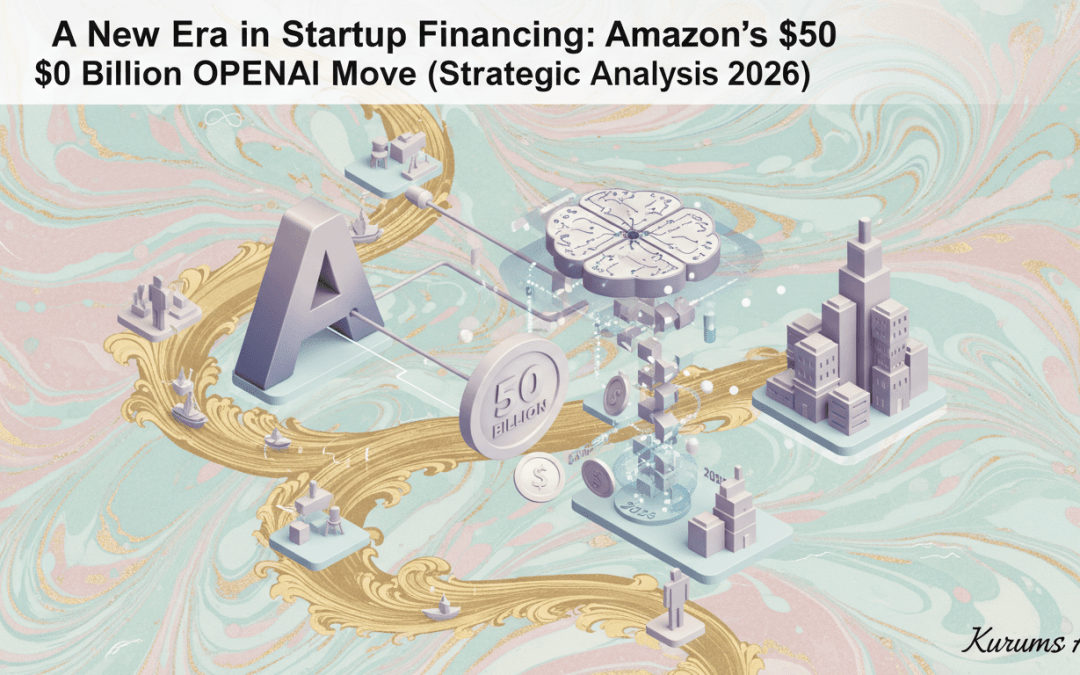
What is the core of the Amazon-OpenAI deal? It is a $50 billion strategic alliance that moves beyond simple cash injections into “compute-for-equity” models, fundamentally altering how AI giants and cloud providers interact.
Why is this happening now? By 2026, the cost of training frontier models has exceeded the capacity of traditional Venture Capital. Strategic corporate alliances are the only way to sustain the massive R&D requirements of AGI (Artificial General Intelligence).
What are the long-term implications? This move signals the end of the traditional “IPO-or-bust” era for AI startups, replaced by deep ecosystem integration where cloud infrastructure is the primary currency of power.
Last Updated: April 28, 2026 | Author: kurums.com Finance Department
The global financial landscape is witnessing a seismic shift. As we navigate the mid-point of 2026, the traditional boundaries between venture capital, corporate strategy, and cloud infrastructure have blurred into a single, massive entity of economic influence. The headline that stopped the world—Amazon’s $50 billion strategic position in OpenAI—is not just a transaction; it is a declaration of a new economic world order. This is no longer about “funding” a startup. It is about the physical and digital integration of the world’s most powerful AI engine into the world’s most expansive logistics and cloud empire.
But why does this matter to you? Because the rules of the game have changed overnight. If you are an investor, a founder, or a policy-maker, the old playbooks are now obsolete. The “Amazon-OpenAI” paradigm represents a move toward sovereign corporate ecosystems where capital is measured not just in dollars, but in FLOPs (Floating Point Operations per Second) and proprietary data access.
The $50 Billion Paradigm: Why Traditional VC is Retreating
For decades, Venture Capital (VC) was the undisputed king of innovation. From the garage-born legends of Silicon Valley to the unicorn era of the 2010s, the model was simple: provide capital, take equity, and exit through an IPO or acquisition. However, as we enter 2026, that model is facing a structural crisis. The sheer scale of capital required to compete in the frontier AI space has outstripped the liquid reserves of even the largest VC funds.
Think about it. When a single training run for a model like GPT-6 costs upwards of $5 billion in electricity and hardware alone, a $100 million Series C round is practically a rounding error. This is where Amazon steps in. By committing $50 billion—a mix of liquid cash, massive AWS compute credits, and co-development rights—Amazon has provided a “permanent capital” structure that traditional VCs simply cannot match.
This shift has led to what analysts call the “Institutionalization of the AI Supply Chain.” When a startup like OpenAI aligns with a provider like Amazon, they aren’t just getting money; they are securing their supply of the most precious resource in the modern world: high-end silicon and energy. The strategic alliance is the new moat.
The Infrastructure-Equity Swap: A New Asset Class
One of the most radical aspects of the Amazon-OpenAI deal is the formalization of “Infrastructure-as-Equity.” In this model, the cloud provider doesn’t just host the startup; they become a co-owner by providing the very air the startup breathes. This creates a feedback loop that is nearly impossible for competitors to break.
The logic is compelling. Amazon utilizes its excess compute capacity (and its specialized Trainium/Inferentia chips) to fuel OpenAI’s research. In exchange, OpenAI’s most advanced models are optimized first for AWS Bedrock, giving Amazon’s corporate clients a six-month lead over the rest of the market. This is vertical integration on a global scale. But there’s more to it than just hardware.
The deal includes “Data Reciprocity Agreements.” While OpenAI maintains its privacy standards, the metadata derived from running these models at Amazon-scale provides a “flywheel” effect. The more OpenAI learns, the better Amazon’s logistics and retail AI becomes. The more Amazon’s retail data grows, the more “real-world grounded” OpenAI’s next-generation models become. It is a symbiotic relationship that redefines the concept of a “strategic investment.”
Comparison: Traditional VC vs. Strategic Corporate Alliances (2026)
| Feature | Traditional VC Model | Strategic Corporate Model (Amazon-OpenAI) |
|---|---|---|
| Primary Capital Source | LP Contributions (Cash) | Balance Sheet + Cloud Infrastructure + R&D Credits |
| Investment Horizon | 7-10 Years (Exit Driven) | Perpetual / Ecosystem Integration |
| Technical Support | General Mentorship | Deep Integration (Chips, Data Centers, Energy) |
| Governance | Board Seat / Control Rights | Observation Rights + Exclusive GTM Partnerships |
| Exit Strategy | IPO or M&A | Deep Strategic Partnership / Revenue Share |
Auto Trend Selection: How AI is Picking the Next Winners
The complexity of the current market has surpassed human analytical capacity. Enter Auto Trend Selection (ATS). In 2026, Amazon and other tech giants are using advanced AI agents to scan the global entrepreneurship ecosystem for the next OpenAI. These ATS systems don’t just look at revenue; they analyze GitHub commits, latent talent migration patterns, and energy consumption signatures of stealth-mode startups.
Why is this significant? Because it removes the “gut feeling” from corporate venture capital. When Amazon committed $50 billion, it wasn’t a gamble; it was the result of a multi-agent simulation that predicted OpenAI’s dominance across 400 different industry verticals. ATS allows these giants to identify “strategic fit” with surgical precision. If a startup fits the trend, the investment offer is generated automatically, often before the founders have even prepared a pitch deck.
But here’s the kicker: The ATS mechanism is now being integrated into the investment contracts themselves. Modern “Smart Term Sheets” can trigger follow-on funding automatically based on real-time performance milestones monitored via API. This reduces friction but also increases the control the corporate giant has over the startup’s operational cadence.
- Real-time Valuation: Startups are valued daily based on model performance and token usage rather than quarterly reports.
- Automated Dilution Protection: Founders are granted “compute-based” anti-dilution clauses to ensure they can keep training models.
- Predictive Hiring: AI systems identify talent gaps and automatically suggest candidates from the corporate parent’s vast network.
- Market Entry Automation: The moment a new feature is developed, ATS identifies which of Amazon’s 200+ business units should deploy it first.
The Antitrust Tightrope: Is an Investment Actually an Acquisition?
As the $50 billion deal moves forward, regulatory bodies in the US, EU, and UK are watching with intense scrutiny. The primary question is: When does a minority stake become a “de facto” acquisition? By controlling the infrastructure (AWS), the chips (Annapurna Labs), and providing the majority of the capital, Amazon exerts a level of influence over OpenAI that mimics traditional ownership, without the regulatory headaches of a full merger.
Regulators are worried that these “Strategic Alliances” are a way to bypass competition laws. If Amazon can lock OpenAI into an exclusive 10-year cloud contract, they have effectively removed OpenAI from the competitive landscape of other cloud providers like Azure or Google Cloud. This “vertical foreclosure” is the new frontline of antitrust litigation in 2026.
To mitigate this, Amazon has structured the deal with “Ethical and Competitive Firewalls.” However, the effectiveness of these firewalls is a matter of heated debate. The reality is that the physical proximity of OpenAI’s clusters within Amazon’s data centers creates a latency advantage that no legal document can truly offset.
The Death of the “Generalist” Startup: Rise of the Verticals
In the wake of this $50 billion move, the era of the “Generalist AI Startup” is effectively over. No small team can compete with the combined might of Amazon and OpenAI in building base models. Instead, we are seeing a massive pivot toward Vertical AI. These are startups that take the foundational power of GPT-6 and apply it to highly specific, high-value domains like sub-surface mineral exploration, quantum chemistry, or hyper-local legal compliance.
Amazon is encouraging this. By opening up the OpenAI-powered Bedrock ecosystem, they are creating a marketplace for these vertical specialists. It’s the “App Store” moment for the AI age. But instead of 99-cent games, we are talking about $10 million-a-year enterprise subscriptions for specialized AI agents.
This shift has led to a reconfiguration of sector balances. Healthcare, Energy, and Logistics are seeing the most significant inflows of capital. The “Sector Rebalancing Index” of 2026 shows that investments in AI-driven biotech have increased by 300% since the Amazon-OpenAI deal was announced, as founders realize that the “platform layer” is now consolidated and the “application layer” is where the remaining gold lies.
Financial Engineering: The Role of Secondary Markets
With IPOs becoming rarer, how do early employees and investors get liquidity? The Amazon-OpenAI deal has popularized the “Structured Secondary Liquidity Window.” Instead of waiting for a public offering, Amazon has committed to a multi-year program where it will buy back shares from OpenAI employees and early investors at pre-defined intervals based on valuation milestones.
This creates a “Private-Public Hybrid” model. OpenAI stays private, avoiding the short-termism of quarterly earnings calls, while still providing its stakeholders with the liquidity typical of a public company. This is a game-changer for talent acquisition. If you can work at a high-growth startup and still have a guaranteed path to cash out your equity every 24 months, why would you ever go to a traditional public company?
Estimated Financial Impact: Sector-Wise Rebalancing (2026-2028)
| Industry Vertical | Projected Investment Growth | Dominant Strategic Partner | Impact Level |
|---|---|---|---|
| Logistics & Supply Chain | +410% | Amazon / OpenAI | Extreme |
| Genomic Medicine | +215% | Google / DeepMind | High |
| Cybersecurity | +180% | Microsoft / OpenAI | High |
| Renewable Energy Grid | +340% | Amazon / Tesla Energy | Extreme |
Global Geopolitics: AI Alliances as State Power
Wait, there’s more. We cannot view the Amazon-OpenAI deal solely through a corporate lens. In 2026, these alliances have become instruments of national power. The US government views the consolidation of AI infrastructure within American companies like Amazon as a “Strategic National Reserve.”
The $50 billion investment ensures that the primary development of AGI stays within the American regulatory and cultural orbit. This has led to a “bipolar” global AI market. On one side, you have the US-based “Corporate-Sovereign” alliances (Amazon, Microsoft, Google); on the other, the state-backed Chinese clusters (Huawei, Baidu, Tencent). The “non-aligned” nations are now scrambling to build their own “Sovereign AI Clouds” to avoid becoming digital vassals to these corporate giants.
The competition is no longer just about who has the best chatbot. It is about who controls the “Intelligence Layer” of the global economy. If Amazon’s logistics network is run by an OpenAI model that is trained on AWS hardware, Amazon essentially controls the “operating system” of physical commerce.
The Talent War: Equity is No Longer Enough
In this new era, attracting the world’s top 0.1% of AI researchers requires more than just a high salary and a 4-year vesting schedule. Talent is gravitating toward these mega-alliances because of Resource Access. A researcher today would rather work at a company with an alliance that provides immediate access to 100,000 H200 GPUs than at a smaller startup with $500 million in the bank but no guaranteed compute supply.
Amazon and OpenAI have pioneered the “Joint Talent Pool.” Researchers can move between OpenAI’s core research and Amazon’s specialized hardware teams without losing their seniority or equity status. This fluidity creates a “brain trust” that is incredibly difficult to disrupt.
- Compute-Guaranteed Compensation: High-level hires are being offered “GPU hours” as part of their signing bonuses, allowing them to pursue personal research side-projects.
- Cross-Ecosystem Mobility: Talent can rotate between the “Pure Research” of OpenAI and the “Applied Engineering” of Amazon AWS.
- AI-Augmented Management: Use of advanced management agents to reduce administrative friction for high-value researchers.
Sovereign AI and the Future of Cloud Computing
The final piece of the puzzle is the shift toward “Sovereign AI.” As Amazon integrates OpenAI, they are building “Region-Locked AI Zones.” For example, a German corporation can use OpenAI models running exclusively on AWS servers within Germany, powered by local renewable energy, and subject only to EU data laws. This “Localized Intelligence” is the only way for global giants to maintain compliance while scaling rapidly.
This is where the $50 billion pays off. By owning the full stack—from the power source to the data center to the model weights—Amazon can offer a level of “Trusted AI” that a fragmented ecosystem cannot. This has led to the “End of the Public Internet” as we knew it, replaced by a series of interconnected, highly-regulated “Corporate Gardens.”
Conclusion: Strategies for the New Era
The Amazon-OpenAI $50 billion deal is the definitive signal that the “Golden Age of the Startup” has evolved into the “Era of the Strategic Giant.” The rules of financing have been rewritten. Liquidity is now structured, capital is infrastructure-heavy, and competition is as much about energy and silicon as it is about software code.
For entrepreneurs, the path forward is clear: Find your niche within the ecosystem or build something so unique that the ATS systems cannot ignore you. For investors, the focus must shift from traditional financial metrics to “Strategic Synergy” and “Compute Moats.”
The window for the “Old World” of financing is closing. As we move further into 2026, those who understand the deep integration of infrastructure and intelligence will lead the next decade of economic growth. The question is no longer whether you can compete with the giants, but how you will position yourself within the new architecture they are building.
Discover more from Kurums | Business Intelligence
Subscribe to get the latest posts sent to your email.