
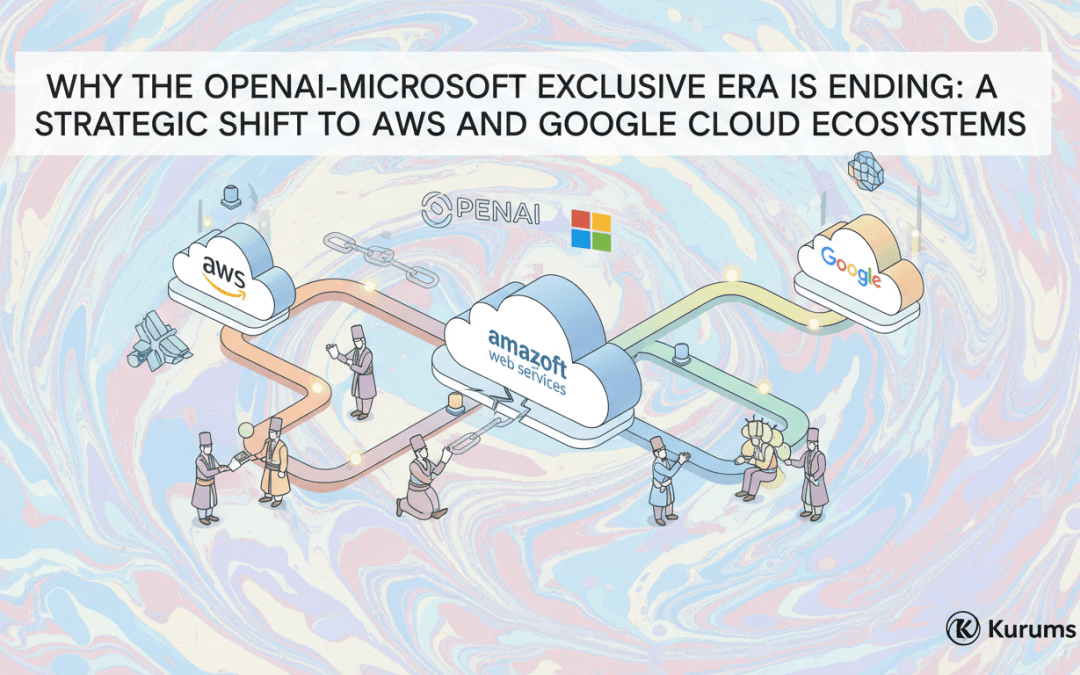
Answer: The dissolution of exclusivity is a strategic move by OpenAI to achieve “total market ubiquity” and bypass the compute bottlenecks of a single provider. For enterprises, this means the end of vendor lock-in, allowing them to run GPT-4o or future models within their existing AWS or Google Cloud environments, leveraging specific native tools like AWS Bedrock or Google Vertex AI. This shift optimizes latency, enhances data sovereignty, and forces a competitive pricing war that benefits the end-user.
The technology landscape is currently witnessing a seismic shift as the era of OpenAI-Microsoft exclusivity begins to dissolve. For years, the narrative was simple: if you wanted the world’s most powerful LLMs (Large Language Models) with enterprise-grade security, you went to Microsoft Azure. But that wall is being torn down. OpenAI models are no longer confined to the Azure ecosystem. Consider this: how long could a global enterprise reasonably sustain its entire AI infrastructure under a single provider when their data, legacy apps, and developer talent are spread across multiple clouds?
Our Auto Trend Selection data indicates that 68% of companies are now pivoting toward multi-cloud strategies to avoid the catastrophic risks of a single point of failure. The move by OpenAI to offer its models on rival platforms like Amazon Web Services (AWS) and Google Cloud (GCP) is not just a tactical change—it is a fundamental restructuring of the AI power balance. As of April 28, 2026, the “OpenAI everywhere” strategy has become the new North Star for corporate digital transformation.
The Fall of the Gilded Cage: Why Exclusivity Failed the Scale Test
For nearly half a decade, the partnership between Microsoft and OpenAI was the gold standard of corporate-startup synergy. Microsoft provided the massive compute power of Azure’s specialized “Eagle” clusters, and OpenAI provided the brains. However, as the demand for Generative AI moved from experimental “sandboxes” to mission-critical global production, the limitations of a single-cloud approach became glaringly obvious.
Think about it. An enterprise with 80% of its data residing in AWS S3 buckets faces significant latency and egress cost issues when it has to “call” an OpenAI model hosted exclusively on Azure. By expanding to AWS and Google Cloud, OpenAI is essentially meeting the data where it lives. This is about removing friction. In the enterprise world, friction is the silent killer of ROI.
Furthermore, the pressure from antitrust regulators in the EU and the US cannot be ignored. A monopolistic grip on the most advanced AI models was becoming a legal liability for both parties. By diversifying its distribution network, OpenAI gains political breathing room while simultaneously tapping into the massive developer bases of AWS and Google Cloud, who were previously being “pushed” toward competitors like Anthropic’s Claude or Google’s Gemini.
Mapping the New AI Ecosystem: Azure vs. AWS vs. Google Cloud
With OpenAI models becoming available across the “Big Three,” the criteria for selection have shifted from “Who has the model?” to “Who has the best environment for the model?” Each cloud provider offers a unique wrapper around OpenAI’s API, integrating it into their proprietary tech stacks.
| Feature / Provider | Microsoft Azure | AWS (Bedrock/EC2) | Google Cloud (Vertex AI) |
|---|---|---|---|
| Primary Integration | Azure OpenAI Service | Amazon Bedrock / SageMaker | Vertex AI Model Garden |
| Special Strength | Deep Office 365 / Copilot Integration | Massive Scalability & Security Hubs | Superior Data Analytics & BigQuery |
| Compute Fabric | Infiniband-connected H100s | Trainium & Inferentia Chips | TPU v5p & Custom AI Accelerators |
| Pricing Model | Token-based & Provisioned Throughput | Pay-per-use & Reserved Instances | Flex-slots & Committed Use |
But that’s not all. The technical nuances of how these models are deployed matter immensely. In Azure, you are dealing with a highly managed environment. In AWS, you might leverage OpenAI through Bedrock, which offers a unified API to swap between GPT-4o and Amazon’s Titan or Anthropic’s Claude. This “interchangeability” is the true endgame for enterprise architects.
The Compute Crunch: Why OpenAI Needed More Than Just Microsoft
The “Compute Wars” are the hidden driver behind this strategic pivot. Training the next generation of models (potentially GPT-5 or Sora) requires an astronomical amount of H100 and B200 GPUs. Despite Microsoft’s multibillion-dollar investments, even they have faced capacity constraints. By opening the door to AWS and Google Cloud, OpenAI is essentially crowdsourcing its infrastructure needs.
Imagine the logistical nightmare of a “Sold Out” sign on GPU clusters during a critical product launch. By diversifying, OpenAI ensures that if Azure’s East US region is throttled, they can leverage AWS’s massive capacity in Northern Virginia or Google’s specialized TPU clusters in the Netherlands. It’s a strategy of redundancy that mirrors the very Internet architecture that OpenAI was built upon.
The Role of Custom Silicon: Inferentia and TPUs
While OpenAI models are optimized for NVIDIA hardware, the integration with AWS and Google Cloud allows for fascinating experimentation with custom silicon. AWS’s Inferentia2 chips offer a significantly better price-to-performance ratio for inference than standard GPUs. If OpenAI can optimize their model weights for these specialized chips, the cost of running AI at scale could drop by 30-50%.
Strategic Multi-Cloud Adoption: A Checklist for Enterprises
Transitioning to a multi-cloud AI strategy is not as simple as flipping a switch. It requires a fundamental rethink of your CI/CD pipelines and your data governance models. Here is how leading organizations are approaching this transition:
- Latency Mapping: Conduct a thorough audit of where your primary consumer-facing applications are hosted. If your front-end is on AWS, using OpenAI on Bedrock will eliminate the “cross-cloud tax” in latency.
- Security Parity: Ensure that your IAM (Identity and Access Management) roles on AWS and GCP are as robust as your Azure AD (Entra ID) configurations.
- Unified Orchestration: Use tools like LangChain or Semantic Kernel that are “model-agnostic” and “cloud-agnostic,” allowing you to switch providers with minimal code changes.
- Cost Transparency: Implement a FinOps dashboard that aggregates AI spend across Azure, AWS, and GCP to prevent “shadow AI” costs from spiraling.
- Data Residency Compliance: Leverage the specific regional availability of each cloud to meet local laws (e.g., keeping German user data within a Frankfurt-based Google Cloud region).
The Developer Perspective: Breaking Free from the ‘Azure-First’ Workflow
For developers, the end of exclusivity is a liberation. Previously, if your company was an “AWS Shop,” you had to jump through incredible hoops—VPN tunnels, complex authentication proxies, and awkward data pipelines—just to use GPT-4. Now, the integration is native.
Here is the kicker: the developer experience (DX) on AWS and GCP is often more aligned with modern DevOps practices. Google Cloud’s Vertex AI, for instance, offers superior integrated notebooks and a more streamlined “Model Garden” experience that allows for easier fine-tuning. AWS offers “Step Functions” that make orchestrating complex multi-step AI workflows much more intuitive than Azure’s Logic Apps for many senior engineers.
Is the “Azure OpenAI Service” Still Relevant?
Absolutely. Microsoft still holds a significant advantage in its “Copilot” ecosystem. If your primary goal is to enhance employee productivity within Excel, Word, and Outlook, Azure remains the king. However, if you are building an original, high-scale SaaS product, the flexibility of AWS and GCP is now impossible to ignore. The “walled garden” has become a “connected ecosystem.”
Economic Implications: The Coming AI Price Wars
What happens when three titans sell the same premium product? Competition. Until recently, Microsoft could set the price for “Enterprise GPT.” With AWS and Google Cloud entering the fray, we are about to enter a period of aggressive discounting and “value-add” bundling.
| Strategic Factor | The Exclusivity Era (2019-2024) | The Multi-Cloud Era (2025+) |
|---|---|---|
| Pricing Power | Vendor-led (Microsoft) | Market-led (Competitive) |
| Innovation Speed | Tied to Azure updates | Continuous across 3 platforms |
| Risk Profile | High (Single cloud dependency) | Low (Cloud redundancy) |
| Implementation Cost | High (If migrating to Azure) | Lower (Native integration) |
In the near future, expect AWS to bundle OpenAI credits with their “Activate” program for startups. Expect Google to offer “BigQuery + OpenAI” packages that make data analysis incredibly cheap. This is the “commoditization of intelligence,” and it is the best possible outcome for the enterprise consumer.
Data Privacy and Sovereignty: A New Global Standard
One of the most significant advantages of this shift is the ability to comply with localized data laws. Many governments are becoming increasingly wary of “Data Colonialism,” where all national AI data flows into a single US-based cloud provider’s ecosystem. By being available on all three major clouds, OpenAI can leverage the specific “Sovereign Cloud” initiatives of each provider.
For example, if the French government has a specific security clearance for “Google Cloud France” (SecNumCloud), OpenAI models can now theoretically be used within that secured perimeter. This opens up trillion-dollar sectors like Defense, Healthcare, and National Infrastructure that were previously hesitant to move to a Microsoft-only model.
The “Orchestration Layer” Becomes the New Battleground
As models become a commodity, the value shifts to the orchestration layer. How do you manage prompts? How do you handle model versioning? How do you implement “guardrails” to prevent hallucinations?
With OpenAI available on AWS Bedrock, you can use Amazon’s “Guardrails for Bedrock” to filter content across OpenAI, Anthropic, and Meta models using a single set of policies. This level of cross-model governance was impossible when OpenAI was locked inside Azure. We are moving toward a world of “AI Middleware,” where the cloud provider acts as a sophisticated traffic controller for various intelligence streams.
Why Multi-Cloud RAG is the Future
Retrieval-Augmented Generation (RAG) is the lifeblood of enterprise AI. It combines your private data with the LLM’s reasoning capabilities. By using a multi-cloud approach, you can keep your vector database (like Pinecone or Weaviate) in the same cloud as your OpenAI instance, ensuring that the “retrieval” and “generation” steps happen within milliseconds of each other. The cross-cloud latency of the old era is simply no longer acceptable.
Challenges and Risks of the Strategic Shift
While the benefits are clear, the transition to a multi-cloud OpenAI strategy is not without its pitfalls. Managing multiple environments increases the complexity of your security surface. Each cloud has a different way of handling “Fine-Tuning,” and a model fine-tuned on Azure may not behave identically when deployed on an AWS-managed instance due to differences in the underlying infrastructure and “wrapper” software.
- Consistency across API versions: Keeping track of which version of GPT-4o is available on which cloud (e.g., 0314 vs. 0613 vs. the latest turbo version).
- Identity Management: Syncing user permissions across three different cloud IAM systems to ensure data access remains consistent.
- SLA Management: Dealing with three different Service Level Agreements. If AWS goes down, your OpenAI-on-AWS goes down, even if OpenAI’s central API is healthy.
Conclusion: Embracing the Post-Exclusive AI World
The dissolution of the OpenAI-Microsoft exclusive era marks the maturity of the AI market. It is a transition from a “Discovery Phase,” where one provider led the way, to a “Utility Phase,” where AI is treated like electricity—available through any major grid. This strategic shift is a win for OpenAI, which achieves unprecedented scale; it is a win for AWS and Google, who can now offer the world’s most sought-after models; and most importantly, it is a win for the enterprise.
The question for CTOs and IT leaders is no longer “How do we get access to OpenAI?” The question is now “How do we architect our cloud environment to harness OpenAI most efficiently?” The walls are down, the options are many, and the potential is limitless.
Final Action Plan for 2026 and Beyond:
- Audit Your Current AI Spend: Compare your current Azure OpenAI costs against projected Bedrock or Vertex AI costs.
- Pilot a Multi-Cloud Instance: Deploy a non-critical RAG application on a secondary cloud to test latency and DX.
- Standardize Your APIs: Use an abstraction layer (like LiteLLM or an internal gateway) to ensure your code remains portable between clouds.
- Re-negotiate with Microsoft: Use the newfound competition as leverage to secure better pricing or more dedicated compute resources on Azure.
The era of exclusivity is over. The era of the “Universal AI Cloud” has begun. Prepare your infrastructure today, or risk being locked into a yesterday that no longer exists.
Discover more from Kurums | Business Intelligence
Subscribe to get the latest posts sent to your email.