
What is Technical Debt 2.0? Unlike traditional software debt, Technical Debt 2.0 focuses on the hidden, compounding costs of AI model decay, data pipeline fragility, and non-linear failure modes that do not appear on standard financial ledgers.
How does it impact enterprise value? It creates “invisible liabilities” that can lead to sudden, exponential operational costs, regulatory fines, and brand erosion, effectively acting as a high-interest, unhedged loan against the company’s future EBITDA.
What is the Financial Controller’s role? Controllers must move beyond static auditing to dynamic oversight, treating AI feedback loops and data dependencies as balance sheet items that require regular valuation and risk-mitigation strategies.
Last Update: May 27, 2026
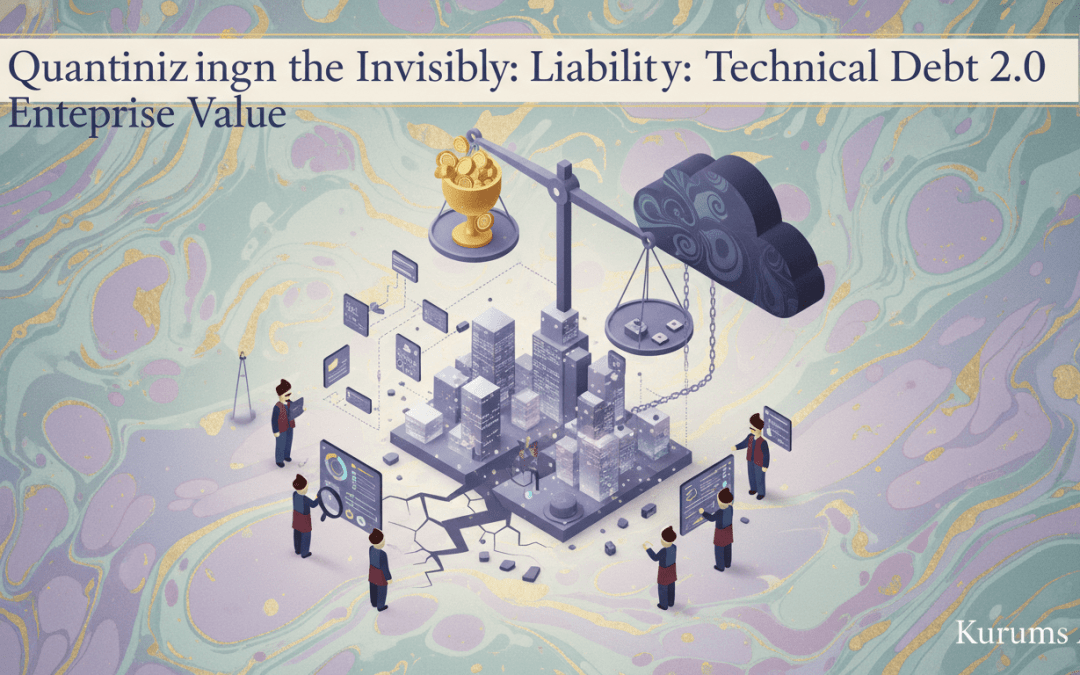
Quantifying the Invisible Liability: How Technical Debt 2.0 Erodes Enterprise Value
For decades, the term “Technical Debt” was relegated to the basement of IT departments. It was a developer’s problem—a shortcut taken today that would need to be refactored tomorrow. However, as we enter the mid-2020s, the paradigm has shifted. We are no longer dealing with simple code inefficiency. We are facing Technical Debt 2.0: the systemic, non-linear risks embedded within Enterprise AI and Machine Learning (ML) ecosystems.
For the modern Financial Controller, this isn’t just a technical nuance; it is a profound valuation challenge. If your organization has deployed AI to optimize supply chains, automate customer service, or manage algorithmic trading, you are likely carrying a massive, unquantified liability on your balance sheet. The real kicker? These liabilities don’t behave like traditional debt. They are non-linear, meaning a small change in data input can lead to a catastrophic, exponential collapse in system performance.
In this comprehensive guide, we will explore how to identify, quantify, and audit these invisible liabilities before they trigger a “Flash Crash” of corporate operational efficiency.
Section 1: Redefining Debt—From Software 1.0 to AI 2.0
Traditional technical debt is predictable. If you write messy code, it takes longer to add new features. The cost is linear and human-centric. Technical Debt 2.0, however, is algorithmic and data-centric. It lives in the “black box” of AI models where the relationship between cause and effect is often obscured by high-dimensional mathematics.
Think of it this way: Software 1.0 is a machine built of gears. If a gear breaks, you replace it. AI 2.0 is an ecosystem. If the “soil” (data) becomes toxic, the entire “crop” (model output) fails, often without immediate warning signs. This shift requires a fundamental change in how financial leadership views technology assets.
| Feature | Technical Debt 1.0 (Legacy Software) | Technical Debt 2.0 (Enterprise AI) |
|---|---|---|
| Primary Driver | Bad code, lack of documentation. | Data dependencies, model drift, feedback loops. |
| Cost Profile | Linear (More work = More time). | Non-Linear (Small shift = System collapse). |
| Auditability | High (Code reviews, static analysis). | Low (Black-box models, dynamic data). |
| Financial Impact | Operational Expense (OpEx) increase. | Balance Sheet Risk & Enterprise Value Erosion. |
Section 2: The Anatomy of Non-Linear Failure Modes
Why should a Financial Controller care about “non-linear failure modes”? Because in the world of finance, non-linearity is synonymous with volatility. Traditional systems fail gracefully—one feature stops working, but the rest of the engine keeps humming. AI systems, conversely, fail “explosively.”
A non-linear failure occurs when a marginal change in input leads to a disproportionate change in output. For an AI-driven pricing engine, a 1% shift in consumer sentiment data might not result in a 1% price adjustment, but rather a 50% price crash if the model reaches a “tipping point” or enters a feedback loop with competitor bots. This is where the “invisible liability” manifests. You aren’t just paying for maintenance; you are holding a “short position” on your own operational stability.
Section 3: Auditing the Black Box—The Controller’s New Mandate
Financial controllers are traditionally trained to audit transactions, assets, and cash flows. However, the AI-driven enterprise requires auditing probabilistic outcomes. You are no longer auditing what happened; you are auditing the reliability of the mechanism that decides what happens.
But here is the real challenge: How do you audit a system that learns and changes every second? The answer lies in “Pipeline Auditing.” Rather than looking at the model itself, controllers must look at the data lineage and the constraints placed upon the model’s decision-making power. If there are no “circuit breakers” in the AI’s financial logic, that is a massive, unhedged liability.
The “CACE” Principle: Changing Anything Changes Everything
In AI development, the “CACE” principle is a primary driver of technical debt. When a data scientist tweaks one variable in a neural network to improve accuracy in Region A, it may unknowingly degrade performance in Region B. For a controller, this means that “improvements” can actually be “liabilities in disguise.”
- ✔️ Verify Data Lineage: Do we know exactly where the training data came from and if it carries legal or quality debt?
- ✔️ Audit Hyper-parameter Shifts: Were the model’s internal settings changed without a corresponding financial risk assessment?
- ✔️ Assess Model Cascades: Does the output of Model A feed into Model B? If so, an error in A will be magnified exponentially in B.
Section 4: Data Pipeline Fragility—The Hidden Cost of “Dirty” Fuel
If AI is the engine, data is the fuel. Most enterprises are running on “low-octane” or “contaminated” fuel. Technical Debt 2.0 accumulates when organizations build complex models on top of unstable data pipelines. If a third-party data provider changes their API format, or if a sensor in a factory begins to drift, the AI model will continue to produce “answers,” but they will be wrong.
Wait, it gets worse. Because these systems are automated, the wrong decisions are made at machine speed. By the time a human controller notices a discrepancy in the quarterly reports, the AI might have already misallocated millions of dollars in capital. This “detection lag” is a core component of the total cost of technical debt.
Section 5: Model Decay and Performance Drift
In the financial world, we understand depreciation. A delivery truck loses value as it ages. In AI, models suffer from Model Decay (or Concept Drift). The world changes—inflation rises, consumer habits shift, new regulations are enacted—but the model is stuck in the past, trained on historical data that is no longer relevant.
A model that was a $10 million asset on January 1st might be a $5 million liability by June 1st if it hasn’t been retrained to account for market shifts. This is “Digital Depreciation,” and it must be accounted for in the valuation of the firm’s intangible assets.
Section 6: Quantifying the Invisible—Financial Metrics for AI Debt
How does a controller actually put a dollar sign on Technical Debt 2.0? It requires a move toward Probabilistic Financial Modeling. Instead of a single number, controllers should view AI value as a range of outcomes. Below is a framework for quantifying these risks.
| Metric | Definition | Calculation Method |
|---|---|---|
| Remediation Cost (RC) | The cost to retrain and redeploy the model. | (Compute hours x Cost) + (Data Scientist Hours x Rate) |
| Opportunity Cost of Drift (OCD) | Revenue lost due to sub-optimal AI decisions. | (Expected Revenue – Actual AI-Driven Revenue) |
| Liability Exposure (LE) | Potential fines or legal costs from biased/erroneous AI. | Probability of failure x Estimated Regulatory Fine |
| Debt Ratio | The ratio of maintenance costs to innovation costs. | AI Maintenance Budget / AI R&D Budget |
Section 7: The Correction Cascade—When Debt Becomes a Crisis
In 2026, we are seeing the rise of the “Correction Cascade.” This happens when a minor error in an upstream AI system triggers a series of automated corrections in downstream systems, leading to a total operational freeze. For a Financial Controller, this is the equivalent of a margin call.
Think about a retail giant. Their demand-forecasting AI makes a 5% error. This error flows into the automated procurement AI, which overbuys inventory. This triggers the logistics AI to rent extra warehouse space at premium rates. Finally, the pricing AI slashes prices to move the excess stock, destroying the quarter’s margins. This is the non-linear nature of Technical Debt 2.0 in action. Every “smart” system amplified the original error.
Section 8: Regulatory and Compliance Risks—The Legal Debt
With the advent of the EU AI Act and similar global regulations, Technical Debt 2.0 now has a legal dimension. If your AI model is a “black box” and cannot be explained to a regulator, that is a legal liability. If your data was harvested without proper consent, that is a compliance debt that could lead to fines reaching 7% of global turnover.
Controllers must ensure that “Explainability” is not just a technical feature, but a financial safeguard. If you cannot explain how the AI arrived at a financial decision, you cannot defend that decision in a court of law or an audit chamber.
- ✔️ Model Transparency: Ensure all AI systems have a “Human-in-the-loop” for high-stakes financial decisions.
- ✔️ Bias Auditing: Regularly test models for discriminatory outputs that could trigger ESG-related liabilities.
- ✔️ Data Provenance: Maintain a clear audit trail of all data used for model training to mitigate IP theft risks.
Section 9: Mitigating AI Debt—Strategies for the C-Suite
How do we stop the erosion of enterprise value? It starts with a shift from “AI First” to “Sustainable AI.” Organizations must treat AI development as a lifecycle, not a one-time project. This means budgeting for “Model Maintenance” with the same rigor as “Model Development.”
But wait, there’s a more proactive approach: Modularization. By breaking down large, monolithic AI systems into smaller, independent “micro-models,” organizations can contain the damage of a non-linear failure. If one micro-model fails, it doesn’t take the whole enterprise down with it. This is the equivalent of “diversifying your portfolio” within your own technology stack.
Section 10: Building an AI-Resilient Balance Sheet
To truly manage Technical Debt 2.0, financial leadership must integrate technical health metrics into the quarterly reporting cycle. We need to move toward an “Adjusted EBITDA” that accounts for the potential “remediation interest” of our AI systems.
The Role of the “Algorithmic Internal Auditor”
The future of the finance department includes a new role: the Algorithmic Internal Auditor. This individual bridges the gap between the Data Science team and the Controller’s office. Their job is to translate “Mean Squared Error” into “Loss Given Default” and “Model Variance” into “Earnings Volatility.”
- ✔️ Cross-Functional Oversight: Establish a committee including the CFO, CTO, and Chief Risk Officer to review AI debt levels.
- ✔️ Stress Testing: Conduct regular “What-If” scenarios to see how the AI responds to extreme market data.
- ✔️ Vendor Transparency: Demand “Service Level Agreements” (SLAs) from AI vendors that specifically address model drift and failure modes.
Conclusion: The New Frontier of Financial Leadership
Technical Debt 2.0 is the defining financial challenge of the AI era. It is an invisible, compounding, and non-linear liability that can erode enterprise value faster than any traditional market force. For Financial Controllers, the message is clear: ignore the “black box” at your own peril.
By treating AI models as dynamic, depreciating assets and auditing the pipelines that fuel them, you can transform a hidden liability into a competitive advantage. The goal is not to eliminate technical debt—that is impossible in a fast-moving world—but to manage its interest rate. When you control the debt, you control the future of the enterprise.
Call to Action: Start by conducting a “Technical Debt Audit” of your top three AI-driven processes. Identify the data dependencies, quantify the potential cost of a non-linear failure, and begin reflecting these risks in your internal risk assessments. The era of the “Invisible Liability” is over; it’s time to bring AI debt into the light of the ledger.
Discover more from Kurums | Business Intelligence
Subscribe to get the latest posts sent to your email.