
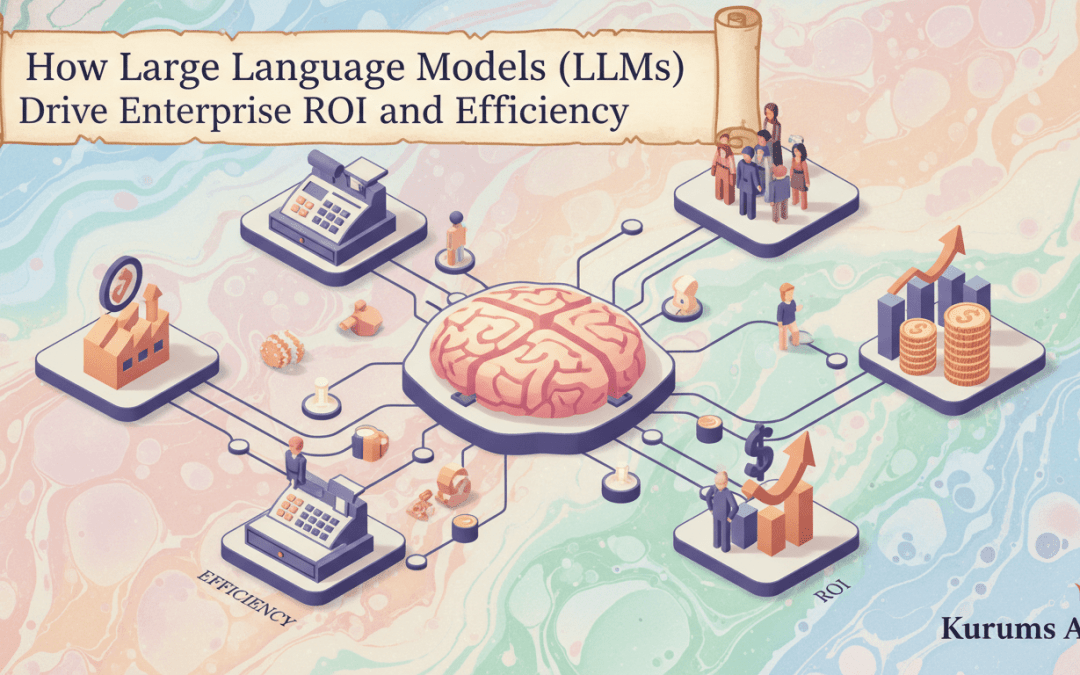
- What is an LLM? A deep learning model, specifically using the Transformer architecture, trained on trillions of tokens to perform sophisticated linguistic tasks.
- The Core Advantage: Unlike traditional automation, LLMs process unstructured data (emails, PDFs, voice) into actionable insights with human-like reasoning.
- ROI Impact: Enterprises report up to 40-50% operational cost reductions in data-heavy departments like Finance, Legal, and Customer Support.
- Technical Strategy: Successful integration relies on RAG (Retrieval-Augmented Generation) to minimize hallucinations and maximize data security.
Imagine a CFO tasked with auditing tens of thousands of internal transactions across dozens of global branches. In the traditional era, processing this would take a dedicated team months of manual labor, prone to fatigue and oversight. However, today, Large Language Models (LLMs) can ingest this gargantuan dataset in seconds, identifying anomalies with surgical precision and providing a summarized risk report before the morning coffee is cold.
We are no longer in the “hype” phase of Artificial Intelligence. We have entered the era of the AI-Driven Enterprise. But what exactly happens under the hood? Why are multi-billion dollar corporations shifting their entire tech stacks to accommodate these models? To understand the ROI, we must first dissect the technical DNA of these digital powerhouses.
Last Updated: May 27, 2026
What Is a Large Language Model and Why Does It Matter for the Modern CEO?
At its simplest level, an LLM is a type of artificial intelligence trained on petabytes of text data. However, for a professional enterprise environment, this definition is too surface-level. An LLM is a complex mathematical structure—a neural network with billions (and now trillions) of parameters—designed to predict the next “token” or piece of information in a sequence.
Think of parameters as the “synapses” of the AI. The more parameters a model has, the more nuance it can capture. For a business, this means the difference between a chatbot that says “I don’t understand” and an AI agent that says “Based on the 2024 Q3 tax regulations in Germany, your filing requires an additional VAT disclosure for cross-border services.”
The real magic lies in the Transformer architecture. Before Transformers, AI processed text sequentially (word by word). Transformers utilize “Self-Attention” mechanisms, allowing the model to look at an entire paragraph simultaneously. It understands that the word “bank” in a financial document refers to a monetary institution, whereas in a geographical report, it refers to a river edge. This contextual awareness is why LLMs are revolutionizing enterprise workflows.
The ROI Equation: Quantifying the Efficiency of Large Language Models
Calculating the ROI of an LLM isn’t just about “saving time.” It’s about shifting the cost curve of knowledge work. In a typical enterprise, the cost of processing information is linear: if you have twice as many documents, you need twice as many people (or twice as much time). LLMs make this cost logarithmic.
Here is the kicker: the true ROI is found in three distinct areas:
- Direct Labor Savings: Automating repetitive tasks like email drafting, meeting summarization, and data entry.
- Speed to Market: Reducing the time it takes to analyze market trends or generate product documentation from weeks to hours.
- Error Reduction: Using AI as a “second pair of eyes” to catch inconsistencies in complex technical or financial data that humans might miss due to “cognitive fatigue.”
But how does this look in numbers? Let’s compare a traditional document review process against an LLM-accelerated workflow.
| Metric | Manual Workflow (Team of 5) | LLM-Enhanced Workflow | Efficiency Gain |
|---|---|---|---|
| Processing 1,000 Contracts | ~150 Hours | ~2 Hours (incl. human audit) | 98.6% |
| Accuracy Rate | 92% (Human error margin) | 99.2% (Consistency check) | +7.2% |
| Cost per Document | $45.00 | $1.20 (API + Human Review) | 97.3% Reduction |
Deep Dive: The Technical Pillars of Enterprise LLM Deployment
To achieve the ROI mentioned above, businesses cannot simply use a “public” chatbot. There are three technical integration strategies that dictate performance and security.
1. Retrieval-Augmented Generation (RAG)
RAG is currently the “Gold Standard” for enterprise AI. Instead of relying solely on the LLM’s pre-trained knowledge (which might be outdated), RAG connects the model to your company’s private database. When a user asks a question, the system searches your private documents first, retrieves the relevant text, and feeds it to the LLM to summarize.
Why does this matter? It virtually eliminates hallucinations. The model is forced to cite its sources from your internal data.
2. Fine-Tuning
While RAG provides the facts, Fine-Tuning provides the tone and specialized vocabulary. If you are in a niche field like Oncology or Quantum Computing, the “base” LLM might not understand your specific jargon. Fine-tuning involves retraining the model on a smaller, curated dataset of your specific industry language.
Sector Spotlight: Finance, Law, and Human Resources
How are these technologies actually being used in the trenches? Let’s explore the three sectors seeing the highest immediate ROI.
Finance: Beyond Simple Calculations
In Finance, LLMs are being used for “Sentiment Analysis” on earnings calls and news reports. By analyzing thousands of data points simultaneously, LLMs can predict market volatility shifts before they occur. Furthermore, they automate the Know Your Customer (KYC) and Anti-Money Laundering (AML) processes, which previously required thousands of man-hours to cross-reference sanctions lists and transaction histories.
Legal: The End of the “Billable Hour” Trap?
Law firms are using LLMs to perform “Discovery.” This involves scanning millions of emails and memos to find evidence for a case. An LLM can be trained to look for specific “intent” rather than just keywords, making the discovery process much more robust. For corporate legal departments, LLMs generate the first drafts of NDAs or Service Agreements, ensuring that all standard clauses are present and compliant with local laws.
Human Resources: Personalized Employee Lifecycle
HR departments leverage LLMs to move beyond simple keyword-matching in resumes. Modern LLM-based recruitment tools can evaluate the quality of an applicant’s experience and how well their tone matches the corporate culture. Additionally, internal “HR Bots” can handle 90% of employee queries regarding benefits, leave policies, and payroll, freeing HR managers for strategic talent development.
- Candidate Screening: Contextual analysis of resumes vs. job descriptions.
- Onboarding: AI-driven personalized training paths for new hires.
- Compliance: Automatic monitoring of changing labor laws across different jurisdictions.
Overcoming the “Black Box” Problem: Transparency and Governance
One of the biggest hurdles for enterprise adoption is the perceived “lack of control.” How can you trust a model that you can’t see “inside” of? This is where AI Governance comes in. To successfully deploy LLMs, an organization must establish a Responsible AI Framework.
Wait, it gets even more critical: Governance isn’t just about ethics; it’s about reliability. If an LLM gives different answers to the same question on different days, it’s useless for financial reporting. This is why “Temperature Control” and “Seed Management” are vital technical settings. By setting the “temperature” to 0, you ensure the model is deterministic—meaning it provides the most probable, consistent answer every time, rather than being “creative.”
| Deployment Risk | Mitigation Strategy | Technical Tooling |
|---|---|---|
| Hallucinations | Implement RAG & Fact-Checking Layers | Vector Databases (Pinecone, Milvus) |
| Data Leakage | Private Instance Deployment | Azure AI Studio / AWS Bedrock |
| Bias in Output | RLHF (Reinforcement Learning from Human Feedback) | Human-in-the-loop (HITL) Workflows |
The “Tokenomics” of Enterprise AI: Managing Costs
Every interaction with an LLM has a cost, measured in Tokens. A token is roughly 0.75 of a word. For a small business, this cost is negligible. For an enterprise processing millions of requests a day, “Token Burn” can become a significant line item on the balance sheet.
To optimize for ROI, architects must use “Model Tiering.” You don’t need a massive, expensive model (like GPT-4o or Claude 3.5 Sonnet) to summarize a simple internal memo. You can use a smaller, faster, and cheaper model (like Llama 3-8B or Mistral 7B) for simple tasks, and only “escalate” complex reasoning tasks to the high-tier models. This strategy, known as Model Routing, can save enterprises up to 70% on API costs.
The Future: From LLMs to AI Agents
We are currently moving from “Chatbots” to “Autonomous Agents.” An LLM-based agent doesn’t just write a response; it takes action. It can log into your CRM, update a lead’s status, send a follow-up email, and schedule a meeting in your calendar—all without human intervention.
But how do we prepare for this? The foundation is data. If your company’s data is messy, fragmented, or stored in silos, an LLM will struggle. The first step toward enterprise AI ROI is Data Democratization—ensuring your data is clean, indexed, and accessible to the models.
Ethical Considerations and Long-Term Sustainability
As we integrate LLMs deeper into our corporate DNA, we must address the ethical implications. Will AI replace workers? The data suggests a “Copilot” model is more likely. AI handles the “drudge work,” while humans focus on high-level strategy, empathy, and creative problem-solving. Companies that position AI as a tool for augmentation rather than replacement see higher employee satisfaction and better long-term ROI.
- Transparency: Employees and customers should know when they are interacting with an AI.
- Accountability: A human must always be responsible for the final output of an AI system in high-stakes environments.
- Sustainability: Be mindful of the carbon footprint of training and running large-scale models; opt for “Green AI” providers where possible.
Conclusion: The Path Forward for Your Enterprise
Large Language Models are no longer a luxury; they are a fundamental utility for the competitive modern enterprise. From reducing operational costs by 40% to unlocking new insights from dark data, the ROI is undeniable. However, success is not found in the “plug-and-play” of a single model. It is found in the strategic architecture: utilizing RAG for accuracy, fine-tuning for brand voice, and model routing for cost efficiency.
Are you ready to transform your data into a competitive advantage? The first step is a comprehensive AI Audit. Identify your most data-heavy, repetitive processes and start with a pilot program. The future of your industry is being written in tokens—make sure your enterprise is the one holding the pen.
Start your journey today by integrating LLM workflows that prioritize security, scalability, and measurable ROI. The window of opportunity to be an “Early Adopter” is closing—the time to act is now.
Discover more from Kurums | Business Intelligence
Subscribe to get the latest posts sent to your email.