
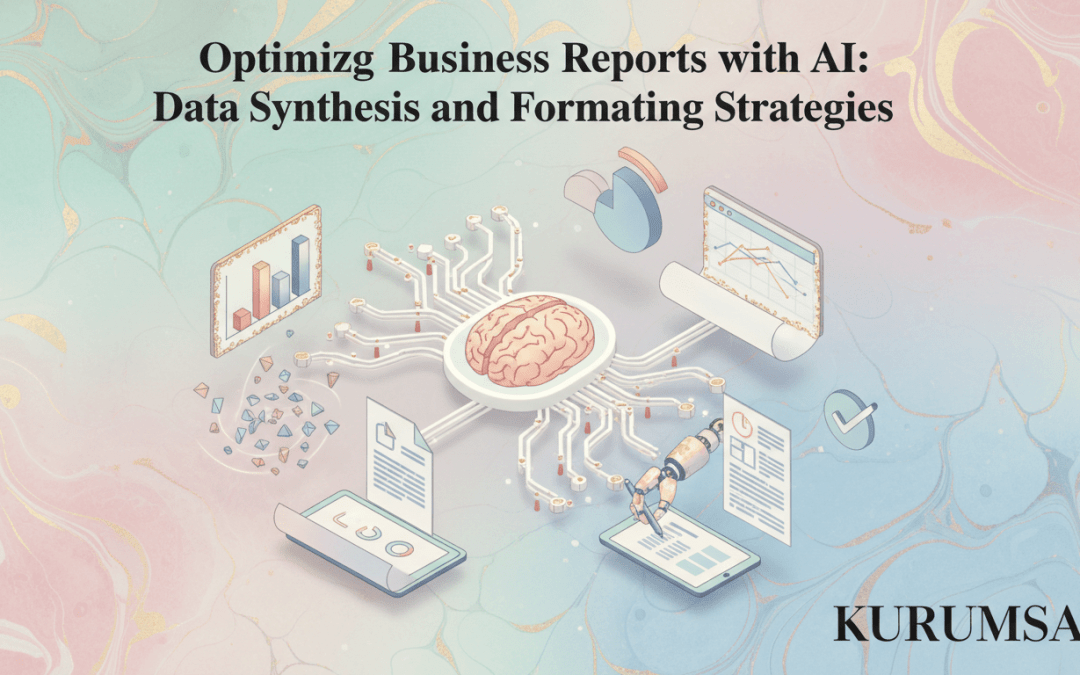
- What is data synthesis in business reporting? It is the AI-driven process of combining disparate data sources into a cohesive, strategic narrative.
- How does AI ensure professional formatting? By using predefined templates, style guides, and CSS/LaTeX-based generation to maintain brand consistency.
- Can AI handle sensitive corporate data? Yes, through “Private LLMs” and secure RAG (Retrieval-Augmented Generation) frameworks that keep data within the corporate firewall.
- What is the main benefit? Speed and clarity. Executives can move from raw data to actionable insights in seconds rather than days.
When a critical strategic decision is on the line, is your 100-page data dump a hurdle or a catalyst? For most executives, the bottleneck is not the lack of information but the speed at which that data is synthesized into a coherent narrative. Artificial Intelligence (AI) has shifted the paradigm, turning business reporting from a tedious task into a high-octane competitive advantage.
In the modern corporate landscape, we are drowning in data but starving for wisdom. Traditional reporting methods—where analysts spend 80% of their time cleaning data and only 20% analyzing it—are no longer sustainable. AI flips this ratio on its head. By leveraging Natural Language Processing (NLP) and advanced machine learning models, businesses can now automate the “heavy lifting” of data processing. But how exactly does this transition happen, and what are the strategies to ensure the output is not just “generated,” but truly professional? Let’s dive deep.
1. The Evolution of Business Reporting: From Manual Spreadsheets to AI-Driven Insights
For decades, the standard for business reporting was the spreadsheet. It was a manual, error-prone process that relied heavily on the individual skill of an analyst. Then came Business Intelligence (BI) tools, which offered better visualizations but still required significant manual configuration.
Today, we are in the era of Generative AI and Cognitive Reporting. This isn’t just about making charts; it’s about the machine understanding the context of the data. When an AI looks at a quarterly revenue dip, it doesn’t just see a lower number; it can cross-reference market trends, internal supply chain disruptions, and even social media sentiment to tell you why it happened.
But here is the kicker: the most sophisticated data analysis in the world is useless if it isn’t presented in a way that humans can digest. This is where the intersection of data synthesis and formatting becomes critical. AI tools are now capable of not only crunching the numbers but also structuring the output into executive summaries, SWOT analyses, and strategic recommendations.
2. Understanding Data Synthesis: The Core of Strategic Intelligence
What exactly is data synthesis? It is the process of integrating various information components into a unified whole. In a corporate setting, this means taking unstructured data (emails, meeting notes, industry news) and structured data (ERP outputs, sales figures, inventory levels) and finding the “red thread” that connects them.
2.1 Aggregation vs. Synthesis: The AI Difference
Many people confuse aggregation with synthesis. Aggregation is simply gathering data. Synthesis is interpreting it. AI excels at synthesis because it can identify patterns across thousands of data points that a human would miss. For example, an AI might notice that every time a competitor changes their pricing in the EMEA region, your churn rate in Southeast Asia increases three weeks later. That is a synthesized insight.
- Pattern Recognition: Identifying non-obvious correlations between different business units.
- Narrative Construction: Building a story that explains the data trends to stakeholders.
- Contextual Weighting: Giving more importance to high-impact variables while filtering out noise.
- Cross-Departmental Linking: Connecting financial data with HR metrics to show the cost of employee turnover.
3. AI Technologies Powering Modern Synthesis
How does the “magic” happen? It’s not just one technology but a stack of innovations working in harmony. Think of it as a specialized factory line for information.
3.1 Large Language Models (LLMs) and RAG
The backbone of modern report automation is the LLM (like GPT-4, Claude 3.5, or Gemini). However, LLMs have a “knowledge cutoff.” To make them useful for business, we use Retrieval-Augmented Generation (RAG). This allows the AI to “read” your private corporate documents in real-time and use that specific information to generate the report, ensuring accuracy and relevance.
3.2 Natural Language Understanding (NLU)
NLU allows the AI to understand the tone and intent. If you ask for a “conservative financial outlook,” the NLU layer ensures the synthesized report avoids speculative language and focuses on risk mitigation strategies.
4. Formatting Strategies: Turning Data into High-Impact Documents
You’ve synthesized the data. Now, how do you make it look like a million-dollar consultant wrote it? Formatting is the silent communicator of authority. A poorly formatted report looks amateurish, regardless of the quality of the insights.
4.1 The Cognitive Load Factor
AI can be programmed to follow the principles of Visual Hierarchy. This means using white space, bold headers, and strategic color coding to guide the reader’s eye to the most important information first. Research shows that executives spend an average of less than 2 minutes on a single report; AI helps make those 2 minutes count.
4.2 Automated Templating and Consistency
One of the biggest advantages of AI in formatting is its ability to adhere to a strict style guide perfectly. Whether it’s font choices, margin sizes, or the way charts are captioned, AI ensures 100% consistency across a 500-page document.
5. Comparative Analysis: AI Tools for Business Reporting
Not all AI tools are created equal. Depending on your needs—whether it’s heavy data crunching or beautiful visual presentation—you need to choose the right toolset.
| Tool Category | Key Features | Best For… | Formatting Strength |
|---|---|---|---|
| General LLMs (GPT-4/Claude) | High reasoning capabilities, narrative flow. | Executive summaries & strategic analysis. | Moderate (requires prompting). |
| Specialized BI AI (Tableau/PowerBI) | Direct data pipeline integration. | Visualizing complex numerical datasets. | High (Dashboard style). |
| Report Automation (Beautiful.ai/Gamma) | Automated layout and design. | Pitch decks and internal presentations. | Very High (Design-centric). |
| Custom RAG Solutions | Deep integration with proprietary data. | Complex, data-sensitive internal audits. | Customizable. |
6. Step-by-Step Guide: Building an AI-Synthesized Report
So, you want to build a report. Where do you start? It’s not as simple as “Type and Go.” It requires a structured workflow to ensure quality.
6.1 Stage 1: Data Ingestion and Cleaning
AI cannot synthesize garbage. Use AI tools to first “clean” your data—remove duplicates, handle missing values, and standardize date formats. This is the foundation.
6.2 Stage 2: The “Multi-Persona” Prompting Strategy
Want a better report? Use the multi-persona approach. First, ask the AI to act as a Data Scientist to find the correlations. Then, ask it to act as a CFO to prioritize the financial impact. Finally, ask it to act as a Professional Editor to format and polish the text.
- Step 1: Define the objective clearly.
- Step 2: Provide the AI with “Safe” data subsets.
- Step 3: Use iterative prompting to refine the narrative.
- Step 4: Apply a final “Human-in-the-loop” review for emotional intelligence and nuance.
7. Overcoming the “Hallucination” Hurdle
We’ve all heard the stories: AI making up facts or figures. In business reporting, a 1% error can lead to a million-dollar mistake. How do we prevent this?
The answer lies in Deterministic vs. Probabilistic outputs. By using AI to write the narrative but pulling the numbers directly from a verified database (using SQL tools or API integrations), you eliminate the risk of the AI “guessing” a number. This hybrid approach—letting the code handle the math and the AI handle the prose—is the gold standard.
8. The Cost of Implementation vs. The ROI of Speed
Is investing in AI reporting worth it? Let’s look at the numbers. Traditional report generation is a massive drain on human resources.
| Metric | Manual Process | AI-Enhanced Process | Efficiency Gain |
|---|---|---|---|
| Time to First Draft | 15 – 40 Hours | 30 – 60 Minutes | ~95% |
| Data Processing Volume | Limited to human capacity | Virtually unlimited | Exponential |
| Formatting Consistency | Subjective/Variable | 100% (Template-based) | High |
| Error Rate | High (Human fatigue) | Low (Logic-verified) | Significant Reduction |
9. Advanced Formatting: Mastering Data Visualization with AI
A picture is worth a thousand spreadsheets. AI tools like ChatGPT Data Analyst or Python-based kernels can now generate complex visualizations on the fly. But it’s not just about the chart; it’s about the story the chart tells.
9.1 Choosing the Right Visual for the Narrative
AI can automatically determine if your data is best suited for a Pareto chart, a waterfall chart, or a simple bar graph based on the underlying relationship of the variables. For example, if the AI detects a time-series relationship with seasonality, it will prioritize a line graph with a trend-line overlay.
9.2 Dynamic Reports: The Future of Interactivity
Static PDFs are becoming obsolete. The next wave of business reporting involves AI-generated HTML reports that are interactive. Imagine a report where the CEO can click on a specific data point and the AI instantly generates a “sub-report” explaining that specific anomaly. This is the ultimate in data synthesis.
10. Ethical Considerations and Data Sovereignty
As we automate more of the reporting process, we must address the ethics of transparency. If an AI synthesizes a report that recommends closing a branch office, the stakeholders have a right to know why. This is known as Explainable AI (XAI).
Businesses must ensure that their AI reporting tools are not biased. For example, if a synthesis tool is trained on historical data that shows a bias against certain regions, its future reports might continue that bias. Regular audits of the AI’s “logic path” are essential.
- Traceability: Can you trace every synthesized claim back to a raw data source?
- Bias Audits: Regularly testing the AI with “control” datasets to check for skewed results.
- Data Residency: Ensuring that data processed by the AI doesn’t leave the country if required by law.
11. Future Trends: Autonomous Reporting Agents
We are moving from AI as a “tool” to AI as an “agent.” In the near future, you won’t ask an AI to write a report. Instead, an Autonomous Reporting Agent will monitor your data feeds 24/7. When it detects a significant shift in market conditions or internal performance, it will proactively synthesize a report and send it to your inbox before you even know there’s a problem.
This “Proactive Synthesis” will redefine competitive advantage. The companies that win will be the ones that can react to synthesized data in minutes, not those that wait for the monthly board meeting.
Conclusion: Embracing the AI-Powered Reporting Revolution
The transition to AI-driven business reporting is no longer optional; it is a necessity for survival in a data-saturated world. By mastering data synthesis, you turn raw information into strategic wisdom. By mastering professional formatting, you ensure that wisdom is heard, understood, and acted upon.
Think about it: while your competitors are still wrestling with VLOOKUPs and manual PowerPoint formatting, you could be spending your time making the high-level decisions that grow your business. The tools are here. The strategies are proven. The only question is: are you ready to revolutionize your reporting?
Start today: Identify one recurring report that takes your team more than 5 hours to produce. Use an AI tool to synthesize the narrative for the next iteration. Compare the results. You will be surprised at the depth, the speed, and the clarity that AI brings to the table.
Ready to transform your corporate data into a strategic asset? It’s time to move beyond the spreadsheet and into the era of AI-powered intelligence.
Discover more from Kurums | Business Intelligence
Subscribe to get the latest posts sent to your email.