
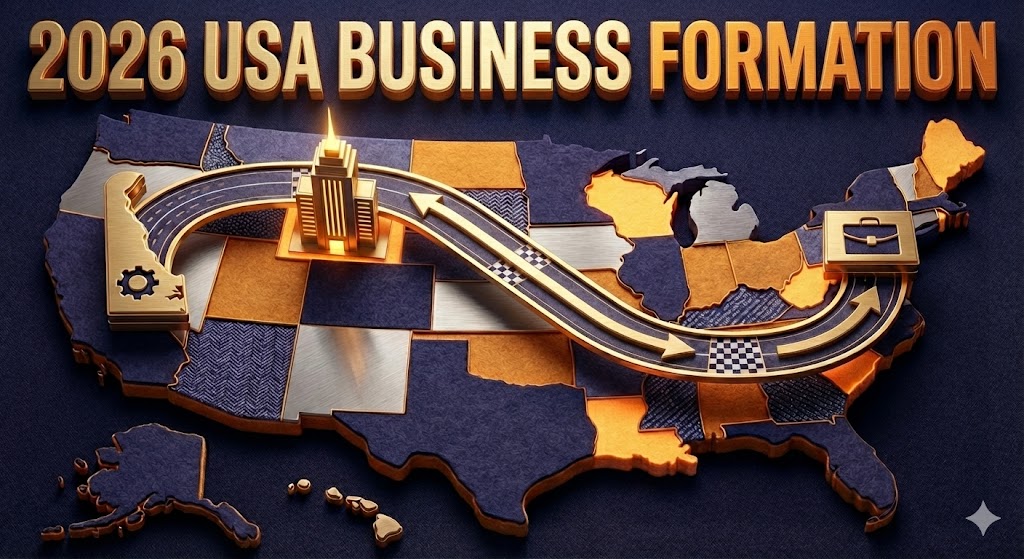
Executive Preface: The Modern Architecture of American Entrepreneurship
The landscape of business formation in the United States has undergone a radical transformation as we settle into the fiscal and regulatory environment of 2025. For decades, the narrative of "starting a business" was largely a local affair—a brick-and-mortar endeavor governed by municipal codes and physical handshakes. Today, however, the paradigm has shifted toward a digital-first, jurisdiction-agnostic model where a founder in Bangalore or Berlin can incorporate a Delaware C-Corporation, open a Federal Deposit Insurance Corporation (FDIC) insured bank account, and manage complex compliance protocols without ever stepping foot on American soil. Yet, this democratization of access has been met with a concomitant rise in regulatory friction. The implementation of the Corporate Transparency Act (CTA), the rigorous enforcement of Know Your Customer (KYC) banking statutes, and the geopolitical tightening of visa corridors—most notably the 2026 visa freeze affecting 75 nations—have created a dualistic environment. It has never been easier to click a button and start a company; it has never been harder to keep that company compliant, banked, and operationally resilient.
We will dissect the US business formation ecosystem into its constituent atoms: legal structures, jurisdictional strategy, banking infrastructure, compliance regimes, and the content strategies required to communicate these complexities to an audience of aspiring entrepreneurs. This is not merely a guide to filing paperwork; it is a strategic roadmap for navigating the American commercial theater in 2026.
Part I: Strategic Entity Selection – The Legal Chassis
The selection of a business entity is the first critical decision in the entrepreneurial lifecycle, serving as the legal chassis upon which all future revenue, liability, and tax obligations rest. In 2026, the menu of options remains standardized, but the strategic implications of each choice have evolved in response to tax reform and the preferences of the venture capital asset class.
1.1 The Limited Liability Company (LLC): The Flexible Standard
The Limited Liability Company (LLC) stands as the dominant vehicle for the vast majority of new business formations in the United States, particularly for small-to-medium enterprises (SMEs), holding companies, and bootstrapped digital ventures. Its enduring popularity stems from its hybrid nature, which ingeniously amalgamates the liability shielding of a corporation with the tax efficiency of a partnership.
Fundamentally, the LLC is a creature of contract. Unlike corporations, which are governed by rigid statutes and shareholder rights, an LLC is governed by its Operating Agreement—a private contract between members. This allows for immense flexibility in management and profit distribution. In a corporation, profit distribution must generally match share ownership (e.g., a 10% shareholder gets 10% of the dividends). In an LLC, the Operating Agreement can stipulate "special allocations," allowing a member who contributes 10% of the capital but 90% of the labor to receive 50% of the profit, provided the allocation has "substantial economic effect" under IRS rules.
The Liability Shield and the Commingling Trap The primary function of the LLC is to create a "corporate veil" that separates the personal assets of the owners (members) from the liabilities of the business. If a customer slips in a store or a client sues for breach of contract, the plaintiff is theoretically limited to seizing the assets of the LLC, leaving the member's home, car, and personal savings untouched. However, this protection is not absolute. Courts can "pierce the corporate veil" if they find that the business is merely an "alter ego" of the owner. This usually happens when founders fail to maintain financial separation—using the business debit card for groceries or depositing client checks into personal accounts. This "commingling" of funds is the single most common vector for destroying liability protection.
Taxation Dynamics By default, the IRS does not recognize the LLC as a taxing entity. A single-member LLC is treated as a "disregarded entity," meaning its activities are reported directly on the owner's personal tax return (Schedule C of Form 1040), effectively taxing it as a sole proprietorship. A multi-member LLC is taxed as a partnership (filing Form 1065), where the entity pays no tax but issues Schedule K-1s to members to report their share of profits. This "pass-through" taxation avoids the double taxation inherent in C-Corporations.
1.2 The C-Corporation (C-Corp): The Venture Capital Engine
While the LLC is the darling of the small business world, the C-Corporation remains the non-negotiable standard for high-growth startups intending to raise institutional capital. If the goal is to secure funding from Y Combinator, Andreessen Horowitz, or any serious angel syndicate, the entity must be a Delaware C-Corporation.
The Double Taxation Trade-off The C-Corp is a distinct taxpayer. It pays federal corporate income tax (currently flat at 21%) on its profits. If those profits are then distributed to shareholders as dividends, the shareholders pay personal income tax on that money. This phenomenon, known as "double taxation," is often cited as a disadvantage. However, for a growth startup, this is largely theoretical in the early years. Startups typically reinvest every dollar of revenue into growth (hiring, R&D, marketing), resulting in zero taxable profit at the corporate level. Consequently, there are no dividends to tax. The double taxation issue only crystallizes when the company becomes profitable and decides to extract cash, by which time the company has ideally achieved significant scale.
Qualified Small Business Stock (QSBS) The most compelling tax argument for the C-Corp in 2025 is Section 1202 of the Internal Revenue Code, governing Qualified Small Business Stock (QSBS). This provision allows founders and early investors to exclude up to 100% of capital gains from federal tax upon the sale of their stock, provided the stock was held for at least five years and the company had less than $50 million in gross assets at the time of issuance. For a founder who sells their startup for $10 million after five years, the QSBS exemption can save millions in taxes—a benefit unavailable to LLC owners.
1.3 The S-Corporation Election: A Tax Strategy, Not an Entity
A pervasive source of confusion for new entrepreneurs—and a prime topic for blog content—is the "S-Corp." It is critical to clarify that an S-Corporation is not a legal entity type like an LLC or C-Corp; it is a tax election made by filing Form 2553 with the IRS. Both LLCs and C-Corps can elect to be taxed as S-Corps.
The Self-Employment Tax Loophole The primary driver for S-Corp election is the mitigation of self-employment tax. In a standard LLC, the entire net profit is subject to the 15.3% self-employment tax (Social Security and Medicare) up to the wage base limit. In an S-Corp, the owner-employee pays themselves a "reasonable salary" (subject to the 15.3% tax) and takes the remaining profit as a "distribution" (not subject to the 15.3% tax).
- Scenario: A consultant nets $100,000.
- As LLC: Pays self-employment tax on the full $100,000 (approx. $15,300).
- As S-Corp: Pays a salary of $60,000 (tax on this is approx. $9,180) and takes $40,000 as distribution ($0 self-employment tax). The savings are roughly $6,000. However, S-Corps come with strict restrictions: shareholders must be US citizens or resident aliens, there can be no more than 100 shareholders, and there can only be one class of stock. This makes the S-Corp election viable for domestic small businesses but generally disqualifies it for international founders or VC-backed startups.
Part II: The Jurisdictional Matrix – State Selection Strategy
Once the entity structure is chosen, the entrepreneur faces the question of where to domicile the business. In the US federalist system, corporate law is state-based, creating a competitive marketplace where states vie for registration fees by offering favorable tax regimes, privacy laws, and judicial systems. For the 2025 founder, the choice essentially boils down to the "Home State" versus the "Big Three": Delaware, Wyoming, and Nevada (with New Mexico and Texas as emerging challengers).
2.1 The "Home State" Rule
For any business with a physical footprint—a coffee shop, a retail store, a consulting firm with a physical office—the "Home State" rule generally applies. If a business has "nexus" in a state (employees, inventory, physical presence), it must register in that state.
- The Dual-Registration Trap: A common mistake is a California resident forming a Wyoming LLC for a local consulting business to "save taxes." California law requires any foreign LLC "doing business" in the state to register as a foreign entity and pay the $800 annual franchise tax. The founder ends up paying Wyoming fees plus California fees, doubling their administrative burden for zero benefit. Blog content must emphasize this: If you are a local business, incorporate locally.
2.2 Delaware: The Corporate Capital of the World
Delaware is a small coastal state that punches significantly above its weight, serving as the legal home for over 66% of Fortune 500 companies and the vast majority of IPO-track startups.
The Value Proposition: Legal Certainty Delaware's dominance is not based on low taxes (it is actually quite expensive) but on the Court of Chancery. Unlike other states where business disputes are heard by general juries who may not understand complex corporate governance, Delaware disputes are heard by judges (Chancellors) who are preeminent experts in corporate law. This creates a highly predictable legal environment. Investors prefer Delaware because they know exactly how the law treats board disputes, fiduciary duties, and shareholder rights. There are no surprises in Delaware.
The Cost of Prestige For the bootstrapped entrepreneur, Delaware can be a financial trap.
- Filing Fee: ~$90.
- Registered Agent: Required (~$100-$200/year).
- Annual Franchise Tax: This is where founders get burned. The minimum for an LLC is $300. For a C-Corp, the default calculation method (Authorized Shares) can result in a bill of $75,000 or more if the company authorizes a large number of shares (e.g., 10 million) but has few assets. We will discuss the mathematical workaround for this in the Compliance section, but the headline risk remains.
2.3 Wyoming: The Privacy Haven & Inventor of the LLC
Wyoming invented the LLC in 1977 and has aggressively positioned itself as the best jurisdiction for small businesses, privacy seekers, and non-resident entrepreneurs.
The "Anonymous LLC" Wyoming is one of the few states that does not require the disclosure of member or manager names on the Articles of Organization. The public record only lists the Registered Agent. This provides a robust layer of privacy for founders who wish to avoid their home address or identity being scraped by data brokers. While this anonymity is pierced by federal reporting (CTA/BOI), it remains effective against the general public, competitors, and casual snooping.
Charging Order Protection Wyoming offers statutory "Charging Order Protection" even for single-member LLCs. In many states, if a single-member LLC owner is sued personally (e.g., for a car accident), the court can force the liquidation of the LLC to pay the debt. In Wyoming, the creditor is limited to a "charging order"—a lien on distributions. The creditor cannot force the sale of company assets or vote in company matters. If the LLC chooses not to distribute profit, the creditor gets nothing (and may even be stuck with the tax bill on the undistributed profit, a tactic known as "K-1 Poison").
Cost Efficiency Wyoming is arguably the most cost-effective state for long-term maintenance.
- Filing Fee: $100.
- Annual Report Fee: $60 minimum (based on assets located in Wyoming, which for digital businesses is usually zero).
- State Income Tax: 0%.
2.4 Nevada: The Fortress (At a Premium)
Nevada markets itself as the "Delaware of the West," emphasizing extreme asset protection and a complete absence of information sharing agreements with the IRS (though federal law supersedes this).
The Cost Barrier Nevada has become increasingly expensive, pushing many small businesses toward Wyoming.
- Initial Filing: Can exceed $425 when including the initial list of officers and business license.
- Annual Fees: The Annual List ($150) + Business License ($200 for LLCs, $500 for Corps) brings the annual holding cost to $350-$650, significantly higher than Wyoming's $60.
- Commerce Tax: Nevada imposes a gross receipts tax on businesses with over $4 million in Nevada-sourced revenue. While this affects few startups, it adds a compliance filing requirement.
2.5 New Mexico: The "Silent" Budget Option
New Mexico is an emerging favorite for privacy-focused entrepreneurs who want the absolute lowest maintenance profile.
- No Annual Report: New Mexico is the only state among the top contenders that requires zero annual reports and zero annual fees for LLCs. Once you pay the $50 filing fee, the entity exists in perpetuity without state-level filings (federal filings still apply).
- Privacy: Like Wyoming, it does not require member names on the formation documents.
- Cons: It lacks the developed corporate case law of Delaware or the specific asset protection statutes of Wyoming. It is a "vanilla" entity—cheap, private, but feature-light.
Comparative Data: The 2025 State Formation Matrix
Feature | Delaware | Wyoming | Nevada | New Mexico | Florida |
Ideal For | VC-Track Startups | Privacy / Crypto / SMEs | High Asset Protection | Budget / Set-and-Forget | Non-Residents / LatAm |
Initial Filing Fee | ~$90 + Tax | $100 | ~$425 (w/ initial list) | $50 | $125 |
Annual Maintenance | $300 (LLC) / Calc (Corp) | $60 (Min) | ~$350 (LLC) / $650 (Corp) | $0 (No Report) | $138.75 |
State Income Tax | No (if non-resident) | 0% | 0% | Yes (Corp/Personal) | 0% (Personal) |
Anonymity (Public) | Low (req. annual report) | High (Anonymous) | High (req. annual list) | High (Anonymous) | Low (Public) |
Asset Protection | Strong (Court of Chancery) | Strong (Charging Order) | Strongest (Statutory) | Standard | Moderate |
Part III: The Formation Lifecycle – A Technical Roadmap
The mechanics of formation in 2025 have been streamlined by technology, yet the sequence of operations remains unforgiving. A misstep in the order of operations—such as filing for an EIN before approval of the Articles, or failing to secure a trademark before incorporation—can lead to costly rebranding or administrative dissolution.
Step 1: Name Availability and the Trademark Minefield
The process begins with a name search on the Secretary of State’s database. The name must be "distinguishable on the record." However, a state-level clearance is a false sense of security.
- The Trademark Trap: A name might be available in Wyoming, but federally trademarked by a company in Oregon. If a founder builds a brand on a name they don't own federally, they risk receiving a Cease and Desist letter years down the line, forcing a total rebrand. Blog content must stress the difference between Corporate Name Availability (State) and Trademark Clearance (Federal/USPTO).
Step 2: The Registered Agent (RA)
Every LLC and Corporation is legally required to designate a Registered Agent. This person or entity must have a physical street address (not a P.O. Box) in the state of formation and be available during business hours to accept "Service of Process" (lawsuits and subpoenas).
- Privacy Implication: For home-based entrepreneurs, acting as their own RA means publishing their home address on the state's permanent public record. This is a privacy, safety, and junk-mail nightmare. Using a third-party RA service ($50-$200/year) is the standard best practice to shield the founder's personal address.
Step 3: Filing Articles of Organization/Incorporation
This is the formal creation event. The document is filed with the Secretary of State.
- Processing Times (2025): The speed of bureaucracy varies.
- Fast States: Wyoming, Nevada, and Delaware often process online filings in 1-3 business days. Some offer same-day service for an expedited fee.
- Slow States: California and New York mail filings can lag by weeks. New York also has a notorious "Publication Requirement" for LLCs, where the new entity must pay to publish a notice in two newspapers (one daily, one weekly) for six weeks, costing upwards of $1,000 in New York City. This "hidden tax" is a critical detail for NY-based founders.
Step 4: The Operating Agreement (The "Hidden" Requirement)
States like Delaware and Wyoming do not require the Operating Agreement to be filed with the state; it is an internal private contract. Consequently, many DIY founders skip it. This is a fatal error.
- Banking Necessity: In 2025, almost every compliant bank (Mercury, Relay, Chase) requires a signed Operating Agreement to open a business account, even for single-member LLCs. They need it to verify who has the authority to open accounts.
- Veil Protection: The Operating Agreement is the primary evidence that the LLC is a legitimate separate entity. Without it, a court is more likely to pierce the corporate veil during a lawsuit, treating the entity as a sole proprietorship.
Step 5: The EIN (Employer Identification Number)
The EIN is the social security number for the business.
- US Residents: Can obtain an EIN instantly online via the IRS portal.
- Non-Residents: This is the single biggest bottleneck for international founders. Without a US SSN, the online portal is inaccessible. Non-residents must file Form SS-4 via fax or mail. In 2025, IRS processing times for faxed SS-4s range from 14 to 30+ business days. This delay effectively freezes the ability to open a bank account or payment gateway (Stripe) for a month. "Blog Marathon" content must advise international founders to start this process immediately upon formation.
Part IV: The 2025 Compliance Regime – Transparency and Taxes
The era of "set it and forget it" business ownership is over. 2024 and 2025 saw the full implementation of the Corporate Transparency Act (CTA), shifting the US from a jurisdiction of privacy to one of federal surveillance.
4.1 Beneficial Ownership Information (BOI) Reporting
Managed by the Financial Crimes Enforcement Network (FinCEN), the CTA requires virtually all US entities (LLCs, Corps) to report who truly owns or controls them.
- The Requirement: Reporting companies must file a BOI report disclosing the full legal name, date of birth, address, and a copy of a government ID (passport/license) for every "Beneficial Owner" (anyone with 25% ownership or "Substantial Control").
- Deadlines (Critical for 2025):
- The Teeth: The penalty for willful non-compliance is $500 per day (up to $10,000) and up to two years in prison. This is a massive compliance trap for small business owners who are unaware of the law.
- Entities formed before Jan 1, 2024: Deadline is Jan 1, 2025.
- Entities formed during 2024: 90 days to file.
- Entities formed on or after Jan 1, 2025: 30 days to file.
4.2 Franchise Taxes and the "Delaware Shock"
While LLCs usually face flat fees (e.g., Delaware's $300/year, Wyoming's $60/year), C-Corporations in Delaware face a variable Franchise Tax that causes panic every tax season.
- The Problem: Delaware defaults to the "Authorized Shares Method." If a startup authorizes 10,000,000 shares (standard for VC deals) but has very few assets, the state sends a bill for roughly $85,165.
- The Solution: Startups must proactively file using the "Assumed Par Value Capital Method." This method calculates tax based on the company's gross assets and total issued shares. For a typical early-stage startup with few assets, this recalculation reduces the bill from $85,000+ to the minimum of $400.
- Calculation Logic: Tax is approx. $400 per $1 million in gross assets. If assets are <$1M, the tax is $400.
- Action Item: Founders must define the "Par Value" of their shares low (e.g., $0.00001) in their charter to facilitate this.
4.3 Annual Report Deadlines (2025 Calendar)
- Delaware LLC: Tax of $300 due June 1. No report required.
- Delaware Corp: Report + Tax due March 1.
- Wyoming: Report + $60 fee due on the first day of the anniversary month (e.g., formed in Nov, due Nov 1).
- Florida: Report + $138.75 fee due May 1. The late fee is a strictly enforced $400.
- California: $800 Franchise Tax due by the 15th day of the 4th month after the tax year begins.
- Texas: Franchise Tax Report due May 15 (though many small businesses owe $0 tax, the report is mandatory).
Part V: Financial Infrastructure – Banking in a KYC World
For non-resident founders, the ability to incorporate is meaningless without the ability to bank. The US banking system, governed by the Patriot Act and strict Anti-Money Laundering (AML) laws, is hostile to non-residents.
5.1 The "Physical Presence" Dilemma
Banks are required to verify the physical existence of a business. They routinely reject applications that use P.O. Boxes or known Registered Agent addresses as the "Principal Business Address."
- The Strategy: Founders typically need a specialized "Virtual Mailroom" address—a service that provides a real street address (suite number) and scans mail. However, even these are increasingly flagged by legacy banks. Fintechs are generally more lenient, accepting foreign residential addresses for the owners while using the Registered Agent or a virtual address for the business, provided the "Operating Presence" is explained.
5.2 The Banking Hierarchy
- Tier 1: Legacy Banks (Chase, BoA, Wells Fargo)
- Tier 2: The "Tech Darlings" (Mercury, Brex)
- Tier 3: The SME Workhorses (Relay, Novo)
- Tier 4: The Money Movers (Wise Business)
- Requirement: Physical presence. You must walk into a branch to sign signature cards.
- Verdict: Generally impossible for remote international founders unless they travel to the US.
- Mercury: The gold standard for startups. Supports remote opening for non-residents. Requires EIN, Articles, and Passport. Offers FDIC insurance via sweep networks ($5M+). Known for great UI and free wires.
- Brex: Has pivoted away from SMEs. Now focuses on funded startups and mid-market companies. Difficult to get approved without venture backing or significant revenue.
- Relay: Excellent for LLCs and bootstrappers. Allows multiple sub-accounts (Profit First method). Remote friendly. Highly transparent on requirements.
- Wise: Not a bank, but an Electronic Money Institution. Crucial for international founders to hold USD and convert to local currency (EUR, INR, GBP) at mid-market rates. Often used in tandem with Mercury.
Part VI: The Geopolitical Headwinds – The 2026 Visa Freeze
The business environment is inextricably linked to immigration policy. The incoming administration has announced a significant shift affecting global mobility.
6.1 The 75-Country Visa Freeze
Effective January 21, 2026, the US State Department has paused immigrant visa processing for nationals of 75 countries, citing "public charge" concerns (the risk of immigrants relying on welfare).
- The List: The list spans Africa, Asia, Latin America, and Eastern Europe. Key affected nations include Russia, Iran, Pakistan, Bangladesh, Brazil, Colombia, Nigeria, Egypt, and Vietnam.
- Notable Exclusions: India, China, and Mexico are not on the list, likely due to their critical role in the H-1B labor market and trade ties.
- Business Impact: While the freeze targets immigrant visas (Green Cards), it casts a shadow over non-immigrant business visas (B1/B2, L-1). Founders from affected nations may face extreme vetting or delays when trying to visit the US for client meetings, banking, or conferences. This reinforces the need for a fully remote-capable corporate structure.
Conclusion
The US market in 2025 remains the ultimate prize for global entrepreneurs, offering unparalleled scale, capital depth, and legal robustness. However, the days of "Wild West" formation are over. The modern founder must navigate a sophisticated web of federal transparency (CTA), tax compliance (Franchise Tax), and banking regulations (KYC). By utilizing this framework, content creators can equip their audience not just to start a company, but to build a durable, compliant, and investable American enterprise.
Reference Key:
- Entity Structuring:
- State Analysis:
- Taxation & Math:
- Banking:
- Compliance (BOI):
- Immigration/Visa Freeze:
Works cited
1. How to register a business in the US: A step-by-step guide - Stripe, https://stripe.com/resources/more/how-to-register-a-business-in-the-us 2. A guide for businesses complying with 2025 Corporate ... - Fennemore, https://www.fennemorelaw.com/a-guide-for-businesses-complying-with-2025-corporate-transparency-act-deadlines/ 3. US freezes immigrant visas for 75 countries: Iran, Russia, Thailand among affected nations - key details, https://timesofindia.indiatimes.com/business/international-business/us-freezes-visas-for-75-countries-iran-russia-thailand-among-affected-nations-key-details/articleshow/126529838.cms 4. How to Start an LLC: Complete Guide | Wolters Kluwer, https://www.wolterskluwer.com/en/expert-insights/how-to-form-an-llc-what-is-an-llc-advantages-disadvantages-and-more 5. Starting an LLC for a Blogging Business - Northwest Registered Agent, https://www.northwestregisteredagent.com/llc/blogging-business 6. Annual Requirements for U.S. LLCs in 2025 - Filing Express, https://filingexpress.com/annual-requirements/ 7. Incorporating in Delaware vs. other states - Stripe, https://stripe.com/resources/more/incorporating-in-delaware-vs-other-states-differences-and-key-considerations 8. Register your business | U.S. Small Business Administration, https://www.sba.gov/business-guide/launch-your-business/register-your-business 9. How to Form an LLC in 5 Steps | H&R Block, https://www.hrblock.com/tax-center/small-business/creating-an-llc/ 10. Delaware vs. Nevada vs. Wyoming LLC | http://www.harborcompliance.com, https://www.harborcompliance.com/delaware-vs-nevada-vs-wyoming-llc 11. Delaware vs. Wyoming LLCs Top States for Business 2025, https://filingexpress.com/delaware-vs-wyoming-llcs-why-these-states-dominate-in-2025/ 12. Why incorporate or form an LLC in Delaware, Nevada, or Wyoming?, https://www.wolterskluwer.com/en/expert-insights/why-incorporate-in-delaware-or-nevada 13. Cost of an LLC in 2025: Filing Fees, Annual Costs & Cheapest ..., https://www.myllc.com/cost-of-llc-2025.aspx 14. How to Calculate Franchise Taxes - Delaware Division of Corporations, https://corp.delaware.gov/frtaxcalc/ 15. Wyoming vs. Nevada, Delaware & New Mexico LLCs, https://wyomingllcattorney.com/Form-a-Wyoming-LLC/vs-Nevada-Delaware-New-Mexico 16. Wyoming vs. New Mexico LLC: Which State is Right for You?, https://nchinc.com/compare-your-state/wyoming/vs-new-mexico 17. 5 Best States to Incorporate In and Why - Fynloapps, https://www.fynloapps.com/blog/5-best-states-to-incorporate-in-and-why/ 18. Best State To Form An LLC: Comprehensive Comparison and Guide ..., https://wise.com/us/blog/best-state-to-form-llc 19. Delaware vs Other States for International Companies: Tax ..., https://www.footholdamerica.com/blog/delaware-vs-other-states-for-international-companies-tax-calculator-decision-matrix/ 20. NM vs Wyoming for privacy? : r/llc - Reddit, https://www.reddit.com/r/llc/comments/1mr1j3x/nm_vs_wyoming_for_privacy/ 21. How to start an LLC in 6 steps – 2025 complete guide - GoDaddy, https://www.godaddy.com/resources/skills/how-to-start-an-llc 22. LLC Processing Times For All 50 U.S. States in 2025 - BusinessRocket, https://www.businessrocket.com/business-corner/start/llc/formation-time/ 23. LLC and Corporation State Approval Times - TotalLegal, https://www.totallegal.com/llc-and-corporation-state-approval-times 24. Instructions for Form SS-4 (12/2025) | Internal Revenue Service, https://www.irs.gov/instructions/iss4 25. Can Non-US Residents Open a US Business Bank Account?, https://thetaxbooks.com/blog/can-a-non-us-resident-open-a-us-business-bank-account/ 26. Top 3 US Business Bank Accounts for Non-Residents in 2025, https://www.entity.inc/blog/top-us-banks-for-non-residents/ 27. Beneficial Ownership Information (BOI) Reporting Requirements for ..., https://www.nerdwallet.com/business/learn/boi-reporting-requirements 28. How do I calculate the Delaware franchise tax? - Help Center | Clerky, https://help.clerky.com/article/2796-calculate-delaware-franchise-tax 29. Annual Report Filing US States: State-by-State Deadlines - Globalfy, https://globalfy.com/blog/annual-report-filing-us-states/ 30. How to Open a US Business Bank Account as a Foreign Entrepreneur, https://globalfy.com/blog/open-us-business-bank-account-online-non-resident/ 31. Top 5 US Banks for Non-Resident Owned US Company - Easyfiling, https://easyfiling.com/blog/top-5-us-banks-for-non-resident-owned-us-company/ 32. Best banks and business accounts for startups - Mercury, https://mercury.com/blog/best-banks-business-accounts-startups 33. Mercury Alternatives for Startup Banking - NerdWallet, https://www.nerdwallet.com/business/banking/learn/mercury-alternatives 34. The best business banking account for startups & enterprises | Brex, https://www.brex.com/product/business-account 35. How to open US business bank account for US LLC for non resident?, https://www.reddit.com/r/fintech/comments/1ncv8cs/how_to_open_us_business_bank_account_for_us_llc/ 36. Pakistan, 74 other nations hit by US immigrant visa freeze; check full list here, https://www.businesstoday.in/nri/visa/story/75-nations-hit-by-us-immigrant-visa-freeze-starting-jan-21-is-india-included-check-full-list-here-510968-2026-01-15 37. US freezes immigrant visas for 75 countries: 5 key questions answered for Indians, https://timesofindia.indiatimes.com/world/us/us-freezes-immigrant-visas-for-75-countries-5-key-questions-answered-for-indians/articleshow/126532220.cms 38. The full list of 75 countries where Trump is suspending visa processing, https://www.theguardian.com/us-news/2026/jan/14/full-list-75-countries-visa-processing-suspended 39. Top States to Register Your U.S. LLC: Delaware, Florida, or Wyoming?, https://www.dasbanq.com/en/blogs/best-state-for-llc-delaware-florida-wyoming
Discover more from Kurums | Business Intelligence
Subscribe to get the latest posts sent to your email.