
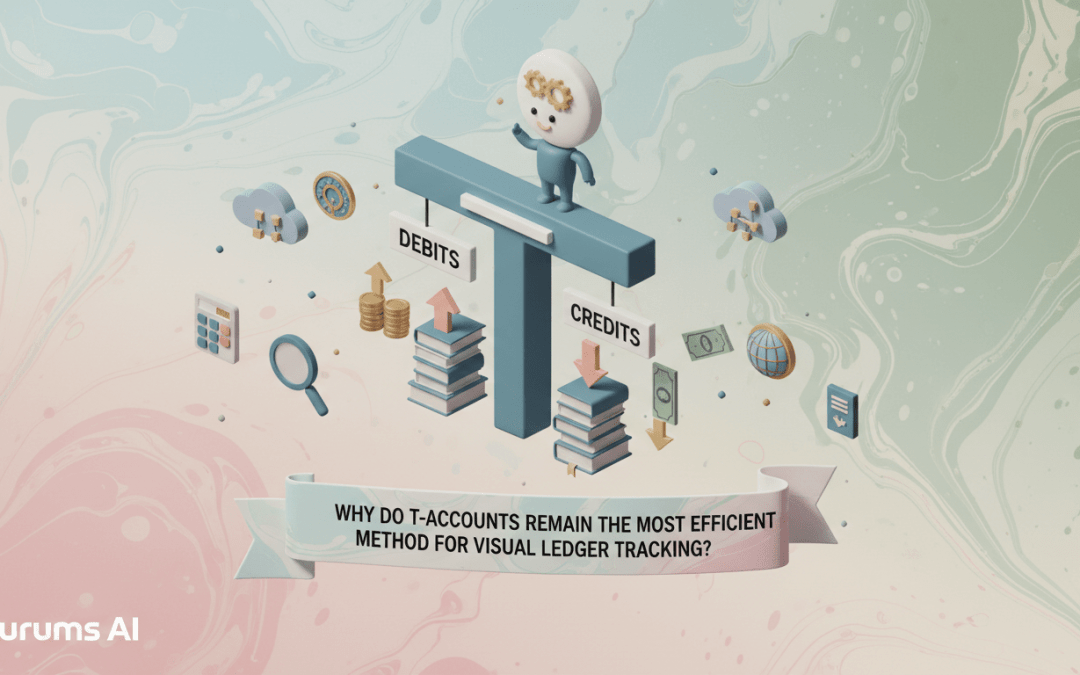
What is a T-Account? It is a visual representation of a general ledger account, shaped like a ‘T’, used to track debits on the left and credits on the right.
Why is it still used in the ERP era? Despite advanced software like SAP or Oracle, T-accounts provide a clear, skeletal view of transaction flows, making it easier to troubleshoot complex journal entries and identify errors that raw data tables might hide.
What are the main benefits? Enhanced visibility, streamlined reconciliation, improved error detection, and a better understanding of the double-entry accounting system’s impact on financial statements.
In the high-velocity world of modern corporate finance, where automated ERP systems process millions of transactions per second, one might assume that the humble T-account—a relic of the 15th-century double-entry system—would have been relegated to the archives of history. However, the reality is quite the opposite. For Chief Financial Officers (CFOs), senior auditors, and forensic accountants, the T-Account remains the ultimate “whiteboard” for dissecting the most complex financial maneuvers.
Think about the last time you looked at a thousand-row Excel export from your general ledger. The numbers are there, but the story is missing. Where did the cash go? Why is the accrual account not clearing? This is where T-accounts come in. They strip away the noise and provide a skeletal, visual roadmap of every dollar’s journey through the organization. In this guide, we will dive deep into why this “manual” logic is still the gold standard for visual ledger tracking and how you can leverage it to ensure 100% financial integrity.
1. The Anatomy of Efficiency: Why the ‘T’ Shape Works
The T-Account is not just a drawing; it is a structural manifestation of the fundamental accounting equation: Assets = Liabilities + Equity. By bifurcating an account into two distinct vertical columns, it creates a psychological and technical boundary that prevents the “mushing” of data. But wait, there is more to it than just two sides.
On the left side, we have the Debit (Dr). On the right side, we have the Credit (Cr). For an asset account, like Cash or Accounts Receivable, the left side represents growth and the right side represents reduction. For a liability or equity account, the logic flips. This symmetry is the DNA of global finance. When you visualize a T-account, you are essentially looking at the heartbeat of a specific financial category.
In a corporate environment, T-accounts allow managers to see “at a glance” whether an account is behaving normally. For instance, if a “Prepaid Insurance” account shows a massive credit entry without a corresponding debit to “Insurance Expense,” a T-account makes this discrepancy jump off the page immediately. It provides a level of spatial awareness that a linear list of numbers simply cannot match.
2. Comparing Visual Tracking vs. Linear Reporting
Why do professionals still prefer a T-account over a standard ledger report? To understand this, we must compare how our brains process information. Linear reports (like those found in standard accounting software) are excellent for record-keeping but terrible for diagnostic analysis.
| Feature | Linear General Ledger Report | Visual T-Account Mapping |
|---|---|---|
| Primary Use | Compliance and historical record. | Analysis, troubleshooting, and teaching. |
| Error Detection | Requires filtering and sorting through thousands of rows. | Errors (like un-balanced entries) are visually obvious. |
| Transaction Flow | Hard to follow the “other side” of the entry. | Maps the “Debit here, Credit there” relationship clearly. |
| Speed of Insight | Slow; requires mental calculation of running balances. | Instant; the ending balance is clearly positioned below the line. |
As the table above illustrates, the T-account is the superior tool for understanding rather than just storing data. It provides the “Why” behind the “What.”
3. The Double-Entry Safeguard: Ensuring Ledger Integrity
The real secret to the T-account’s longevity is its symbiotic relationship with the double-entry system. Every transaction affects at least two accounts. If you buy a new piece of machinery for $50,000 in cash, you don’t just have one entry; you have a story of transformation.
But here is the catch: in a complex corporate structure, one transaction might trigger five or six different ledger entries. Using T-accounts allows an accountant to “map” these legs of the journey. For example:
- Asset Transfer: Dr. Equipment / Cr. Cash.
- Tax Impact: Dr. VAT Recoverable / Cr. Accounts Payable.
- Depreciation Setup: Dr. Accumulated Depreciation (Contra-asset) / Cr. Depreciation Expense.
Without the visual aid of T-accounts, keeping track of these moving parts during a month-end close is a recipe for disaster. The T-account acts as a structural guardrail, ensuring that for every action, there is an equal and opposite reaction across the entire ledger system.
4. How T-Accounts Detect Financial Irregularities and Fraud
Forensic accountants often revert to T-accounts when they suspect “creative accounting” or fraud. Why? Because fraud often hides in the complexity of journal entries. A perpetrator might hide a theft by spreading credits across multiple obscure expense accounts.
When you aggregate these entries into T-accounts, patterns emerge. For example, if a “Miscellaneous Expense” account shows a series of unusual credit entries (which would normally be debits), it raises an immediate red flag. But that’s not all—T-accounts also highlight “plugged” numbers where an entry was forced to balance the books without a legitimate source document.
4.1. Spotting the “Ghost” Transactions
Ghost transactions are entries that appear in the ledger but have no physical or digital paper trail. By utilizing T-accounts during an internal audit, you can trace the flow of funds. If an inflow (Debit) in the Inventory account does not have a corresponding outflow (Credit) in Accounts Payable or Cash, you have found a ghost. This visual “missing link” is much harder to spot in a raw data dump.
5. Mastering the Logic: The Rules of Increase and Decrease
To use T-accounts effectively, one must master the internal logic of different account types. This is where most junior accountants stumble, but it is also where the most efficiency is gained. Let’s break down the logic of account behavior within the T-structure.
| Account Type | Debit Side (Left) | Credit Side (Right) | Normal Balance |
|---|---|---|---|
| Assets (Cash, AR, Inventory) | Increase (+) | Decrease (-) | Debit |
| Liabilities (AP, Loans, Accruals) | Decrease (-) | Increase (+) | Credit |
| Equity (Capital, Retained Earnings) | Decrease (-) | Increase (+) | Credit |
| Revenue (Sales, Interest Income) | Decrease (-) | Increase (+) | Credit |
| Expenses (COGS, Rent, Utilities) | Increase (+) | Decrease (-) | Debit |
Understanding this grid is the “Superpower” of any finance professional. Once this logic is internalized, you no longer look at numbers; you look at energy transfers within the business. For example, an expense is essentially “consuming” an asset (Cash) or “creating” a liability (Accounts Payable). The T-account shows this consumption in real-time.
6. T-Accounts in Complex Corporate Scenarios: A Case Study
Let’s look at a real-world scenario involving a manufacturing company that uses a sophisticated ERP but relies on T-accounts for its quarterly consolidation. Suppose the company sells a piece of fully depreciated equipment for $10,000 cash.
This transaction involves three different accounts:
- Cash: Needs to increase (Debit).
- Equipment (Cost): Needs to be removed from the books (Credit).
- Gain on Sale of Assets: Needs to record the profit (Credit).
By drawing these three T-accounts side-by-side, the controller can see that the $10,000 Debit to Cash is perfectly balanced by the Credits to Equipment and Gain. If the equipment had an accumulated depreciation balance, a fourth T-account would be involved. Mapping this visually ensures that the “Accumulated Depreciation” (a contra-asset) is also cleared out. This level of multi-layered tracking is where the T-account truly shines over simple journal entries.
7. Integrating T-Accounts with Modern ERP Systems (SAP, Oracle, NetSuite)
You might be wondering: “If I have SAP, why do I need to draw a T-account?” The answer lies in the black box problem. Modern ERPs are essentially massive engines of automation. They take an input and generate an output. But if the logic behind the automated entry is flawed—say, a wrong tax code or a misconfigured GL mapping—the error will propagate silently.
Corporate finance teams use T-accounts to reverse-engineer ERP outputs. By taking a sample of 10 automated transactions and mapping them into T-accounts, they can verify that the system’s logic aligns with IFRS or GAAP standards. It is a form of quality control that no automated tool can perform on itself.
7.1. Bridging the Gap between IT and Finance
When a system error occurs, IT developers and Finance managers often speak different languages. A T-account serves as the “Universal Translator.” A Finance manager can show a developer a T-account diagram to explain exactly how the data should flow through the ledger. This visual clarity reduces the “Mean Time to Repair” (MTTR) for critical financial system bugs.
8. Strategic Decision Making: Moving Beyond Bookkeeping
T-accounts aren’t just for looking backward; they are for looking forward. When a company is considering a major acquisition or a change in its revenue model (e.g., moving from one-time sales to a subscription model), the impact on the balance sheet can be modeled using T-accounts.
Think about it: how will a “Buy Now, Pay Later” scheme affect your cash flow? By mapping out the “Unearned Revenue” and “Accounts Receivable” T-accounts for the next 12 months, management can visualize the “lag” between a sale and the actual cash-in-hand. This visual foresight is critical for maintaining liquidity in volatile markets.
9. Maintaining Financial Statement Integrity: The Trial Balance Connection
The T-account is the bridge between the daily chaos of journal entries and the formal structure of the Trial Balance. Every “Ending Balance” calculated at the bottom of a T-account becomes a single line item on the Trial Balance. If the T-accounts are accurate, the Trial Balance must balance.
This hierarchy ensures a “Single Source of Truth.” If the Balance Sheet doesn’t balance, the investigation starts at the Trial Balance, then moves down to the individual T-accounts. By maintaining clear T-accounts throughout the period, you simplify the year-end audit process exponentially. Auditors love T-accounts because they provide an easy-to-follow audit trail that justifies every figure on the financial statements.
10. The Best Practices for Visual Ledger Management
To get the most out of this method, you should follow a standardized approach. Consistency is the key to clarity. Here are the steps to follow for elite-level T-account tracking:
- Standardize Naming: Use the exact account names from your Chart of Accounts (COA) to avoid confusion.
- Date Every Entry: Never just write a number. Include a date or a transaction reference number (e.g., INV-9901) next to each entry.
- The “Single Line” Rule: Use a single horizontal line to separate the entries from the calculation, and a double line below the final balance to indicate it is a “finalized” figure for the period.
- Color Coding: Use different colors for adjusting entries (e.g., red for year-end adjustments) to distinguish them from standard operational entries.
11. Common Mistakes to Avoid in T-Account Visuals
Even the pros make mistakes. The most common error is the “Balance Misplacement.” As we discussed earlier, every account has a “normal balance” (either Debit or Credit). A common error is placing the ending balance on the wrong side. For example, a Cash account should almost never have a Credit balance (unless you are overdrawn). If your T-account shows a Credit balance for Cash, you have either missed a deposit or recorded a payment twice.
12. The Future of T-Accounts: AI and Real-Time Visualization
As we move into the era of AI-driven finance, T-accounts are evolving. We are now seeing “Dynamic T-Accounts” built into dashboard software like PowerBI or Tableau. These tools take live data from the ERP and automatically generate T-account visualizations. This allows managers to see the “Double-Entry Impact” of their operations in real-time, without having to wait for the month-end close.
However, no matter how advanced the technology becomes, the logic remains the same. The T-account is the language of business. Understanding this language is what separates a “data entry clerk” from a “strategic financial advisor.”
Conclusion: Why You Should Master the T-Account Today
The T-account is more than just a tool; it is a philosophy of clarity. In an age of information overload, it provides the filter we need to see the truth behind the numbers. Whether you are a student learning the ropes or a veteran CFO managing a multi-billion dollar budget, the T-account offers a level of visual integrity that no other method can match.
Ready to elevate your financial tracking? Start by mapping your next complex adjustment using a T-account. You will be surprised at how much hidden detail you uncover. Remember, in finance, visibility is not just a luxury—it is the foundation of trust and accuracy. Don’t let your ledger be a mystery; let the T-account tell the story of your success.
Discover more from Kurums | Business Intelligence
Subscribe to get the latest posts sent to your email.