
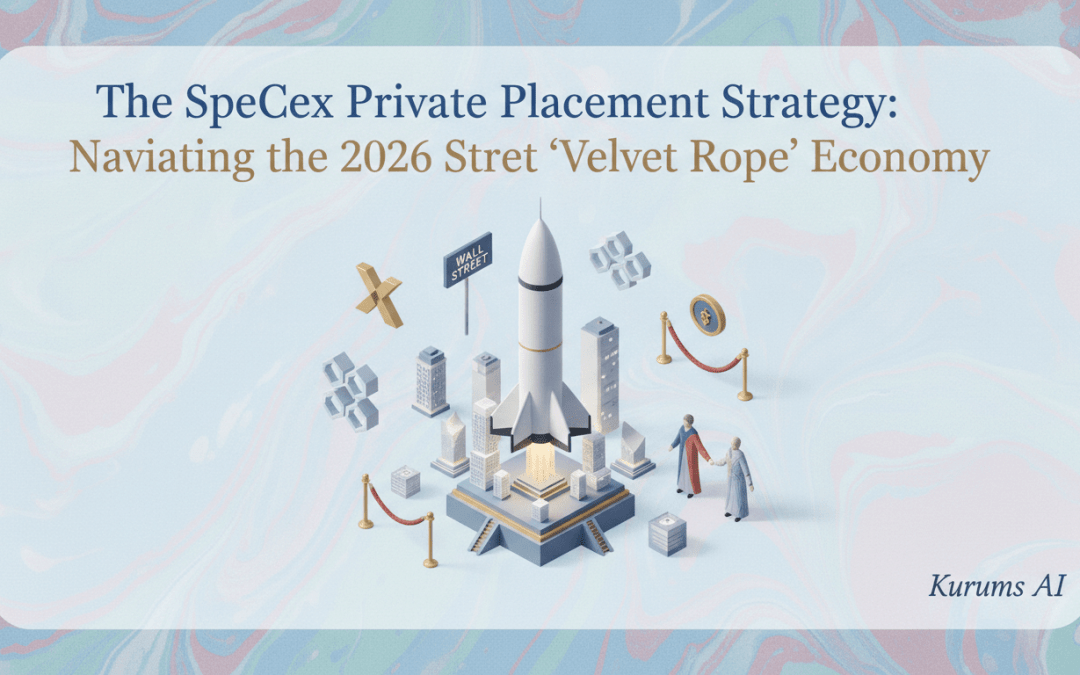
Executive Q&A Summary: The SpaceX Private Placement Paradigm
Q: What is the ‘Velvet Rope’ economy in Wall Street terms?
A: It is a strategic shift where Tier-1 investment banks use exclusive access to high-demand, pre-IPO companies like SpaceX to attract and lock in ultra-high-net-worth individuals (UHNWIs) and institutional clients, moving away from traditional commission-based models.
Q: Why is SpaceX the primary asset for this strategy?
A: With its dominance in global launch services and the massive potential of Starlink, SpaceX represents a “generational asset” that remains private, forcing investors to go through specific banking channels to gain exposure.
Q: How does this change institutional wealth management?
A: Relationship managers are no longer just selling products; they are selling “access.” This creates a deeper, more defensive moat around client relationships, making it harder for clients to move their capital to competitors who lack similar private market allocations.
The financial landscape of 2026 is no longer defined by the democratic access of the public markets. Instead, we are witnessing the solidification of the “Velvet Rope” economy—a bifurcated system where the most lucrative growth opportunities are cordoned off for an elite tier of investors. At the center of this revolution sits SpaceX, Elon Musk’s aerospace juggernaut, which has become the ultimate “strategic carrot” for Wall Street’s most prestigious institutions. But make no mistake: this is about far more than just aerospace. This is a fundamental reimagining of how banks maintain institutional client relationships in an era where traditional alpha is increasingly difficult to find.
The Shift from Public Liquidity to Private Exclusivity
For decades, the Initial Public Offering (IPO) was the holy grail of wealth creation. Investors would wait for a company to “go public” to capture the lion’s share of its value. However, that timeline has shifted dramatically. Companies are staying private for longer, often reaching decacorn or even hectocorn status ($100B+ valuation) before even considering a listing. SpaceX, currently valued in the hundreds of billions, is the poster child for this trend.
Think about it: Why would a bank simply facilitate a trade in a public stock when it can use a private allocation to secure a $500 million relationship? By controlling the flow of SpaceX secondary shares, banks like Goldman Sachs, Morgan Stanley, and JPMorgan are creating a modern-day “Velvet Rope.” If you want in, you have to be more than just a customer; you have to be a foundational partner. This exclusivity is the new currency of wealth management.
SpaceX: The ‘Generational Asset’ Driving Institutional Loyalty
SpaceX is not just another tech company; it is a multi-vertical monopoly in the making. From its Falcon 9 dominance to the global telecommunications play of Starlink and the frontier potential of Starship, the company offers a diversified tech portfolio under one private umbrella. For an institutional wealth manager, having an allocation of SpaceX shares is like holding the keys to a kingdom.
The demand for these shares is so high that they are often oversubscribed within minutes of an internal bank offering. This “scarcity engine” allows banks to dictate terms. They can require clients to bring more Assets Under Management (AUM) to the firm in exchange for a slice of the SpaceX pie. The reality is that in 2026, the strength of a bank’s private equity desk is more important for UHNWI retention than its proprietary trading algorithms.
The Mechanics of the ‘Velvet Rope’ Strategy
How does this actually work in the boardroom? It starts with the secondary market. Because SpaceX employees and early investors need liquidity, the company periodically allows for “tender offers.” Wall Street banks act as the intermediaries for these offers, but they don’t just open the gates to everyone. They use a tiered system of access.
- Tier 1 Access: Reserved for clients with $100M+ in AUM who utilize the bank’s full suite of services, including credit lines and estate planning.
- Strategic Allocation: Shares are distributed not based on who asked first, but on who provides the most long-term “strategic value” to the bank’s ecosystem.
- Managed SPVs: For smaller (relatively speaking) institutional players, banks create Special Purpose Vehicles (SPVs) that pool capital, allowing the bank to charge both management fees and carried interest.
Table 1: Evolution of Growth – Public vs. Private Markets (2015-2026 Forecast)
| Metric | S&P 500 (Public) | Elite Private Tech (e.g., SpaceX) |
|---|---|---|
| Average Annual Growth | 8% – 11% | 25% – 45% (Estimated) |
| Access Barrier | Low (Retail) | Extreme (Institutional/UHNWI Only) |
| Liquidity Window | Daily (T+2) | Periodic (Structured Tenders) |
| Information Asymmetry | Low (SEC Filings) | High (Internal Bank Research) |
Revolutionizing Wealth Management via Private Secondary Markets
Wealth management has moved from “What can we buy for you?” to “What can we get you into?” This shift is profound. In the 2026 landscape, the primary value proposition of a top-tier private bank is its ability to bypass the public markets. By leveraging high-demand listings like SpaceX, banks are transforming their relationship from “service provider” to “exclusive gatekeeper.”
But that’s not all. This strategy also serves as a powerful defense against fintech disruptors. While robo-advisors can optimize a portfolio of ETFs, they cannot offer a seed-level allocation in a Starlink spin-off or a pre-IPO SpaceX tranche. The “Velvet Rope” is what keeps the world’s wealthiest families tethered to traditional Wall Street institutions.
The Role of Institutional Portfolio Management in 2026
Institutional portfolios are undergoing a structural re-rating. Traditionally, a 60/40 split between stocks and bonds was the gold standard. Today, that has evolved into a “Core and Satellite” model where private equity allocations make up 20% to 30% of the total portfolio for the ultra-wealthy. Within that 30%, “trophy assets” like SpaceX serve as the anchor.
The allure of SpaceX lies in its defensibility. Most tech companies are vulnerable to rapid shifts in consumer taste or AI disruption. SpaceX, however, owns the physical infrastructure of the future. Whether it’s global internet via Starlink or lunar logistics, the company is building deep moats that institutional investors find irresistible. Banks know this, and they use it as leverage during every quarterly review.
Analyzing the Risk-Reward Profile of SpaceX Allocations
Is it all upside? Certainly not. The valuation of SpaceX is often driven by “last round” pricing which may not reflect the immediate liquid value. Furthermore, the concentration risk is real. When a bank encourages a client to put a significant portion of their venture allocation into a single name—even one as successful as SpaceX—it creates a dependency on Elon Musk’s personal and political trajectory.
Now, here’s the interesting part: Wall Street has developed sophisticated hedging tools for these private holdings. We are seeing the rise of “collateralized private lending,” where banks allow clients to borrow against their SpaceX shares to maintain liquidity without selling their position. This keeps the client “locked in” twice—once through the asset, and once through the debt.
The Regulatory Landscape: SEC and the Accredited Investor Moat
The “Velvet Rope” economy is supported by current regulatory frameworks that distinguish between “Accredited” and “Retail” investors. As of 2026, the SEC has maintained strict barriers, which ironically benefits the banks. By keeping these high-growth opportunities out of the hands of the general public, the regulator inadvertently increases the “prestige value” that banks can offer to their top-tier clients.
However, there is growing pressure to democratize this access. Banks are responding by creating “Feeder Funds” that allow slightly lower-tier investors (those with $5M-$10M in assets) to participate, albeit with higher fees. This effectively expands the “Velvet Rope” without letting it touch the ground.
Table 2: Comparison of Access Methods for SpaceX Shares
| Method | Target Audience | Fee Structure | Minimum Investment |
|---|---|---|---|
| Direct Secondary Purchase | UHNWIs / Family Offices | Low / Relationship-based | $5M – $50M+ |
| Bank-Managed SPV | Institutional Clients | 2% Management / 20% Carry | $1M – $5M |
| Specialized PE Funds | High-Net-Worth (HNW) | Standard PE Fees (High) | $250k – $1M |
How Banks Use Private Allocations to Cross-Sell Services
The “SpaceX Strategy” is a masterclass in modern corporate synergy. Once a bank has secured a client’s interest in a private placement, they don’t stop there. The allocation becomes the “hook” for a much broader relationship. This is where the real revenue for the bank lies.
- Lombard Loans: Using private shares as collateral for low-interest loans to fund lifestyle or other investments.
- Estate Planning: Structuring the private holdings within trusts to minimize future tax liabilities, ensuring the bank manages the family’s wealth for generations.
- Investment Banking: If the client is also a business owner, the private placement relationship often leads to the bank handling the client’s own corporate M&A or IPO needs.
The Future of the ‘Velvet Rope’ Economy
As we look toward the late 2020s, the “Velvet Rope” is likely to extend to other sectors—AI infrastructure, nuclear fusion, and biotech. But SpaceX will remain the template. The company’s ability to execute on long-term, high-capital-intensity projects makes it the perfect vehicle for institutional capital that is patient but hungry for outsized returns.
The danger? A potential “private market bubble” where valuations are decoupled from reality because the “access value” is being priced in alongside the “asset value.” If banks are over-valuing SpaceX shares just to keep clients happy, a market correction could be devastating for the very UHNWIs they are trying to protect.
Strategic Implementation: How to Navigate the Private Markets
For institutional investors and UHNWIs, the path forward requires a shift in mindset. You are no longer just an investor; you are a participant in a curated ecosystem. To navigate the SpaceX private placement strategy effectively, one must understand the leverage points that banks use.
- Audit Your Relationship: Are you getting “Tier 1” access, or are you being sold marked-up shares through third-party SPVs?
- Analyze the Underlying: Deep-dive into Starlink’s cash flow projections, as this is the primary driver of the current SpaceX valuation.
- Negotiate Exit Rights: Ensure you understand how you can exit the position if the IPO is delayed beyond 2030.
Conclusion: The New Era of Institutional Power
The “Velvet Rope” economy represents the ultimate evolution of Wall Street’s power. By controlling access to generational assets like SpaceX, banks have found a way to remain indispensable in a world of automated trading and passive indexing. For the global elite, this offers a path to wealth creation that the public markets simply cannot match. For the banks, it is the ultimate tool for client retention and institutional dominance.
As 2026 unfolds, the gap between those “behind the rope” and those outside it will only widen. If you are an institutional leader or a high-net-worth investor, the message is clear: Access is no longer a luxury—it is the most critical asset in your portfolio. Now is the time to audit your banking relationships and ensure you are positioned to ride the rocket, rather than watching it from the sidelines.
Are you ready to secure your place in the 2026 private market landscape? Contact our institutional advisory desk today to discuss SpaceX allocations and the broader ‘Velvet Rope’ strategy.
Discover more from Kurums | Business Intelligence
Subscribe to get the latest posts sent to your email.