
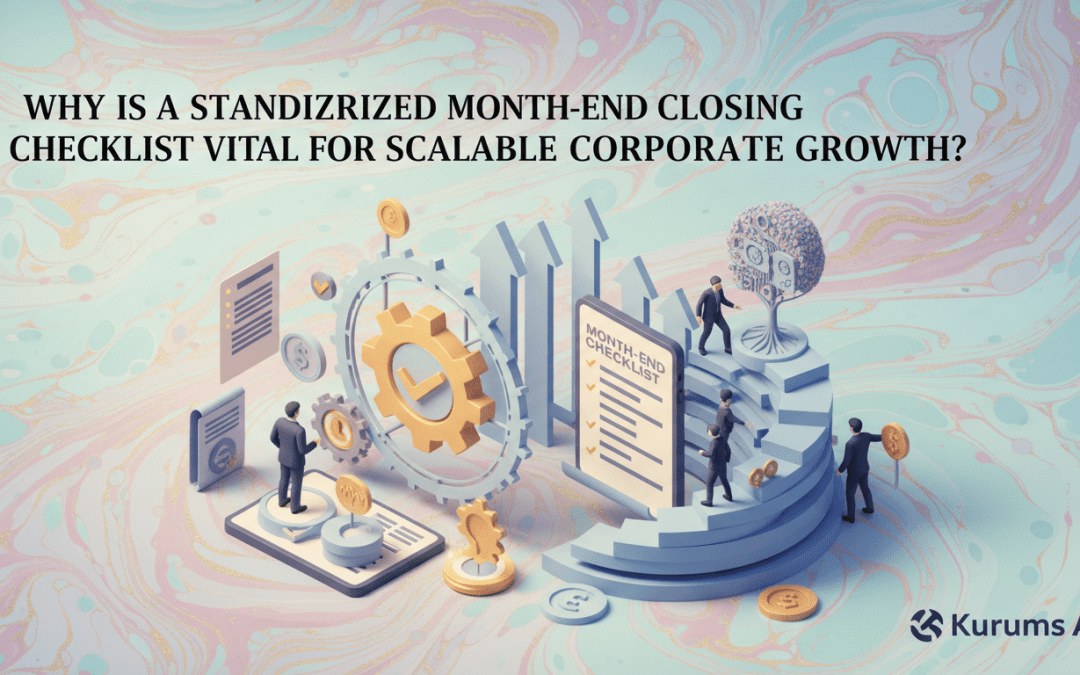
A standardized checklist ensures that financial data is accurate, repeatable, and transparent. It reduces audit risk by creating a clear paper trail, eliminates data silos between departments, and accelerates the reporting cycle, allowing executives to make data-driven decisions faster.
What are the key components of an effective closing process?
An effective process includes bank reconciliations, accounts payable and receivable aging reviews, intercompany eliminations, tax provisions, and final financial statement validation. Standardizing these tasks minimizes human error and provides a scalable foundation for global expansion.
Last Update: May 28, 2026
In the high-stakes world of corporate finance, the difference between a “good” company and a “great” one often lies in the shadows of the back office—specifically, within the month-end closing process. For many CFOs and financial controllers, the fiscal rollover is a period of high stress, characterized by frantic data entry, late-night reconciliations, and the constant fear of a material misstatement. But why is this the case? The answer is simple: a lack of standardization.
A disorganized month-end close is more than just a bureaucratic bottleneck; it is a direct threat to capital allocation and operational agility. When financial data remains unverified, C-suite executives are forced to make high-stakes decisions based on fragmented information. Industry data suggests that companies with non-standardized closing procedures experience a 40% higher rate of year-end reporting errors. As organizations scale, these inefficiencies do not just grow—they multiply.
The Anatomy of a World-Class Month-End Closing Checklist
To understand why standardization is vital, we must first define what a robust checklist looks like. It is not merely a to-do list; it is a strategic framework that aligns the entire finance department with the broader corporate objectives. A standardized checklist serves as the “single source of truth,” ensuring that every team member, from the junior accountant to the regional controller, follows the same rigorous protocols.
But that’s not all. A professional checklist categorizes tasks by priority, department, and dependency. For instance, you cannot finalize the balance sheet until all bank reconciliations are cleared. This logical flow prevents the “wait-and-see” game that often delays closing cycles by several days.
Why Manual Processes Are the Silent Killers of Corporate Agility
Manual processes introduce human error in data entry, version control issues in spreadsheets, and significant delays in information flow. Think about it: if your team is manually keying in hundreds of invoices or reconciling bank statements in Excel, they aren’t analyzing the data. They are simply surviving the data. This creates a “latency gap” where the information being presented to stakeholders is already 15 days old by the time the books are closed.
Here is the kicker: as a company grows from a $10 million enterprise to a $100 million corporation, the volume of transactions increases exponentially. Without a standardized, ideally automated, checklist, the finance team will eventually hit a “complexity wall” where the close takes longer than the actual month itself.
The Scalability Paradox: Why Growth Breaks Unstandardized Systems
Scalability is the holy grail of corporate strategy. However, most companies fail to realize that their back-office infrastructure must scale ahead of their sales. If your closing process depends on the tribal knowledge of one or two senior accountants, you are building your growth on a foundation of sand.
Standardization allows for “plug-and-play” scalability. When you open a new subsidiary or acquire a competitor, you can instantly roll out your standardized checklist to the new entity. This ensures consistency in reporting and allows for easy consolidation of global accounts. Without this, every new acquisition becomes a financial black hole for months as you try to reconcile disparate accounting methods.
Comparison: Manual vs. Standardized Closing Processes
To visualize the impact of standardization, consider the following comparison of key performance metrics between companies that use manual checklists versus those that use standardized, integrated frameworks.
| Feature | Manual Process (Chaos) | Standardized Process (Scalable) |
|---|---|---|
| Average Close Time | 10 – 15 Business Days | 3 – 5 Business Days |
| Data Accuracy | Prone to human error & typos | High (System-validated) |
| Audit Preparedness | Reactive (Months of cleanup) | Proactive (Audit-ready daily) |
| Staff Morale | Low (Burnout from overtime) | High (Predictable workload) |
| Decision Support | Historical / Lagging | Strategic / Real-time |
Mitigation of Audit Risk: The Compliance Powerhouse
For any mid-to-large-cap company, the annual audit is a period of intense scrutiny. A standardized month-end checklist is your best defense against audit findings and material weaknesses. When auditors see a structured process where every journal entry is backed by a checklist item and an electronic approval, their confidence in your financial statements skyrockets.
Now, you might be wondering, how does this specifically reduce risk? It’s all about the “Trail of Evidence.” A standardized checklist provides a chronological record of who did what, when they did it, and who reviewed it. This fulfills the core requirements of SOX (Sarbanes-Oxley) compliance and other international standards like IFRS.
The Core Elements of an Audit-Proof Checklist
To ensure your checklist stands up to the most rigorous audits, it must include specific, non-negotiable verification steps. Here is a breakdown of what a high-level checklist should cover:
- Cash & Bank Reconciliations: Verification of all bank statements against the general ledger, ensuring all outstanding checks and deposits are accounted for.
- Accounts Receivable (AR) Review: Aging analysis to identify bad debts and ensure the allowance for doubtful accounts is adequately funded.
- Accounts Payable (AP) Accruals: Ensuring all services rendered and goods received in the current month are recorded, even if the invoice hasn’t arrived.
- Prepaid Expenses & Fixed Assets: Calculating depreciation and amortizing prepaids according to the established schedule.
- Revenue Recognition: Ensuring revenue is recognized in accordance with ASC 606 or IFRS 15 standards.
Bridging the Gap Between Operational Data and Financial Truth
One of the most significant benefits of a standardized checklist is the elimination of data silos. In many organizations, the sales department, warehouse, and finance department operate as three separate islands. This leads to discrepancies where sales are reported in the CRM but not in the ERP.
It gets even better. When you standardize the closing process, you force these departments to communicate. The checklist acts as a bridge. For example, a checklist item requiring a “Warehouse Inventory Count Verification” forces the operations team to provide data to finance on a fixed schedule. This cross-departmental alignment is what enables true corporate agility.
The Financial Impact: Why Speed Equals Capital
In finance, time is literally money. The faster you close your books, the faster you can analyze your cash position and deploy capital into growth initiatives. Companies that close in 3 days have a significant competitive advantage over those that close in 12 days. They can pivot faster, react to market changes more effectively, and provide stakeholders with a clear picture of the company’s health.
Consider the “Opportunity Cost” of a slow close. If your capital is sitting idle because you aren’t sure of your exact cash reserves, you are losing out on investment returns or the ability to fund an immediate marketing push. A standardized checklist accelerates the “Record-to-Report” (R2R) cycle, turning the finance department from a cost center into a value-adding strategic partner.
Efficiency Metrics: How to Measure Success
| KPI | What it Measures | Target Goal |
|---|---|---|
| Days to Close | Total business days from month-end to final report. | < 5 Days |
| Number of Journal Entry Adjustments | How many edits were made after the preliminary close. | < 5% of total entries |
| Automation Percentage | Ratio of automated vs. manual reconciliations. | > 70% |
| Audit Findings | Number of discrepancies found by external auditors. | Zero Material Findings |
Implementing the Standardized Workflow: A Step-by-Step Roadmap
Transitioning from a chaotic, spreadsheet-based close to a standardized corporate workflow is not an overnight task. It requires a cultural shift and a commitment to continuous improvement. However, the ROI on this transition is undeniable. Let’s break down the implementation phases.
Phase 1: The Discovery and Documentation Phase
Before you can standardize, you must understand your current mess. Interview your accounting staff. Where are the bottlenecks? Which reconciliations take the longest? What data is consistently missing? Documentation is the first step toward optimization.
Phase 2: Developing the Comprehensive Checklist
A standardized checklist should be granular. Instead of saying “Do Bank Reconciliations,” the checklist should specify: “Reconcile Chase Operating Account #1234 – Assignee: John Doe – Reviewer: Sarah Smith.” This level of detail removes ambiguity and establishes clear accountability.
- Identify Dependencies: Map out which tasks must be completed before others can begin.
- Standardize Supporting Documentation: Ensure every reconciliation uses the same template so it is easy for managers to review.
- Set Hard Deadlines: Assign specific hours or days for each task completion.
Intercompany Reconciliations: The Complexity Factor in Scalable Growth
As corporations grow, intercompany transactions become a massive headache. If Subsidiary A sells to Subsidiary B, those transactions must net out to zero at the consolidated level. Without a standardized checklist, these often become the biggest source of year-end “plugs” and errors.
Standardization ensures that both sides of the transaction are recorded in the same period and at the same valuation. This is particularly vital for companies operating in multiple currencies, where foreign exchange (FX) gains and losses can complicate the books if not handled systematically.
The Human Factor: Change Management and Training
You can have the best checklist in the world, but it is worthless if your team doesn’t use it. Resistance to standardization often comes from long-term employees who prefer “the way we’ve always done it.”
To overcome this, you must frame standardization not as a policing tool, but as a productivity tool. Show the team how a standardized checklist reduces their overtime during the first week of the month. Provide training on the “Why” behind the tasks, not just the “How.” When employees understand how their task impacts the final financial statements, they are more likely to take ownership of the quality of their work.
Leveraging Technology: From Checklist to Automation
While a manual checklist in a shared document is a good start, true corporate scale requires Financial Close Management (FCM) software. These tools integrate directly with your ERP and automate the “ticking and tying” of data. Imagine a world where 80% of your bank reconciliations are done automatically at 2 AM on the first day of the month.
But that’s not all. Modern FCM tools provide real-time dashboards for the CFO. Instead of asking “Where are we with the close?”, the CFO can simply look at a screen and see that 85% of tasks are complete, with two bottlenecks in the EMEA region. This visibility is what transforms a finance team into a powerhouse of corporate growth.
Final Checklist for a Scalable Month-End Close
- Consolidation of Entities: Ensure all local ledgers are converted to the corporate reporting currency.
- Tax Provisions: Coordinate with the tax department to ensure deferred tax assets/liabilities are adjusted.
- Executive Review Meeting: Hold a 30-minute meeting to discuss the preliminary numbers before the final freeze.
- Post-Mortem Analysis: After every close, identify one task that can be improved or automated for the next month.
Conclusion: The Path to Financial Excellence
A standardized month-end closing checklist is not just an accounting requirement; it is a strategic asset. It provides the foundation for scalable growth, the shield against audit risks, and the engine for rapid financial reporting. In an era where data is the most valuable commodity, the ability to produce accurate, timely, and transparent financial statements is a significant competitive advantage.
If your organization is looking to scale, you must move beyond the era of manual, fragmented processes. Start by documenting your current workflow, identifying the gaps, and implementing a rigorous, standardized checklist. The journey to financial excellence begins with a single, well-organized step.
Are you ready to transform your finance department from a bottleneck into a catalyst for growth? The time to standardize is now.
Discover more from Kurums | Business Intelligence
Subscribe to get the latest posts sent to your email.
