
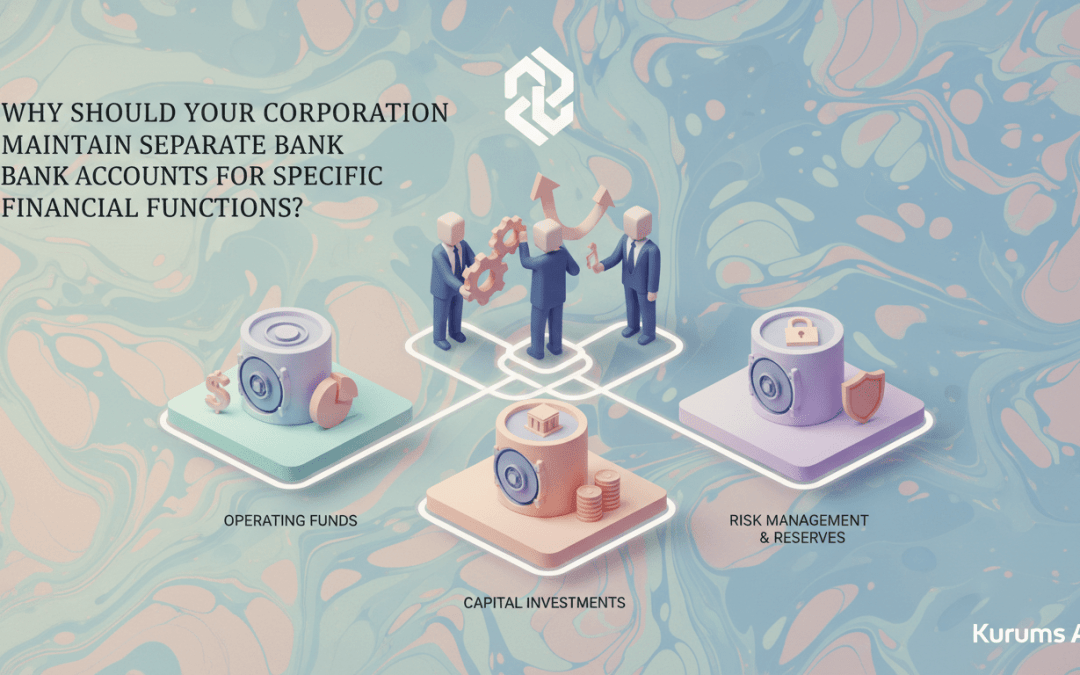
Imagine a CFO who realizes, during a high-stakes Internal Audit, that their operational funds are dangerously comingled with VAT reserves. This scenario often leads to liquidity crises that could have been avoided with a structured multi-account strategy. The truth is: one account is a liability; multiple accounts are a strategy.
But here is the real issue: simply opening accounts isn’t enough. You must implement a rigid Portfolio Management framework to ensure every dollar has a pre-defined destination before it even hits your ledger. In the modern corporate landscape, “all-in-one” banking is an archaic relic of small-business thinking that can stifle a mid-market or enterprise-level corporation’s growth.
1. The Philosophy of Liquidity Partitioning: Moving Beyond the Single-Bucket Trap
For many years, the standard advice for business owners was to keep things simple. “One account for everything” was the mantra for the sake of reconciliation. However, as corporations scale, simplicity becomes the enemy of clarity. Liquidity partitioning is the practice of dividing corporate cash into functional silos based on its eventual purpose.
Think about it this way.
When you have $2 million in a single account, your perception of “available capital” is skewed. You see a large number and feel a false sense of security. But once you subtract upcoming quarterly taxes, the next three months of payroll, and committed vendor payments, that $2 million might actually be a $200,000 deficit waiting to happen. By partitioning these funds, you create a “financial firewall” that protects your core operations from being drained by predictable, yet often overlooked, obligations.
2. The Operational Account: The High-Velocity Engine of Your Business
The Primary Operating Account is the heart of your corporate treasury. This is where the majority of your daily transactions—both incoming and outgoing—take place. Because of its high activity, this account is also the most vulnerable to errors and external threats.
In a sophisticated multi-account setup, the Operating Account should strictly handle revenue deposits and General & Administrative (G&A) expenses. By keeping this account “clean” of tax and payroll duties, your accounting team can perform bank reconciliations in a fraction of the time. There is no longer a need to sift through hundreds of payroll entries to find a missing utility payment.
What’s more, this account serves as the central hub for your Working Capital ratios. When your Operating Account is isolated, your Current Ratio (Current Assets / Current Liabilities) becomes a real-time metric rather than a theoretical calculation performed at the end of the month. You know exactly what your “burn rate” is because the noise of irregular tax payments and massive bi-weekly payroll spikes has been removed.
3. The Payroll Account: Protecting Your Most Valuable Asset
Payroll is more than just a financial obligation; it is a legal and moral contract with your workforce. In many jurisdictions, failing to meet payroll—or comingling payroll taxes with general funds—can lead to personal liability for directors and officers. This is where the “Sanctum” approach comes into play.
- Legal Shielding: In the event of a legal dispute or a frozen account, having a dedicated payroll account can sometimes allow for special dispensations to ensure workers are still paid.
- Fraud Mitigation: Since payroll involves sensitive employee data and frequent ACH transfers, isolating it prevents a compromise of your main operating account from stopping your employees’ checks.
- Budgetary Precision: You can see exactly what your total burden (wages + employer-side taxes + benefits) is by looking at the transfers into this account.
But that’s not all.
Using a separate payroll account simplifies the audit trail for labor costs. When an external auditor looks at your books, they want to see a clear line from your P&L to the bank statement. A dedicated payroll account provides that “clean” trail, reducing the hours spent on forensic accounting during year-end reviews.
4. The Tax Reserve Account: Eliminating the “April Surprise”
For most corporations, taxes are not a surprise—they are a certainty. Yet, many CFOs still find themselves scrambling for liquidity when Corporate Income Tax or VAT payments are due. A dedicated Tax Reserve Account acts as a “forced savings” mechanism.
This account should be a one-way street: money goes in regularly and only leaves when a payment is made to the treasury or revenue service. By maintaining a separate tax account, you ensure that your Effective Tax Rate is reflected in your cash position. You aren’t just profitable on paper; you are liquid enough to stay profitable in the eyes of the law.
Comparing Account Strategies: Single vs. Multi-Account Frameworks
To better understand the operational impact, let’s look at the data comparing these two approaches across key corporate metrics.
| Feature/Metric | Single Account Model | Multi-Account Strategy |
|---|---|---|
| Audit Speed | Slow (requires extensive manual filtering) | Rapid (segmented by function) |
| Fraud Risk Exposure | High (all funds at risk) | Low (risk is siloed/contained) |
| Cash Visibility | Obscured (comingled funds) | Real-time (clear purpose for every dollar) |
| Tax Compliance | Reactive (scrambling for funds) | Proactive (funds pre-allocated) |
| Automated Sweeps | Impossible | Highly effective |
5. Strategic Growth and CAPEX Accounts: Funding the Future
Beyond the “big three” (Operations, Payroll, Tax), high-growth corporations should maintain a Capital Expenditure (CAPEX) account. This is where you set aside funds for future investments, R&D, and equipment upgrades.
Here is why this matters: When growth funds are kept in the Operating Account, there is a temptation to use them for Opex (Operating Expenses) to solve short-term inefficiencies. By moving “Future Growth” money into a separate account, you are psychologically and physically committing to the long-term vision of the company. It allows you to say “Yes” to a new acquisition or a technology upgrade without wondering if you can still pay the rent next month.
6. Risk Management and the “Security Silo” Benefit
Cybersecurity is no longer just an IT issue; it’s a treasury issue. If your main operating account is compromised via a sophisticated phishing attack or an ACH fraud scheme, the damage is proportional to the balance in that account.
By using a multi-account strategy, you practice Financial Defense in Depth. You can keep the majority of your corporate wealth in “Vault” accounts that have no outgoing transfer capabilities except to your internal accounts. Your Operating Account, which is the most exposed to the “outside world,” should only carry the minimum balance necessary to cover the week’s expenses. This limits your “blast radius” in the event of a security breach.
7. Zero Balance Accounts (ZBA) and Automated Treasury Management
For larger corporations, managing five or six different accounts manually is a waste of human resources. This is where Zero Balance Accounts (ZBA) come into play. A ZBA is a system where sub-accounts (like Payroll or specific Department accounts) are kept at a balance of zero. When a check is presented or an ACH is initiated, the bank automatically “sweeps” the exact amount needed from a master concentration account.
This gives you the best of both worlds: the reporting clarity of separate accounts with the liquidity efficiency of a single pool of money. It allows for “Cash Concentration,” which maximizes the interest you earn on your total cash holdings while maintaining the organizational silos necessary for professional accounting.
8. Enhancing Financial Visibility for Stakeholders
Investors and Board Members don’t just care about the bottom line; they care about Capital Allocation. When you present a balance sheet that shows dedicated accounts for specific functions, it signals a high level of fiscal maturity. It shows that the leadership team isn’t just “winging it” with the cash flow but is managing it with a granular, strategic approach.
Furthermore, during a Due Diligence process (for a loan or an acquisition), having segmented accounts makes the company’s financial health much easier to verify. It reduces the “risk premium” that lenders might charge because the transparency of the operation is so high.
9. The Psychological Shift: Applying Parkinson’s Law to Corporate Finance
Parkinson’s Law states that “work expands so as to fill the time available for its completion.” In corporate finance, a similar rule applies: “Expenses expand to fill the cash available.”
When a department head or a manager sees a $10 million balance in the company’s only bank account, their requests for new hires, software, or travel are often more aggressive. However, when the “Operating” account only shows $500,000 (because the rest has been moved to growth, tax, and reserves), it forces a culture of Frugality and Optimization. It creates a “synthetic scarcity” that drives better decision-making across the entire organization.
10. Step-by-Step Implementation: Building Your Multi-Account Architecture
Moving from a single-account setup to a multi-account ecosystem requires a phased approach. You cannot simply flip a switch without disrupting your AP/AR processes.
| Phase | Action Item | Goal |
|---|---|---|
| Phase 1: Analysis | Audit last 12 months of cash flow to identify “Buckets”. | Define specific account types needed. |
| Phase 2: Setup | Open 3 core accounts: Tax, Payroll, and Operating. | Establish the physical infrastructure. |
| Phase 3: Automation | Configure recurring sweeps and ZBA connections. | Reduce manual administrative burden. |
| Phase 4: Integration | Connect accounts to ERP/Accounting software. | Ensure real-time data synchronization. |
| Phase 5: Optimization | Review allocation percentages quarterly. | Align cash strategy with growth goals. |
11. Common Pitfalls to Avoid in Multi-Account Management
While the benefits are massive, there are challenges you must navigate. The most common hurdle is Bank Fees. Many banks charge monthly maintenance fees for corporate accounts. If you have 10 accounts, these fees can add up. However, for a corporation of significant size, the cost of the fees is negligible compared to the cost of a single missed tax payment or a fraud event.
Another pitfall is “Transfer Friction.” If your accounts are spread across different banks, moving money can take 24-48 hours. It is generally recommended to keep your primary “functional” accounts within the same banking institution to allow for instantaneous internal transfers.
- Maintain “Buffer” Balances: Always keep a small “cushion” in each account to prevent overdrafts during timing mismatches.
- Audit Permissions Annually: Ensure that only necessary personnel have access to specific accounts (e.g., the Marketing Manager shouldn’t even see the Payroll account).
- Review Sweep Logic: Ensure your automated sweeps are calculated on *gross* revenue, not net, to ensure taxes are fully covered.
12. The Role of ERP and Fintech in Modern Account Strategy
We are living in a golden age of financial technology. Modern ERP (Enterprise Resource Planning) systems like NetSuite, SAP, or Microsoft Dynamics can now integrate directly with your banking APIs. This means your accounting software can “talk” to your different bank accounts, automatically categorizing every transfer and updating your cash flow forecasts in real-time.
But it doesn’t stop there.
Fintech platforms now offer “Virtual Accounts.” These aren’t separate legal bank accounts, but they act like them for tracking purposes. While they are useful, for high-level corporate functions like Tax and Payroll, having a separate, legally distinct account remains the gold standard for asset protection and legal compliance.
13. Conclusion: Turning Liquidity into a Competitive Advantage
In the final analysis, maintaining separate bank accounts is not just about “staying organized.” It is about transforming your cash management from a defensive, administrative task into a proactive, strategic advantage. It allows the CEO to lead with confidence, the CFO to report with precision, and the corporation to withstand shocks that would cripple a less-structured competitor.
As you look toward your next fiscal year, ask yourself: Is our current banking structure supporting our growth, or is it a fog that obscures our true financial position? The transition to a segmented account strategy may take effort, but the clarity and security it provides are the hallmarks of a truly professionalized corporation.
Discover more from Kurums | Business Intelligence
Subscribe to get the latest posts sent to your email.