
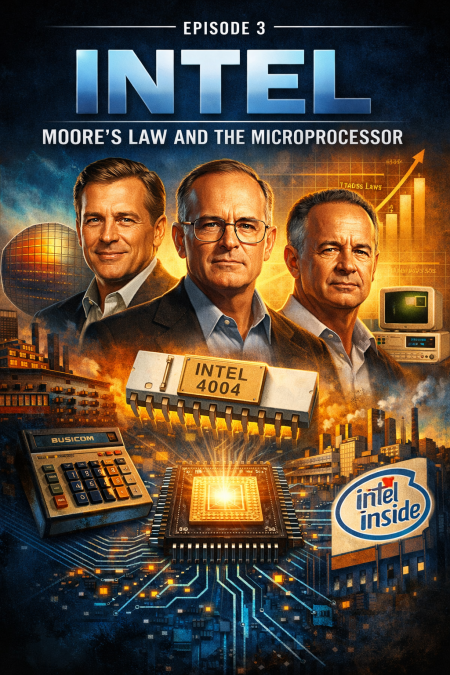
In July 1968, Robert Noyce and Gordon Moore walked into the offices of venture capitalist Arthur Rock with a one-page business plan. The document was remarkably sparse—it contained no detailed financial projections, no market analysis, no organization chart. It simply stated that Noyce and Moore intended to develop large-scale integrated circuits using silicon technology, and that they would need capital to build a manufacturing facility. Rock read the page, asked a few questions about their technical approach, and agreed to raise the money. Within two days, Rock had secured $2.5 million in commitments from investors who were backing the team rather than any specific product. This transaction demonstrated how thoroughly the Fairchild alumni network had transformed technology financing. A decade earlier, such an arrangement would have been inconceivable.
The company Noyce and Moore founded would become Intel Corporation, derived from "Integrated Electronics." Over the following decades, Intel would establish itself as the most consistently profitable and technologically dominant company in semiconductor history. The company's success rested on three interconnected elements: Gordon Moore's prediction that transistor density would double approximately every two years (Moore's Law), the company's maniacal focus on manufacturing excellence, and the fortunate decision to pursue microprocessors despite initial skepticism about their commercial potential. These elements combined to create a company that fundamentally shaped modern computing.
The Third Founder: Andy Grove's Disciplined Intensity
While Noyce and Moore provided technical vision and industry credibility, Andy Grove made Intel operationally excellent. Grove had joined Fairchild in 1963 as a young engineer after completing his PhD in chemical engineering at Berkeley. Unlike Noyce and Moore, who came from comfortable American backgrounds, Grove had fled Hungary after the 1956 revolution, arriving in the United States as a refugee with limited English and no money. This background created a personality marked by intense drive, deep insecurity about status, and unwillingness to accept anything less than maximum effort.
Grove's management style at Intel became legendary for its demands and its effectiveness. He implemented "constructive confrontation," a practice of challenging ideas aggressively in meetings regardless of who proposed them or their position in the company hierarchy. The goal was to stress-test ideas before committing resources, ensuring that decisions were based on merit rather than deference to authority. This approach could be brutal—meetings often involved loud arguments and harsh criticism—but it prevented the kind of groupthink and politeness that allowed bad ideas to proceed unchallenged.
He established rigorous metrics for every aspect of Intel's operations. Manufacturing yields, defect rates, time to market, development costs—everything was measured, tracked, and analyzed. Managers received books of data each week showing how their organizations performed against targets. Grove believed that what gets measured gets managed, and that subjective impressions about performance were usually wrong. This quantitative discipline allowed Intel to identify problems quickly and allocate resources based on objective performance rather than internal politics.
Grove also implemented radical egalitarianism in status and perks while maintaining strict hierarchy in decision-making authority. Intel famously abolished reserved parking spaces, private offices, and executive dining rooms. Everyone, including Noyce and Moore, worked in cubicles in open floor plans. Everyone flew coach on business trips. Everyone adhered to the same rules about expense reports and time off. These symbolic equalizations were paired with clear authority structures where managers made decisions and employees executed them. The combination created a culture where status came from contribution rather than title, but where accountability was absolute.
The relationship between Noyce, Moore, and Grove illustrated complementary leadership. Noyce served as chairman and public face, using his credibility and personal warmth to recruit talent, secure customers, and represent Intel to the industry. Moore focused on technology strategy, understanding where semiconductor manufacturing was heading and making long-term bets on process technology. Grove ran operations, translating strategy into execution and ensuring that Intel's manufacturing and product development performed at world-class levels. This division of responsibilities allowed each leader to work in areas of strength while maintaining unified strategic direction.
Memory Chips: The Foundation Business
Intel's initial product focus was memory chips—specifically, dynamic random-access memory (DRAM) that computers used for temporary data storage while running programs. This choice reflected Moore's understanding of where semiconductor technology was heading. As transistor density increased, memory chips became more valuable because each doubling of density meant each chip could store twice as much data. Memory was also a commodity product where performance specifications were clear and customers would buy from any supplier who met those specifications at competitive prices. This meant Intel could succeed through manufacturing excellence without needing to build deep customer relationships or develop applications.
The company's first product, the 3101 Schottky bipolar static RAM, shipped in April 1969. This was followed by the 1101 MOS static RAM and then the 1103 DRAM in October 1970. The 1103 became Intel's breakthrough product. It was the first commercially available DRAM chip, offering more storage capacity than magnetic core memory at lower cost. By 1972, the 1103 had become the best-selling semiconductor memory chip in the world, with Intel capturing over 80% of the DRAM market.
This early success in memory chips established Intel's manufacturing capability and reputation for reliability. However, it also created a business that would eventually become problematic. Memory chips were commodity products where price competition was intense and profit margins compressed as competitors matched Intel's technology. Japanese semiconductor companies, particularly NEC, Toshiba, and Hitachi, invested heavily in DRAM manufacturing in the 1970s with explicit government support through MITI (Ministry of International Trade and Industry). These companies focused on manufacturing yields and quality control, gradually matching and then exceeding Intel's capabilities.
By the early 1980s, Japanese manufacturers dominated DRAM production through superior yields that allowed them to profitably sell chips at prices below Intel's production costs. Intel faced a strategic crisis: continue competing in a market where the company was no longer the low-cost producer, or exit DRAMs and focus resources elsewhere. This decision would prove existential, but the answer was not immediately obvious because memory chips still generated most of Intel's revenue even as profitability declined.
The Accidental Revolution: The Microprocessor
Intel's development of the microprocessor happened almost by accident, emerging from a contract manufacturing project rather than strategic vision about the future of computing. In 1969, Busicom, a Japanese calculator company, approached Intel to manufacture a set of twelve custom integrated circuits for a new calculator line. Intel engineer Ted Hoff examined Busicom's design and concluded it was too complex and expensive to manufacture efficiently. He proposed an alternative: instead of twelve specialized chips, Intel could build a general-purpose central processing unit that could be programmed to perform different functions depending on instructions stored in memory.
This proposal was radical because conventional wisdom held that general-purpose processors would be too slow and expensive for applications like calculators that needed to perform specific functions quickly at low cost. Hoff believed that advances in semiconductor manufacturing would soon make general-purpose processors fast enough and cheap enough to be practical. He convinced Intel management to pursue this approach, though initially as a way to complete the Busicom contract more efficiently rather than as a standalone product.
Federico Faggin, an Italian engineer who had recently joined Intel from Fairchild, led the detailed design and implementation of what became the 4004 microprocessor. Faggin's work was brilliant and exhausting—he essentially designed the entire processor himself over nine months of intense effort, working late nights and weekends to meet Busicom's delivery deadline. The 4004 was completed in 1971 and initially belonged to Busicom under the contract terms. Intel had manufacturing rights but Busicom owned the design.
The crucial moment came when Busicom, struggling financially, agreed to sell the design rights back to Intel for a reduced chip price. This transaction gave Intel freedom to market the 4004 as a general-purpose microprocessor. Intel took out an advertisement in Electronic News in November 1971 with the headline "Announcing a New Era in Integrated Electronics." The ad described the 4004 as "a microprogrammable computer on a chip" and suggested it could be used for diverse applications from traffic light control to data terminals.
The initial market response was tepid. Engineers were skeptical that a general-purpose processor could match the performance of custom-designed circuits. The 4004 was slow by contemporary standards and lacked the processing power for demanding applications. However, a few companies recognized the value proposition: instead of designing custom circuits for each product, they could use the 4004 and write software to implement desired functionality. This approach dramatically reduced development time and cost for products that needed computational capability but didn't require maximum performance.
The 8080 and the Personal Computer Revolution
Intel's subsequent microprocessors improved performance and capabilities, but the 8080, introduced in 1974, proved historically pivotal. The 8080 was fast enough and capable enough to serve as the heart of a general-purpose computer, not just an embedded controller. It featured a larger instruction set, more memory addressing capability, and significantly higher clock speed than the 4004. Most importantly, it coincided with falling memory costs and the emergence of hobbyist interest in personal computing.
The Altair 8800, introduced in January 1975 by MITS (Micro Instrumentation and Telemetry Systems), used the Intel 8080 as its processor. The Altair was sold as a kit that hobbyists assembled themselves, and it lacked many features that would later define personal computers—no keyboard, no monitor, no permanent storage. Yet it captured the imagination of technology enthusiasts who saw the potential for affordable computing accessible to individuals rather than corporations or institutions. The Altair's unexpected success (MITS sold thousands of units in the first months) demonstrated market demand for personal computers.
This demand created a self-reinforcing cycle that benefited Intel enormously. As more companies designed computers around Intel processors, more software developers wrote programs for Intel-based machines. This growing software library made Intel processors more valuable to computer manufacturers, encouraging them to continue using Intel chips in new designs. This network effect created barriers to competition—even if a competitor developed a technically superior processor, computer manufacturers would hesitate to switch if it meant losing compatibility with existing software.
The IBM PC, introduced in 1981, locked in Intel's dominant position. IBM chose the Intel 8088 processor (a variant of the 8086) for its personal computer, lending enormous credibility to Intel's architecture. When the IBM PC became the business standard for personal computers, Intel became the de facto standard for PC processors. Competitors could build IBM-compatible computers, but to maintain software compatibility, they needed to use Intel processors or compatible alternatives. This position gave Intel pricing power and guaranteed market share that allowed decades of profitable growth.
Moore's Law: Prediction, Self-Fulfilling Prophecy, and Manufacturing Religion
Gordon Moore's 1965 observation that the number of transistors on an integrated circuit doubled approximately every year (later revised to every two years) began as empirical observation but became something far more significant: a roadmap for the industry, a self-fulfilling prophecy, and a manufacturing religion that drove Intel's strategy for four decades.
Moore's Law was never a physical law like gravity or thermodynamics. It was a prediction about the pace of technological improvement in semiconductor manufacturing. However, once articulated, it became a target. Intel and other semiconductor manufacturers organized their R&D and capital investment cycles around achieving the doubling Moore predicted. If the industry believed Moore's Law would continue, companies needed to invest in the next generation of manufacturing technology to avoid falling behind competitors. This created a collective commitment to technological advancement at a specific pace.
The economic implications were profound. If transistor density doubled every two years while manufacturing costs increased only modestly, the cost per transistor fell by approximately half every two years. This meant that Intel could sell chips with twice the capability at similar or lower prices every two years, creating continuous value improvement for customers. It also meant that Intel's previous-generation products became obsolete rapidly, forcing customers to upgrade to remain competitive and ensuring a continuous market for Intel's latest chips.
Maintaining Moore's Law required solving increasingly difficult technical challenges. Each new generation of manufacturing technology—each reduction in the size of transistors and the circuits connecting them—demanded innovation in photolithography, materials science, and process control. Intel invested billions of dollars in R&D and manufacturing facilities to stay on the Moore's Law curve. The company's financial performance depended on successfully executing each technology transition on schedule. Delays meant losing market share to competitors; premature transitions risked manufacturing yields too low to be profitable.
Andy Grove organized Intel around the discipline required to maintain Moore's Law. The company operated on a "tick-tock" development cycle where one generation introduced a new manufacturing process (the "tick") and the next generation introduced new architecture on the existing process (the "tock"). This rhythm allowed Intel to manage the complexity of simultaneous innovation in manufacturing and design. It also created predictability for Intel's customers, who could plan their product roadmaps around Intel's expected chip releases.
The RISC Challenge: Architecture Wars and Strategic Doubling Down
In the early 1980s, computer architecture researchers at universities and companies developed reduced instruction set computing (RISC) processors that challenged the complex instruction set computing (CISC) approach Intel used. RISC advocates argued that processors with simpler, more uniform instructions could execute programs faster because each instruction completed quickly and compilers could optimize code effectively. Several companies, including MIPS, Sun Microsystems (which developed SPARC), and IBM (which developed PowerPC), commercialized RISC architectures and claimed superior performance compared to Intel's CISC-based processors.
Intel faced a genuine technical and strategic threat. RISC processors did demonstrate performance advantages in certain workloads, and they could be manufactured with higher yields because simpler designs meant fewer opportunities for defects. If the industry shifted to RISC architectures, Intel's investment in CISC-compatible processors and the software ecosystem built around them could become worthless. Intel needed to respond.
The company's response combined technical innovation with leveraging its manufacturing advantages. Intel's engineers developed techniques to implement RISC-like execution internally while maintaining CISC instruction set compatibility externally. The Pentium Pro processor, introduced in 1995, decoded complex CISC instructions into simpler micro-operations that executed on a RISC-like internal core. This approach preserved software compatibility while capturing the performance benefits of RISC design principles.
Equally important, Intel's manufacturing prowess allowed building processors with more transistors than RISC competitors could achieve. These additional transistors funded sophisticated branch prediction, out-of-order execution, and larger caches that improved performance beyond what pure architectural elegance could achieve. Intel essentially outran the RISC threat through manufacturing rather than architecture, demonstrating that superior process technology could compensate for architectural disadvantages.
The RISC wars illustrated a crucial principle: in semiconductor competition, manufacturing capability often trumps architectural elegance. The best-designed chip matters little if it cannot be manufactured reliably at competitive cost. Intel's sustained investment in manufacturing technology created competitive advantages that were difficult for rivals to match even when those rivals had technically superior designs.
The Memory Exit: Strategic Inflection and Cultural Crisis
By 1984, Intel faced a crisis. The company's core DRAM business was hemorrhaging money as Japanese competitors sold chips below Intel's production costs. Intel's market share had collapsed from over 80% in 1974 to under 5% in 1984. Yet DRAMs still represented the majority of Intel's revenue, and many Intel employees had spent their entire careers in memory chip development and manufacturing. Exiting DRAMs meant abandoning the business that had built the company and laying off thousands of employees.
Andy Grove later described a conversation with Gordon Moore where Grove asked, "If we got kicked out and the board brought in a new CEO, what do you think he would do?" Moore answered immediately, "He would get us out of memories." Grove responded, "Why shouldn't you and I walk out the door, come back, and do it ourselves?" This thought experiment clarified that Intel's attachment to DRAMs was emotional and historical rather than strategic. A new CEO unconstrained by that history would make the economically rational decision to exit an unprofitable business and focus resources on microprocessors where Intel maintained competitive advantage.
The actual decision was agonizing and took over a year to implement fully. Intel closed DRAM fabrication facilities, laid off thousands of employees, and redirected R&D resources to microprocessors. The human cost was substantial—people who had built their careers at Intel found themselves unemployed in a local economy that was also contracting. The organizational trauma affected Intel's culture, replacing some of the easy confidence of the early years with recognition that past success guaranteed nothing.
However, the decision proved strategically correct. Freed from the capital requirements and management attention that DRAMs consumed, Intel could focus entirely on microprocessors. The company's profitability improved dramatically. By the late 1980s, Intel was earning higher profits from microprocessors alone than it had ever achieved in DRAMs. The memory exit became a case study in strategic inflection points—moments when fundamental business conditions change and companies must adapt radically or decline.
Grove wrote about this experience in "Only the Paranoid Survive," arguing that successful companies must constantly question their assumptions and be willing to transform themselves even when currently successful. The title captured Intel's cultural ethos: paranoia about competitors, paranoia about technological disruption, paranoia about complacency. This defensive intensity drove continuous improvement but also created a stressful, demanding work environment that some found exhilarating and others found exhausting.
Intel Inside: Branding the Invisible
In 1991, Intel launched the "Intel Inside" marketing campaign, a revolutionary approach to branding a component that consumers never saw and didn't directly interact with. Traditionally, semiconductor companies marketed to engineers who designed computers, not to consumers who bought them. Intel's campaign sought to create consumer demand for Intel processors, allowing the company to charge premium prices and making it difficult for computer manufacturers to switch to competing processors.
The campaign worked through cooperative advertising agreements where Intel reimbursed computer manufacturers for a portion of their advertising costs if the ads featured the Intel Inside logo and messaging about Intel processors. This arrangement incentivized manufacturers to promote Intel prominently while effectively making Intel's marketing budget subsidize computer manufacturers' advertising. Consumers began seeing Intel Inside logos on computers and in advertisements, creating brand awareness and implied quality assurance.
The strategy succeeded beyond Intel's expectations. Surveys showed that consumers considered Intel processors when buying computers, with many specifically seeking Intel-based machines. This brand preference gave Intel pricing power—manufacturers using competing processors often needed to discount their products to overcome consumer resistance. The Intel Inside campaign demonstrated that even highly technical products could be successfully marketed to non-technical audiences by associating the brand with quality and reliability.
Critics argued that the campaign exemplified wasteful marketing spending and that consumers lacked the technical knowledge to meaningfully evaluate processors. Intel's response was that brand value was real value—if consumers trusted Intel, they were more likely to buy computers confidently and have positive experiences, creating a virtuous cycle. The hundreds of millions Intel spent on consumer marketing generated billions in revenue premium, making the investment economically rational regardless of whether it was scientifically optimal.
The Pentium FDIV Bug: Crisis Management and Reputation
In 1994, Intel faced a public relations crisis when mathematics professor Thomas Nicely discovered that the Pentium processor produced incorrect results for certain division operations. The error occurred rarely—only specific operands triggered it—but for users performing extensive mathematical calculations, it could produce wrong answers. Nicely published his findings, and the story spread through early internet communities and then mainstream media.
Intel's initial response was defensive and tone-deaf. The company argued that the error was insignificant for most users and would occur only once in 27,000 years of typical spreadsheet usage. Intel offered to replace processors only for users who could demonstrate that they performed calculations likely to be affected. This response outraged customers who believed that a defective product should be replaced regardless of whether the defect affected their specific usage. The controversy escalated when IBM announced it would stop shipping Pentium-based computers until Intel resolved the issue.
Intel eventually capitulated and offered unconditional replacement for any Pentium processor, a decision that cost the company $475 million. More importantly, the episode damaged Intel's reputation and demonstrated the risks of brand-building. By making Intel a consumer brand, the company had exposed itself to consumer expectations about product quality and customer service that differed from traditional business-to-business relationships. Consumers expected defects to be fixed regardless of whether those defects affected them personally.
The crisis forced Intel to improve quality control processes and customer communication. The company established more rigorous testing protocols to detect rare errors before shipping products. Intel also became more responsive to public concerns and more willing to acknowledge problems rather than minimizing them. The Pentium FDIV bug proved to be a temporary setback—sales recovered quickly—but it taught Intel that reputation built over decades could be damaged in weeks by inadequate crisis response.
The Microsoft Partnership: Wintel Dominance
Intel's relationship with Microsoft created the "Wintel" alliance that dominated personal computing from the mid-1980s through the 2000s. While not a formal partnership, the two companies' products were deeply interdependent. Microsoft's Windows operating system ran on Intel processors, and Intel optimized its processors for Windows performance. This symbiosis created barriers to competition for both companies.
The relationship was cooperative and sometimes tense. Intel needed Windows to provide software that showcased its processors' capabilities, but Microsoft controlled the platform and could theoretically shift to other processor architectures. Microsoft needed Intel's performance improvements to enable new Windows features, but Intel's processor roadmap constrained what Microsoft could assume about available computing power. Both companies invested significantly in ensuring their products worked well together, including sharing technical information and coordinating product releases.
This alliance created enormous value for both companies but also fostered complacency. Because Wintel dominated personal computing so thoroughly, both companies underestimated emerging threats from mobile devices running different operating systems on different processor architectures. Intel's early mobile processors were power-hungry and unsuitable for battery-powered devices. Microsoft's mobile operating systems failed to gain traction against iOS and Android. The Wintel partnership that had seemed invincible in personal computing proved less adaptable to the mobile era.
Manufacturing Religion: Copy Exactly and Fab Discipline
Intel's sustained competitive advantage rested on manufacturing excellence implemented through practices that elevated consistency to a religious principle. "Copy Exactly" was Intel's methodology for replicating manufacturing processes across different fabrication facilities. When Intel perfected a process at one fab, every detail—equipment setup, maintenance schedules, chemical suppliers, even the color of the paint on the walls—was duplicated precisely at other fabs. This approach eliminated variables that could cause different facilities to produce chips with different yields or characteristics.
Copy Exactly seemed bureaucratic and inflexible, and it required substantial discipline to maintain. Engineers naturally wanted to improve processes, and local fab managers had insights about optimizations specific to their facilities. Intel's policy prevented these optimizations until they could be validated thoroughly and then rolled out to all facilities simultaneously. The benefit was consistency—Intel could bring new fabs online quickly with predictable yields, and the company could allocate production across facilities without quality concerns.
This manufacturing discipline extended to capital investment. Intel typically invested 30-35% of revenue in R&D and manufacturing facilities, far higher than most technology companies. This commitment meant that in profitable years Intel generated cash but reinvested it in future capability, while in down years the company might operate at a loss to maintain investment levels. Grove and Moore believed this sustained investment was essential to maintaining Moore's Law pace and staying ahead of competitors.
The result was manufacturing capability that competitors found difficult to match. Intel's fabs consistently achieved higher yields on more advanced processes than rivals. This advantage allowed Intel to profitably sell chips that competitors couldn't manufacture economically. Even when competitors designed processors with superior architecture, Intel's manufacturing edge often produced equivalent or better real-world performance through higher clock speeds and more transistors.
Legacy: The Template and Its Limits
Intel's success from 1968 through the 2000s established a template for technology company excellence: combine visionary technical leadership with operational discipline, invest relentlessly in core capabilities, leverage network effects to create sustainable competitive advantage, and maintain paranoid intensity about threats. This template influenced countless companies and became embedded in business school curricula and management consulting frameworks.
However, Intel's subsequent struggles with mobile processors and loss of manufacturing leadership to TSMC revealed limits to the template. The same focus that made Intel dominant in PC processors created blind spots about mobile computing. The same manufacturing advantage that sustained decades of profitability became a liability when customers preferred fabless design companies that could move quickly between different manufacturing partners. The same disciplined execution that Intel prided itself on became rigid when markets shifted faster than Intel's development cycles could adapt.
The Intel story thus offers lessons about both building excellence and the dangers of excellence becoming inflexible. The company demonstrated that manufacturing discipline and technical vision could create decades of profitable growth. It also demonstrated that competitive advantages erode, that markets shift in ways that favor different capabilities, and that past success creates organizational inertia that impedes adaptation. Understanding Intel means appreciating both the brilliance of what Noyce, Moore, and Grove built and recognizing that no competitive advantage, however formidable, persists indefinitely without continuous reinvention.
Discover more from Kurums | Business Intelligence
Subscribe to get the latest posts sent to your email.