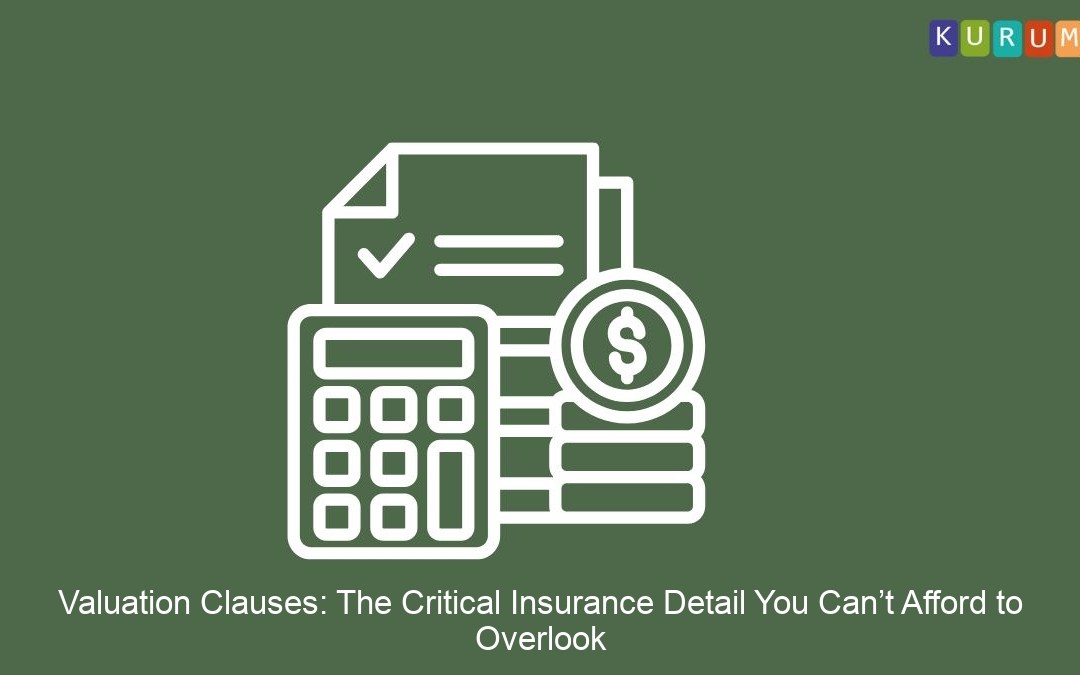
Insurance policies can often feel like layers of complexity wrapped in legalese, but one tiny detail—receiving little attention until disaster strikes—can mean the difference between a thriving recovery and a business’s collapse. 🎓 This detail is the valuation clause, a critical provision that determines just how much you’ll get paid if your assets are damaged, stolen, or destroyed. Whether you’re an entrepreneur safeguarding inventory or a creative safeguarding your gear, understanding valuation clauses isn’t just about checking a box—it’s about securing your peace of mind. Let’s break it down.
🧠 What Is a Valuation Clause (and Why Should You Care)?
A valuation clause isn’t complicated at first glance. It’s the part of an insurance policy that spells out how your items will be valued in the event of a claim. Think of it as the rulebook for calculating your payout bottom-line. But here’s where it gets important:
– If your assets lose value over time (due to depreciation, wear, or market shifts), the clause defines whether you’ll be compensated for original cost, current worth, or something in between.
– During claims, this clause becomes your advocate—or your worst enemy—if the payout doesn’t mirror what you’d expect.
There are a few standard types of valuation clauses to know:
🔐 Agreed Value Clause
– You and your insurer set a fixed value upfront. The promised payout doesn’t consider depreciation. Good for unique, high-value items (e.g., vintage equipment or one-of-a-kind prototypes).
📉 Actual Cash Value (ACV)
– Compensation deducts depreciation. An old warehouse, a fully stocked inventory, or used machinery might fetch less than it took to build them.
📊 Valued at Average Clause
– Often linked to policies covering large volumes of property, this clause penalizes underinsured companies by paying **only the proportion” of loss that your coverage bears to the total asset value.
Imagine Insuring Your Dream Startup’s Prototype 🔧
For creative startups with rare assets—say a newly engineered gadget or a custom laboratory setup—chartering an “Agreed Value Clause” could be lifeblood. Without this clarity, getting into a valuation scuffle can cost you time and money you don’t have.
🎯 Real-World Impact: Stories That Speak Volumes
Let’s turn abstract legal language into real-world stakes. Consider these cases:
🎖️ “We Didn’t Know What We Actually Had Coverage For” (A Close Call at a Music Festival)
EME Entertainment, a company behind crowd-favorite indie festivals, insured its high-tech event equipment with a policy labeled full coverage. When Hurricane Ida hit, pushing FestivalLine into chaos, they discovered their gear was insured under an “Average Clause,” based on historical evaluations. Here’s what happened:
- The festival lost five $30,000-format projectors before the ten-year lifespan was completed.
- Insurer determined that a shortfall existed since equipment was assessed conservatively by industry standards—10% less coverage.
- Payout shortfalls delayed the 2023 event.
But don’t give up yet. They switched providers, negotiated for Agreed Value Clauses focused on replacement costs, and when Hurricane Caroline rolled in, they received the full $150,000 needed to restore their setup.
💡 Lesson: Being proactive about updating clauses can level up your protection.
🍳 Boom or Bust? A Downtown Restaurant’s Infamous Shortfall (ACV Fallout)
Renowned pizzeria Tender Crust South Loop wasn’t just a food spot—it was a $2M community staple overhead, fully custom kitchens, and a loyal staff base. Week one after opening its third branch, a gas fire left everything blackened.
Their policy used Actual Cash Value, which factored in kitchen equipment depreciation (they bought secondhand).
– A brand-new industrial oven replacement costs $50,000. Their payout: ~$29,000.
– Staff layoffs trickle down; brand perception stumbles.
🔑 In contrast, Hive Bistro, a modern cafe nearby, chose Replacement Cost Coverage (a close cousin to agreed value) on its valuables. After a similar incident, it hit the ground running again in two weeks.
💡 Quotes That Helped a Business Bounce Back
Real voices add flavor. Take Jay Biaggi, Risk Manager at Berkley Network Protection, who heavily advocates for proactive valuation clause choices:
“It’s not about hoping for the best—it’s about foreseeing and preparing for the worst. When you use agreed value, you remove a guessing game. That predictability can keep a business breathing after the storm, literally.”
Or the experience of Tara Lin, founder of Re:Notec, a startup valuing musical retro tech:
“When insuring rare synthesizers, only Agreed Value Clauses protect us. Otherwise, we’re stuck battling what market depreciation meaningless equipment can’t even quote for resale.”
🚀 Practical Tips: Making Valuation Clauses Work for You
Navigating valuation clauses can feel white-knuckled, but it doesn’t have to be. Here’s how to approach them:
- Review your clause preferences with insured value types. Every word here alters the payout.
- Opt for Agreed Value Clauses if you have items with irregular depreciation (specialty tools, patented machinery).
- Conduct “asset health checkups” annually to keep values updated. Don’t delete them like the Vintage Guitar Warehouse…
- Avoid ‘sticker shock’ at claim time. Ask upfront: If my building burns down, what depreciation handicaps apply?
🔍 Extra tip: Use service providers who collaboratively relocate or reassess rather than insurtechs plugged into static systems.
🧠 Dr. TL;DR: Speed-Extra the Essentials
Here’s a concise but mighty recap:
– Valuation clauses govern claim payouts in property/specialty policies.
– Agreed Value vs. ACV choices Dunk unique or high-value assets vs. mass inventory/tools.
– Success often lies in regular assessment and customization with your broker.
📋 Most Important Takeaways
Let’s wrap with bullet-point vitality:
– 🧾 A clear valuation clause flanks businesses wisely once understood.
– 🔁 Agreed Value = predictable payout, but expect—and pay—for higher premiums upfront.
– 📉 Actual Cash Value = fair compensation based on depreciated assessment (less upfront, but high-stakes).
– 🎪 Valued at Average clauses = favor insurers; godspeed if misaligned with asset reality.
– ✍️ Talk valuation options before a claim—even when times feel safe.
🤔 Frequently Asked Questions About Valuation Clauses
Q: What factors into determining Actual Cash Value?
A: Typically calculated by subtracting depreciation based on usable life from the item’s replacement cost. Age, usage, and fair market worth—meaning your payout may match local resale prices but lag far behind what owning the asset anew requires.
Q: What are the advantages of an agreed value clause?
A: Peace of mind. The payout assures you named compensation, protecting irreplaceable or distinct assets, and removes “depreciation debates” in a claim.
Q: How can underinsurance happen on purpose?
A: Misjudging inflation, asset appreciation, or obligation boundaries. The Valued at Average Clause penalizes policies that intentionally under-insure for premiums.
Q: Are these clauses only for businesses?
A: Nope—but relevant to property insurance policies, including homeowners/patents/props for creative works. Understand before signing.
Q: Do valuation clauses impact buy-sell agreements?
A: Absolutely. These legal agreements frequently include valuation mechanisms to prevent “economic warfare” amid sudden events like succession or key partner withdrawal.
Time to protect your legacy—not with vague assumptions, but sharp valuation choices. By knowing what triggers coverage depths, how depreciation impacts claims, and what compromises work for your business, you fashion a financial safety net deep enough to cushion both growth and grass-is-always greener moments. Sharpen the lens now. Do your due diligence with a trusted broker. And remember: sometimes, small policy clauses write the biggest chapter in your resilient comebacks. 🛡️✨
Discover more from Kurums | Business Intelligence
Subscribe to get the latest posts sent to your email.