
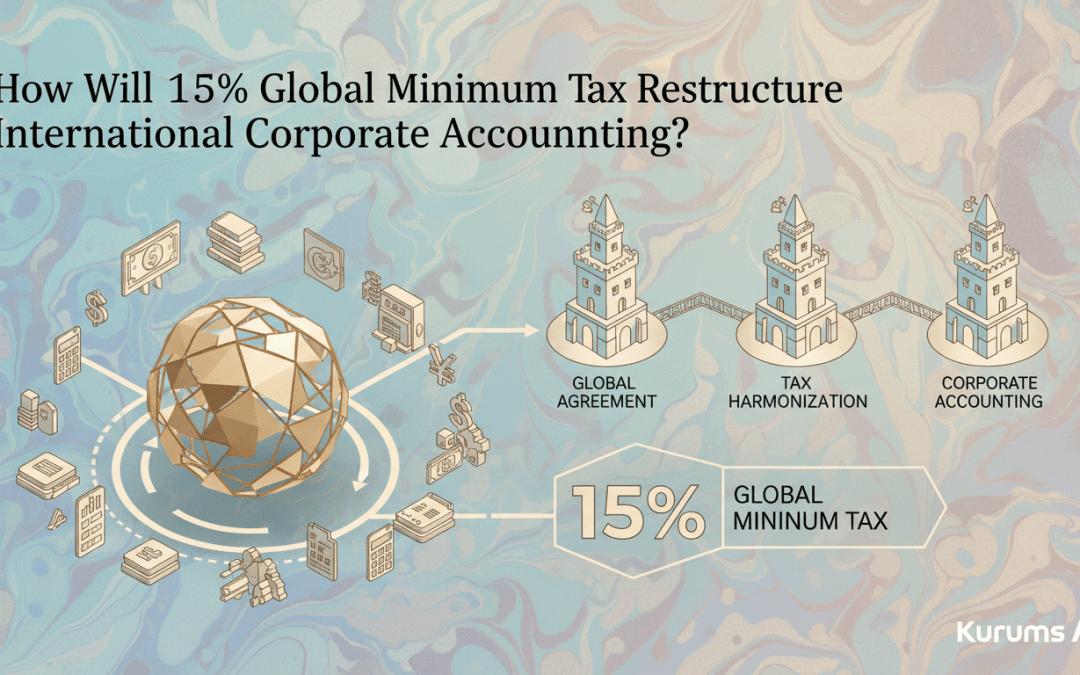
What is the primary goal of the Global Minimum Tax? It aims to ensure that Multinational Enterprises (MNEs) with annual revenues over €750 million pay a minimum effective tax rate (ETR) of 15% on their profits in every jurisdiction where they operate, regardless of local statutory rates.
How does it change corporate accounting? It shifts the focus from statutory tax rates to the “GloBE ETR.” This requires massive data granularization, complex adjustments to accounting profits, and the management of new tax mechanisms like IIR and QDMTT.
What is the impact on IAS 12? The IASB issued amendments to IAS 12 to provide a temporary mandatory exception from accounting for deferred taxes arising from the implementation of Pillar Two, though extensive disclosure is still required.
The international tax landscape is currently undergoing its most significant transformation since the development of the modern tax system following World War II. For decades, multinational enterprises (MNEs) have navigated a world of “tax competition,” where jurisdictions lowered their rates to attract foreign investment. However, that era is coming to a definitive close. With the implementation of the OECD’s Pillar Two initiative, the 15% Global Minimum Tax (GMT) is no longer a theoretical proposal—it is a reality that is fundamentally restructuring international corporate accounting.
For Chief Financial Officers (CFOs), tax directors, and controllers, this isn’t just a minor regulatory update. It is a seismic shift that demands a total overhaul of reporting systems, data collection processes, and strategic financial planning. But how exactly does this 15% floor change the way we calculate profit, manage tax liabilities, and report to stakeholders? Let’s dive deep into the mechanics of this global tax revolution.
1. The Fundamentals of Pillar Two: Understanding the Scope and Reach
The Pillar Two rules, often referred to as the Global Anti-Base Erosion (GloBE) rules, are designed to ensure that large MNEs pay a minimum level of tax on the income arising in each of the jurisdictions where they operate. The scope is specifically targeted at MNE groups with consolidated annual revenues exceeding €750 million in at least two of the four preceding fiscal years.
At its core, Pillar Two introduces a “top-up tax” mechanism. If the effective tax rate (ETR) in a specific country falls below the 15% threshold, the difference must be paid as a top-up tax. This calculation is performed on a jurisdictional basis, meaning losses in one country cannot simply be used to offset profits in another to meet the 15% requirement globally. Each country is its own silo.
2. The Three Pillars of Enforcement: IIR, UTPR, and QDMTT
The enforcement of the 15% minimum tax relies on an interlocking set of rules that ensure no profit goes untaxed. Understanding these three acronyms is essential for any modern accountant.
The Income Inclusion Rule (IIR)
The IIR is the primary rule. It works from the top down. Usually, the parent company’s jurisdiction imposes the top-up tax on the parent entity in respect of the low-taxed income of any constituent entity within the group. Think of it as a “parental override” on global tax leakage.
The Undertaxed Profits Rule (UTPR)
What happens if the parent country hasn’t adopted Pillar Two? This is where the UTPR serves as a backstop. It allows other jurisdictions where the MNE operates to collect the top-up tax through denial of deductions or equivalent adjustments. It ensures that the tax is paid somewhere, regardless of whether the head office is in a participating country.
The Qualifying Domestic Minimum Top-up Tax (QDMTT)
This is perhaps the most important development for local tax planning. Many countries are implementing their own “Qualifying Domestic Minimum Top-up Tax.” This allows the local jurisdiction to collect the top-up tax themselves rather than letting that revenue flow to the parent company’s country. For an MNE, this means the tax is paid locally, but the accounting complexity remains the same.
| Mechanism | Primary Actor | Function | Priority Level |
|---|---|---|---|
| QDMTT | Local Jurisdiction | Local country collects the tax up to 15% first. | Highest (Primary) |
| IIR | Ultimate Parent Entity (UPE) | Parent jurisdiction collects tax for low-taxed subs. | Secondary |
| UTPR | Other Constituent Entities | Backstop rule to collect tax if IIR/QDMTT fails. | Tertiary (Backstop) |
3. Redefining the Effective Tax Rate: The GloBE ETR Calculation
But here’s the catch: the “Effective Tax Rate” you see on your current financial statements is almost certainly not the ETR used for Pillar Two. The GloBE ETR is a highly specific calculation derived from the “GloBE Income” and “Covered Taxes.”
To calculate the GloBE ETR, accountants must start with the financial accounting net income (under IFRS or US GAAP) and then apply a series of rigorous adjustments. These adjustments remove certain items that are typically included in book income but excluded for tax purposes, such as certain dividends and equity gains.
Wait, there’s more. You also have to adjust the “Covered Taxes.” This includes current tax expenses but excludes any taxes that are not based on income (like digital services taxes or property taxes). The resulting formula is:
GloBE ETR = (Adjusted Covered Taxes) / (Net GloBE Income)
If this number is below 15%, the Top-up Tax percentage is the difference between 15% and the calculated GloBE ETR. This percentage is then applied to the “excess profit,” which brings us to another critical concept: the Substance-Based Income Exclusion (SBIE).
4. The Substance-Based Income Exclusion (SBIE): A Buffer for Real Operations
The OECD recognized that taxes shouldn’t necessarily penalize companies with real, physical operations and employees in a country. Therefore, Pillar Two allows for a “carve-out” based on the carrying value of tangible assets and payroll costs.
In the transition period, these carve-outs are quite generous (starting at 10% for payroll and 8% for assets in 2024), gradually declining over a ten-year period to 5% for both. For capital-intensive industries like manufacturing or telecommunications, the SBIE can significantly reduce the amount of profit subject to the top-up tax, even if the ETR is below 15%.
5. IAS 12 Compliance and the Deferred Tax Dilemma
International Accounting Standard (IAS) 12 handles income taxes, including deferred tax assets and liabilities. When Pillar Two was first announced, it created an immediate crisis in the accounting world: How do you account for deferred taxes that might arise from a future 15% global minimum tax?
The complexity was so immense that the International Accounting Standards Board (IASB) stepped in with an urgent amendment. They introduced a temporary, mandatory exception to the requirements in IAS 12 to recognize and disclose information about deferred tax assets and liabilities related to Pillar Two income taxes.
However, this is not a “get out of jail free” card. Companies must still disclose:
- That they have applied the exception.
- Their current tax expense (income) related to Pillar Two income taxes.
- In periods where Pillar Two legislation is enacted but not yet in effect, known or reasonably estimable information that helps users understand the company’s exposure to these taxes.
6. Data: The New Frontier of Tax Compliance
If you thought your current Country-by-Country Reporting (CbCR) was data-intensive, Pillar Two will be a wake-up call. To accurately calculate the GloBE ETR and Top-up Tax, MNEs need to collect approximately 150 to 200 data points per constituent entity, per jurisdiction.
Most existing ERP (Enterprise Resource Planning) systems were not designed to capture this level of tax-specific granularity at the source. This leads to a massive “data gap.” Finance departments are now forced to manually bridge the gap between financial accounting data and Pillar Two requirements, a process prone to error and incredibly time-consuming.
It doesn’t stop there. The data must be audit-ready. Tax authorities will expect the same level of rigor for Pillar Two data as they do for your primary financial statements. This necessitates new internal controls and potentially, the implementation of dedicated “Tax Data Lakes” or Pillar Two compliance software.
7. Impact on Mergers, Acquisitions, and Corporate Strategy
The 15% minimum tax isn’t just an accounting headache; it’s a deal-breaker in M&A. Historically, a target company’s low tax rate was an attractive feature. Now, it can be a liability.
During due diligence, buyers must now assess the “Pillar Two footprint” of the target. If a target company operates in low-tax jurisdictions, the buyer must calculate the potential top-up taxes they will inherit. Furthermore, the €750 million threshold creates a “cliff effect.” A mid-sized company not currently subject to Pillar Two might suddenly fall under its scope if acquired by a larger group, immediately increasing its tax cost and compliance burden.
Strategic Repatriation of Profits
Companies are also re-evaluating where they hold intellectual property (IP) and where they centralize their treasury functions. The traditional “tax haven” model is effectively dead for large MNEs. We are seeing a shift toward “onshoring” IP to jurisdictions with robust R&D incentives that are “GloBE-friendly,” such as those offering Qualifying Refundable Tax Credits (QRTCs).
8. Comparison: Traditional Accounting vs. Pillar Two Accounting
To visualize the scale of change, let’s look at the differences in accounting priorities before and after the implementation of the Global Minimum Tax.
| Feature | Traditional International Tax | Pillar Two (GloBE) Era |
|---|---|---|
| Primary Metric | Statutory Tax Rate | GloBE Effective Tax Rate (ETR) |
| Aggregation | Global or Regional pooling often possible | Strict Jurisdictional Blending only |
| Deferred Taxes | Fully accounted for under IAS 12 | Temporary exception for recognition/disclosure |
| Data Points | Dozens (primarily for CbCR) | Hundreds (Granular entity-level data) |
| Tax Credits | Always reduce current tax expense | Only “Qualifying” credits are treated as income |
9. Operational Changes: The Evolving Role of the Finance Department
As the tax function becomes more data-driven and integrated into the broader finance ecosystem, the “siloed” tax department is becoming a thing of the past. To survive in a Pillar Two world, companies must implement the following operational shifts:
- Cross-Functional Task Forces: Teams consisting of IT, HR (for payroll data), Legal, and Finance must work together to ensure data flow.
- ERP Integration: Upgrading systems like SAP S/4HANA or Oracle Cloud to automate the extraction of GloBE-relevant data.
- Continuous Monitoring: Pillar Two compliance isn’t an annual event; it’s a continuous process that affects quarterly reporting and earnings guidance.
- External Audit Readiness: Auditors will now require documentation for why certain income was excluded and how the SBIE was calculated.
10. Safe Harbors: Navigating the Complexity in the Short Term
Recognizing the massive compliance burden, the OECD introduced “Transitional Safe Harbors.” For a limited time, companies can use simplified calculations based on their CbCR data to determine if a jurisdiction is likely to have an ETR of at least 15%.
If a jurisdiction meets one of three tests (De minimis, Simplified ETR, or Routine Profits test), the top-up tax for that jurisdiction is deemed to be zero for the transition period. This provides a much-needed breathing room for companies to get their permanent data systems in order.
The Three Transitional Tests
- De Minimis Test: Average GloBE Revenue < €10M and Average GloBE Income < €1M in a jurisdiction.
- Simplified ETR Test: The ETR (calculated using simplified data) is 15% (for 2023/24), 16% (for 2025), and 17% (for 2026).
- Routine Profits Test: The jurisdiction’s profit is less than or equal to the Substance-Based Income Exclusion amount.
11. Risk Management: Penalties and Financial Leakage
The risks of getting Pillar Two wrong are enormous. Beyond the obvious financial cost of the top-up tax itself, companies face:
- Double Taxation: If rules are applied inconsistently or if a QDMTT is not properly recognized by the parent jurisdiction.
- Compliance Penalties: Many jurisdictions are introducing stiff fines for late or inaccurate Pillar Two filings.
- Reputational Risk: In an era of ESG (Environmental, Social, and Governance) transparency, being flagged for “undertaxed profits” can harm a brand’s value.
- Market Valuation Impact: Unexpected top-up taxes can lead to earnings misses, directly impacting the company’s stock price.
12. The Future of Corporate Accounting: A New Paradigm
The 15% Global Minimum Tax is more than just a tax law; it is a catalyst for the digitalization of the finance function. It forces a level of transparency and data consistency that has never existed before in international business.
In the long run, we may see a convergence of financial and tax accounting. The need to maintain two separate sets of books—one for shareholders and one for tax authorities—is becoming increasingly difficult under the pressure of GloBE rules. We are moving toward a world where tax is a real-time consideration in every business decision, from where to build a factory to how to structure a cross-border service agreement.
Conclusion: A Call to Action for MNE Leaders
The restructuring of international corporate accounting under the 15% Global Minimum Tax is an ongoing process that will define the next decade of finance. To navigate this successfully, CFOs and tax professionals must move beyond the “compliance mindset” and adopt a “strategic transformation mindset.”
Steps to take immediately:
- Conduct a Pillar Two Impact Assessment: Model your ETR in every jurisdiction using the GloBE rules, not just statutory rates.
- Audit Your Data Supply Chain: Identify where the gaps exist between your ERP output and Pillar Two requirements.
- Engage with Stakeholders: Educate the Board of Directors and investors on how GMT will affect future earnings and effective tax rates.
- Review Incentives and Credits: Evaluate how your current tax incentives (like R&D credits) are treated under GloBE rules to ensure they aren’t effectively neutralized by a top-up tax.
The world of international tax has changed forever. Those who adapt their accounting and data systems now will gain a significant competitive advantage, while those who delay will face a future of compliance crises and financial leakage. The 15% floor is set—it’s time to build your response on solid ground.
Discover more from Kurums | Business Intelligence
Subscribe to get the latest posts sent to your email.