
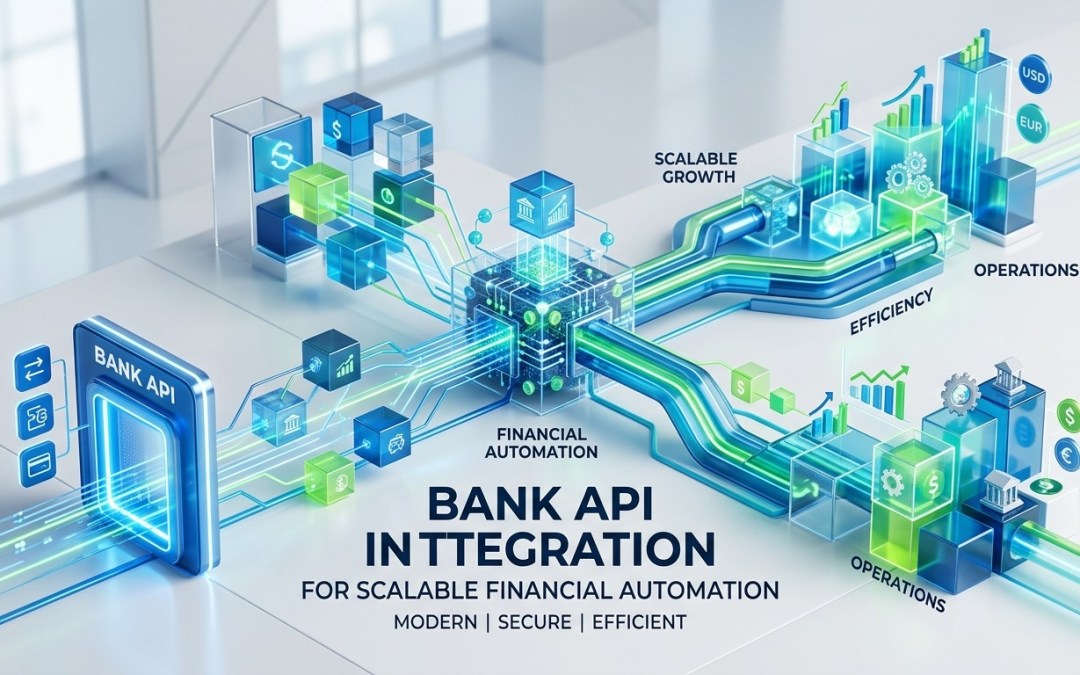
The Evolution of Corporate Banking: From Batch Files to Real-Time APIs
For decades, the standard for corporate-to-bank communication was defined by fragmentation and latency. Finance teams relied on “Host-to-Host” (H2H) connections or manual portal uploads, often utilizing file formats like MT940 (Swift) or BAI2. These methods, while reliable, inherent a “snapshot” philosophy—data was only as good as the last batch transfer, often occurring once every 24 hours.
The emergence of Bank API Financial Automation represents a fundamental decoupling of financial services from traditional banking interfaces. Application Programming Interfaces (APIs) allow for a synchronous exchange of data, enabling “continuous accounting.” Instead of waiting for an EOD (End of Day) statement, a corporate ERP (Enterprise Resource Planning) system can query a bank’s ledger in milliseconds or receive proactive notifications via webhooks the moment a credit hits an account.
Historical Context: The Legacy Debt
In the pre-API era, financial automation was synonymous with “screen scraping” or complex EDI (Electronic Data Interchange) setups. These were brittle and prone to failure whenever a bank updated its UI or file specifications. The introduction of PSD2 (Payment Services Directive 2) in Europe and the subsequent global move toward Open Banking forced financial institutions to standardize their data access points. This transition transformed banks from closed silos into modular service providers, allowing businesses to treat banking functions as programmable code.
Technical Architecture of Modern Bank API Integration
Implementing bank APIs requires a sophisticated understanding of modern web standards and security protocols. Unlike generic SaaS APIs, financial APIs demand higher levels of uptime, stricter security handshakes, and rigorous error handling to prevent financial loss or data leakage.
1. Security Protocols: Mutual TLS and OAuth 2.0
Standard API key authentication is insufficient for high-value corporate transactions. Most Tier-1 banks utilize mTLS (Mutual Transport Layer Security). In an mTLS setup, both the client (the corporation) and the server (the bank) must present valid X.509 certificates. This ensures that even if an API key is compromised, the connection cannot be established without the private key stored in the corporate Hardware Security Module (HSM) or secure vault.
Furthermore, OAuth 2.0 with Fine-Grained Scopes is used to manage authorization. A specific API client might have the accounts:read scope but be restricted from payments:initiate. This principle of least privilege is critical for mitigating internal and external risks.
2. The Role of Webhooks in Event-Driven Finance
Polling an API every 60 seconds to check for new transactions is inefficient and resource-heavy. Modern automation relies on Webhooks. When a transaction occurs, the bank pushes a JSON payload to a pre-defined endpoint in the corporate environment. This enables:
- Instant Credit Advice: Notifying the shipping department the moment a customer payment is confirmed.
- Real-time Fraud Detection: Triggering an automated freeze if a high-value outgoing payment doesn’t match historical patterns.
Data Comparison: Legacy vs. API-Driven Automation
The following table illustrates the performance gap between traditional methods and modern API-centric financial automation.
| Feature | Legacy (H2H/MT940) | Modern Bank API |
|---|---|---|
| Data Latency | T+1 (24 Hours) | Real-time (Milliseconds) |
| Reconciliation | Manual/Batch Matching | Automated/Continuous |
| Security | Static Credentials/SFTP | mTLS, OAuth 2.0, JWS |
| Error Handling | Manual Investigation | Programmatic Retry/Idempotency |
| Integration Cost | High (Custom Middleware) | Medium (Standard REST/JSON) |
Core Use Cases for Bank API Financial Automation
1. Automated Payouts and Treasury Management
Large enterprises often manage hundreds of vendor payments daily. Manually entering these into a bank portal is error-prone and slow. With Bank API Financial Automation, the ERP system can trigger payments directly. A key technical requirement here is Idempotency. By including a unique Idempotency-Key in the API header, the business ensures that if a network timeout occurs and the request is retried, the bank will not process the payment twice.
2. Smart Reconciliation (The “Triple-Match” Logic)
Traditional reconciliation involves comparing a bank statement against internal invoices. APIs allow for automated matching engines that use fuzzy logic to pair incoming credits with open receivables based on:
- The exact amount (down to the cent).
- The virtual account number (IBAN) used for the transfer.
- The transaction reference metadata.
When a match is 100%, the ERP marks the invoice as “Paid” without human intervention, immediately updating the company’s credit risk profile for that client.
3. Dynamic Liquidity Management
For multi-national corporations, managing cash across different jurisdictions is a nightmare. Bank APIs enable “sweeping” or “pooling” automation. If an account in Singapore falls below a certain threshold, the system can automatically trigger a cross-border transfer from a surplus account in London, optimizing interest and ensuring operational continuity.
Detailed Implementation Strategy
Transitioning to an API-first financial model is a multi-phase project that requires collaboration between Finance, IT, and Security teams.
- Inventory Legacy Processes: Document all current manual bank interactions and file-based exports.
- Bank Capability Mapping: Verify if your current bank supports RESTful APIs or if they are still on SOAP/legacy wrappers.
- Credential Management: Establish a secure environment for storing certificates and OAuth secrets (e.g., Azure Key Vault, HashiCorp Vault).
- Sandbox Validation: Run at least 500 test transactions in the bank’s sandbox environment to simulate edge cases like “Insufficient Funds” or “Invalid BIC.”
- Parallel Running: Maintain legacy file transfers alongside the API for a 30-day period to ensure data integrity.
- Audit Logging: Implement comprehensive logging for every API request and response for compliance (SOC2/GDPR).
Failure-Case Analysis: Managing the Risks of Automation
Even the most robust API integrations can fail. Corporate systems must be designed for “Graceful Degradation.”
Scenario A: API Downtime during Payroll
If the bank’s payment initiation API goes down while processing 5,000 employee salaries, the system must have a “Circuit Breaker” pattern. Instead of repeatedly hammering a failing endpoint (which might lead to rate-limiting), the system should queue the payments and alert the treasury team to potentially switch to a secondary bank or a manual backup file.
Scenario B: Data Drift and Latency
Sometimes, a webhook might arrive before the transaction is visible via the GET /transactions endpoint due to internal bank database replication delays. This is known as “Data Drift.” A sophisticated automation layer must include a “Retry with Exponential Backoff” to handle these temporary inconsistencies.
Scenario C: Payload Mutation
Banks occasionally update their API versions. If a field name changes (e.g., transaction_id becomes txn_ref), a poorly designed integration will break. Utilizing an API Gateway or an Abstraction Layer allows developers to map bank-specific payloads into a standardized internal format, shielding the ERP from minor upstream changes.
The Future: AI and Autonomous Finance
We are entering the era of Autonomous Finance. Beyond simple automation, AI models are now being layered on top of API data streams. These systems can predict cash flow gaps three months in advance by analyzing historical transaction patterns via the API. They can also perform “Smart Routing,” choosing the cheapest or fastest payment rail (e.g., SEPA Instant vs. SWIFT) based on real-time bank performance metrics.
Furthermore, the integration of ISO 20022 standards will further enrich API payloads. This global standard for financial messaging allows for significantly more data to be attached to a payment (e.g., full invoice details, tax breakdowns), reducing the need for out-of-band communication between buyers and sellers.
Technical Deep-Dive: The “Idempotency Key” Pattern
In the context of Bank API Financial Automation, idempotency is the most critical technical concept for developers. When your system sends a request to pay a vendor $10,000, several things can happen:
- The request succeeds, and you get a 201 Created.
- The request fails with a 400 Bad Request (you fix the data and retry).
- The connection drops (504 Gateway Timeout or a TCP reset) *before* you get a response.
In case #3, you don’t know if the bank received the instruction or not. Without an idempotency key, retrying the request could result in a $20,000 total payout. By including a X-Idempotency-Key: unique-uuid-12345, the bank’s server checks if it has seen that specific UUID in the last 24-48 hours. If it has, it returns the cached result of the first attempt instead of processing the transaction again.
Data-Driven Insights: ROI of API Integration
Recent industry benchmarks indicate that enterprises moving to API-based financial automation realize:
- 60-80% Reduction in manual reconciliation hours.
- 99.9% Accuracy in payment routing, compared to 97.5% for manual entry.
- Reduced Days Sales Outstanding (DSO) by an average of 4.5 days due to faster payment application.
- Lower Transaction Costs by utilizing domestic real-time rails (like FedNow or Faster Payments) which are often cheaper than legacy wire transfers.
Conclusion: Building a Scalable Financial Future
Leveraging Bank API Financial Automation is no longer a luxury for tech-forward startups; it is a necessity for any enterprise seeking to scale in a globalized economy. The ability to move money at the speed of data provides a competitive advantage that legacy-bound competitors cannot match.
However, the journey requires more than just “writing code.” It requires a shift in the corporate mindset—treating the bank not as an external portal, but as a core component of the software stack. By focusing on robust security (mTLS), event-driven architecture (Webhooks), and foolproof payment logic (Idempotency), organizations can build a financial infrastructure that is both resilient and infinitely scalable.
Discover more from Kurums | Business Intelligence
Subscribe to get the latest posts sent to your email.