
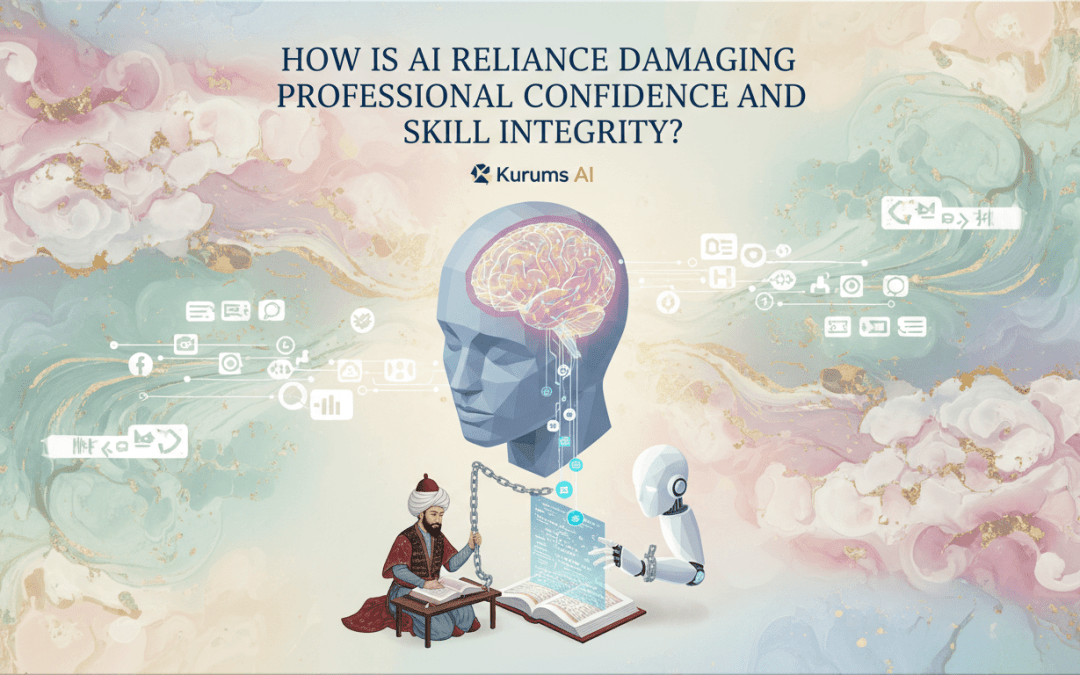
Quick Summary: AI Reliance vs. Professional Integrity
What is Skill Atrophy? It is the gradual loss of fundamental professional skills due to over-reliance on automated tools and AI algorithms. Reports from HR Dive and Glassdoor indicate that while productivity spikes initially, long-term critical thinking is declining.
How does it affect confidence? Professionals feel a “fraud syndrome” where they execute tasks through AI but lack the underlying knowledge to validate the output, leading to psychological burnout and anxiety.
What is the solution? A “Human-in-the-Loop” strategy that prioritizes skill retention through mandatory manual cross-checks, cognitive load management, and psychological safety protocols.
The immediate surge in productivity provided by Large Language Models (LLMs) often masks a decaying foundation of human expertise. Organizations are beginning to witness a paradoxical phenomenon: as AI proficiency grows, foundational technical skills are diminishing. This is not just a loss of efficiency; it is a structural threat to Human Capital Management and professional liability.
Think about this: If a senior analyst relies on AI to interpret complex tax regulations for years without touching the raw legal texts, what happens when the AI hallucinates? Or worse, what happens to that analyst’s internal sense of authority? They transition from being a “subject matter expert” to a “prompt operator.” This transition is at the heart of the current psychological crisis unfolding in modern workplaces.
The Psychological Impact: Analyzing HR Dive and Glassdoor Insights
Recent data from HR Dive suggests that the rapid integration of AI is not just a technical shift but a psychological one. Employees are reporting higher levels of “AI Anxiety”—a fear that their core competencies are being hollowed out. But it goes deeper than just fear of job loss. It is the fear of irrelevance while still employed.
Glassdoor reviews from top-tier tech and finance firms have shown a disturbing trend: employees feel they are “losing their edge.” When the machine does the heavy lifting, the human brain enters a state of cognitive ease. While this sounds productive, cognitive ease is the enemy of skill retention. According to psychological reports, the struggle to solve a problem is exactly what encodes the solution into long-term memory. By removing the struggle, AI is inadvertently deleting our professional “muscle memory.”
The Burnout Paradox
You might think that if AI is doing the work, humans should be less stressed. The reality is the opposite. Glassdoor insights reveal that workers are feeling more burnt out because the “output expectation” has scaled higher than the AI’s actual capability. Managers now expect 10 reports a week instead of 2, forcing professionals to spend their entire day “babysitting” AI outputs. This shift from creation to supervision is mentally exhausting and robs professionals of the joy of craft.
The “Skill Atrophy” Phenomenon in High-Stakes Sectors
In sectors like Law, Finance, and Medicine, the stakes of skill atrophy are not just about productivity—they are about liability. Let’s break down how this decay manifests across different tiers of an organization.
But wait, there’s more.
It isn’t just the junior employees who are at risk. Senior executives, who should be the final gatekeepers of quality, are increasingly delegating the “first draft of thought” to AI. When the foundational thought process is outsourced, the final decision-making becomes untethered from reality.
Erosion of Foundational Technical Skills
- Legal Research: Attorneys who rely on AI summaries often miss the nuances of case law that don’t fit the AI’s “most probable” response pattern.
- Financial Modeling: Analysts who use AI-generated spreadsheets may lose the ability to spot formulaic errors that lead to multi-million dollar discrepancies.
- Software Engineering: Junior devs using Copilot frequently struggle to explain the logic of the code they “wrote,” leading to massive technical debt.
- Human Resources: Recruiters relying on AI screening lose the “gut feeling” and interpersonal discernment necessary for culture-fit assessment.
Comparison: Human Expertise vs. AI-Generated Output
To understand why professional confidence is shaking, we must look at the qualitative difference between human-derived work and AI-augmented work. The following table illustrates the key points of friction.
| Feature | Human-Led Process | AI-Over-Reliant Process |
|---|---|---|
| Problem Solving | First-principles thinking; explores the “Why.” | Pattern recognition; replicates “What” is most likely. |
| Error Detection | High; based on internal heuristic models. | Low; users tend to trust the AI’s confident tone (Hallucination risk). |
| Professional Confidence | High; derived from mastery of the craft. | Fragile; dependent on tool availability and prompt luck. |
| Skill Development | Compound learning over time. | Skill stagnation or “atrophy.” |
The Confidence Gap: When the Machine Knows More Than the Maker
Here is where it gets interesting. As AI tools become more sophisticated, the “Confidence Gap” widens. This is a phenomenon where a professional feels like an impostor because they can no longer reproduce the AI’s quality of work without the tool.
According to Glassdoor surveys, 42% of professionals in AI-heavy roles feel their skills would be obsolete within 12 months if they lost access to their specific AI toolsets. This creates a psychological dependency that is detrimental to leadership. How can a C-Level executive lead a department if they secretly feel they’ve lost the “know-how” of their industry?
Cognitive Offloading and the Death of Nuance
Cognitive offloading is the use of physical action to alter the information processing requirements of a task so as to reduce cognitive demand. In simpler terms: we use AI so we don’t have to think hard. While this is great for repetitive tasks like scheduling, it is lethal for strategic thinking.
When we offload the synthesis of information to an AI, we lose the ability to see the “connective tissue” between disparate facts. This is why many HR Dive reports highlight a decline in “Strategic Vision” among middle management. If the AI provides the strategy, the manager only provides the execution. Over time, the capacity to envision a 5-year plan without an algorithmic prompt disappears.
The “Rubber-Stamping” Trap
In many corporate environments, the pressure for speed leads to “rubber-stamping.” A professional generates a report via AI, skims the first paragraph, and hits “send.” This lack of engagement leads to a detachment from the work itself. When you aren’t “in” the work, you don’t care about the work. This loss of professional integrity is the first step toward mass employee disengagement.
Strategic Framework for C-Level Executives: Rebalancing Human Capital
How do we fix this? C-suite leaders must realize that AI is a leverage tool, not a replacement tool for the human brain. The following table provides a strategic roadmap for maintaining skill integrity in an automated world.
| Strategic Pillar | Action Item | Desired Outcome |
|---|---|---|
| Skill Auditing | Quarterly testing of “non-AI” baseline competencies. | Ensuring foundational knowledge remains intact. |
| Cognitive Load Management | Reducing volume expectations to allow for “Deep Verification.” | Higher quality work and reduced employee burnout. |
| Transparency Protocols | Mandatory “AI-Human Contribution” labeling on internal docs. | Accountability and pride in human craftsmanship. |
The Managerial Challenge: Retaining the “Human” in Human Resources
According to HR Dive, the most successful companies in the AI era are those that are doubling down on “soft skills” that AI cannot replicate: empathy, ethical judgment, and complex negotiation. However, even these skills are under threat. If a manager uses AI to write a performance review or an empathetic email to a grieving employee, the integrity of the human connection is severed.
The challenge for HR is to define where AI ends and the human begins. If an employee discovers their “personal” feedback was a 100% ChatGPT-generated template, the trust—which is the bedrock of professional confidence—is destroyed instantly.
Tactical Steps for HR Leaders
- Redefine Performance Metrics: Move away from “output volume” and toward “critical insight” and “error-trapping.”
- Promote “Expert-Led” Training: Instead of general AI training, focus on how an expert uses AI to *enhance* their unique perspective.
- Psychological Safety: Create a culture where employees can admit they don’t understand an AI’s logic without fear of being replaced.
- Mentorship Revitalization: Ensure senior mentors are teaching the “old ways” of problem-solving to juniors before introducing AI tools.
Liability and the “Black Box” Problem
One of the most significant risks of skill atrophy is the “Black Box” problem. If your team doesn’t understand the logic behind an AI’s financial forecast or legal argument, they cannot defend it in a court of law or before a board of directors.
Professional integrity is built on the ability to stand behind one’s work. When that work is generated by an algorithm whose inner workings are opaque (even to its creators), professional liability increases exponentially. We are seeing cases where companies are held liable for AI-driven biases or errors that any competent human professional should have caught, but didn’t—simply because they “trusted the machine.”
The Future of Professional Mastery: Becoming an “AI Architect”
So, is all hope lost? Not at all. The goal is to move from AI Reliance to AI Orchestration. An orchestrator understands the music; they just use the baton (AI) to make it louder and more complex.
The “AI Architect” of the future is someone who maintains their core technical integrity while using AI as a cognitive exoskeleton. They know the math, but they use the calculator to save time. They know the law, but they use the AI to search the database. The difference is that if the tool breaks, the Architect can still build the house.
The Road Ahead: 5 Steps to Reclaiming Professional Integrity
- Audit Your Dependencies: Identify which tasks you can no longer do without AI and spend 2 hours a week practicing those tasks manually.
- Verify, Don’t just Skim: Treat AI output as a draft from a highly confident but occasionally lying intern.
- Master the “Why”: Always ask the AI for its reasoning and cross-reference that reasoning with primary data.
- Invest in “Human-Only” Spaces: Ensure critical strategy meetings are “screen-free” to encourage organic brain activity.
- Lead with Transparency: Be open about when and how you use AI to set a standard of integrity for your team.
Conclusion: A Call to Action for Integrity-Driven Leadership
The findings from HR Dive and Glassdoor serve as a canary in the coal mine. We are at a crossroads where we can either use AI to elevate human potential or allow it to hollow out our professional identities. Skill atrophy is a choice, not an inevitability.
As a leader, your mission is to protect the human capital of your organization. This means fostering an environment where expertise is celebrated, where the “struggle” of learning is valued, and where AI is kept in its proper place: as a servant to human wisdom, not a replacement for it.
Are you ready to audit your organization’s reliance on AI? Start today by identifying one critical skill in your department that is at risk of atrophy and create a plan to protect it. Your professional integrity—and the future of your company—depends on it.
Discover more from Kurums | Business Intelligence
Subscribe to get the latest posts sent to your email.